
Cet article est également disponible en :
What is it?
I turn toward the only voice that has just spoken in French above the surrounding noise.
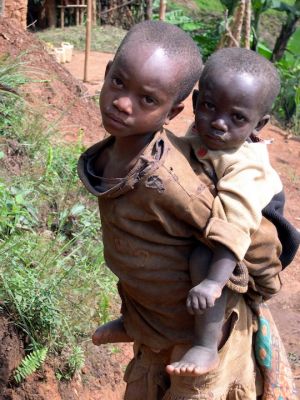
I am surrounded by children. We have just arrived at the primary school where Alphonse himself studied as a boy, and we happen to have arrived during recess. The school headmaster has also come outside.
His first question to Alphonse was what the white man had brought them. Those were literally his first words. Alphonse translated the question for me.
Once again, the white man seems to be perceived as nothing more than a walking wallet.
And that irritates me.
More and more.
I was thinking about how to answer when the little girl — because it is a little girl who has spoken — provides a welcome diversion.
“What is it?”
I look at her.
I don’t understand the question.
Embarrassed by her own boldness, she runs away. The headmaster points to the small bag hanging around my neck.
“What is it?”
I laugh.
Without saying a word, I pull out my digital camera. I take a picture of the children crowded around me, then turn the camera toward them to show them the image.
It’s an ovation.
A huge exclamation of surprise, as always.
Out of the corner of my eye, I notice that the little cheeky girl has returned. She wants to be in the picture too.
After leaving the school, we go to the local CARA center.
In the girls’ workshop, a beautiful pedal-powered sewing machine — there is no electricity — stands proudly in the middle of the room. In the boys’ workshop, I see brand-new hand planes.
Both were purchased thanks to a donation from a French association: Culture Môme, a friend and partner of Constellation.
In the hills around Nyakabanda, there are ten CARA centers… and only four sewing machines, two of which are in the CARA headquarters itself, in Nyakabanda.
Very few students are present.
We didn’t announce our visit, and I wonder whether this level of absenteeism is normal. There are only three boys and one girl.
The other girls have gone to the market to buy ingredients for the cooking class, the instructor explains.
She shows us the work the students have made. It’s quite well done.
I buy two or three small objects, and we climb back into the 4×4.
We have an appointment at the school in Gasovu, another nearby village. That’s where I am supposed to meet the first Constellation group.
The road is bad and the slope very steep. The 4×4 struggles its way up.
A small child — he can’t be more than five — stops in the middle of the path as we pass.
“Muzunguuuuu!”
In his voice there is the same mixture of wonder and astonishment a child might have the first time he sees Santa Claus.
I smile and wave back.
Yes, I am the Muzungu.
The white man.
And here the white man is not only the one who has money.
He is also the one who helps.
The one from whom people expect both moral and material support.
The Muzungu is not just another person.
He is the white man.
Different.
That’s the way it is.
Should I laugh about it… or cry?
I once spoke about this with Norbert, a friend and former fellow seminarian of Alphonse. He now works for COFORWA. He is young, educated and intelligent.
I told him that Africans should eventually stop seeing white people as a separate category, that they should learn that skin color does not matter.
He answered that yes, of course that was true.
But it would take time.
And for the moment it was normal for the white man to have a special status.
Normal that, for people here, the Muzungu is simply the Muzungu.
Whatever the case, it is a heavy responsibility.
We arrive in Gasovu.
The Constellation children are waiting for us, sitting quietly in the classroom.
It is one of the rare classrooms I see equipped with tables and chairs. Most classrooms have only benches, and the children write on their knees.
The room is silent.
Even though I am beginning to get used to these introductions, I still feel slightly intimidated each time.
For a moment I consider arranging the desks in a circle, which would seem more friendly. Then I give up and take my place at the front of the room.
The introductions begin.
I speak first, then the children introduce themselves one after another. Some are so shy they can barely speak loudly.
After that, I give a short presentation about my journey. I speak in French, of course; one of the teachers, Gratien, translates.
Then I ask if they have any questions.
There are only a few.
A small boy finally speaks:
“The problem here is that we have nothing — no books.”
I avoid pointing out that this isn’t exactly a question…
Once again, I am the Muzungu.
There are indeed no books, and the only books available are reserved for the teachers. The children must copy everything from the blackboard.
It takes a long time.
And it prevents them from studying longer texts.
Gradually, a few more questions appear.
“Are you married?”
I tell them about Odile, who died.
“How old are you?”
Then silence falls again.
So now it’s my turn to ask questions.
I ask them how they imagine France.
The answer is the same as that given by many other African children:
“We imagine people are rich there and that life is better.”
Then I ask whether they enjoy painting and what painting brings them.
A small boy gives a disarmingly honest answer:
“I come to the painting group because I hope Constellation will pay for my schooling.”
In fact, Culture Môme, not Constellation, has paid for the education of four children from Constellation groups.
It seems to inspire a few ambitions.
Alphonse asks them what they would like to become later.
Most answer teachers or nurses.
But there are a few unusual answers.
Among them: two future sports journalists, a veterinarian, a lawyer, a nun, a member of parliament… and even a director.
That last one is barely taller than a table, but he already looks very confident.
Little by little, the discussion becomes lively.
The shyness disappears.
The first attack comes from my left.
It is the small nun sitting at the very back of the classroom who shifts the debate.
“Have there been genocides in France?”
I explain that no, there have not been genocides in France itself, but that there were in Europe — in Germany during the Second World War — and that there were collaborators in France in that genocide.
The second attack comes from my right.
But this time it comes from outside the classroom.
It is recess time and many children have gathered at the windows to see and listen to the Muzungu.
The question comes from a small boy whose head I can barely see above the window frame.
“You say there was no genocide in France. But on the radio we hear that the genocide in Rwanda happened because of France.”
I did not expect that question.
For a moment, I am destabilized.
Then I answer.
I explain that I do not know what my government may have done. But if it were ever proven that France had taken part in that genocide, then my government should be condemned.
I also tell them that I do not believe that to be true.
I explain that it is indeed correct that France supported the Rwandan government before the genocide, but that it seems unlikely to me that my country would have knowingly supported a genocide.
My answer is imperfect.
I can feel it.
But I have not had time to think it through.
I answer on the spot.
In the end, I ask my young inquisitor whether he is satisfied with my answer.
He says yes.
Then I ask him why, in his opinion, there was a genocide in Rwanda.
He thinks for a moment.
Then he replies:
“Perhaps it was a problem with the administration of the time.”
The debate grows more and more animated.
I have always avoided overly political discussions — but is this politics, or civic education? — and I suddenly find myself speaking about Human Rights, Equality, non-violence, tolerance, and figures such as Nelson Mandela, Martin Luther King, and Gandhi.
We go far beyond the time originally planned.
And in the end it is the little nun — the very one who started everything — who has the final word.
Or rather the final question.
“Do you plan to remarry?”
To be continued – Day 5: Should we despair?
And so this brings my accounts from that time to an end. I never wrote the chapter I had planned — “Should We Despair?”. In fact, I would hardly be able to say today what I had intended to write in it.
The texts you have just read were rediscovered by chance by my old travelling companion Alain. It was his father who had carefully printed all the emails I sent back then.
I simply took the time to put them back into shape (correcting spelling and syntax) with the help of ChatGPT.
I stayed a few more days in Nyakabanda. I wandered through the surrounding countryside, armed only with my camera, trying to capture a few scenes of everyday life. Because of the lack of space, the cattle remained penned up. On their way home from school, the children would cut grass along the sides of the paths to feed them.
During my stay, the schools were closed for the commemorations.
Some Interahamwe (Hutu militias responsible for the genocide) took advantage of the situation to make a few incursions from nearby DR Congo. I must admit I was a little worried. One man had to hide all night under a nearby bridge to escape them.
Alphonse became a true friend during those few days. He was Hutu and engaged to Tatiana, a Tutsi. One day I asked him what he was waiting for to get married. He simply replied: being able to pay the bride price. Among the Tutsi, the bride price is a cow.
So I discreetly asked around about the price of a cow. It was 250 dollars. I placed that amount in an envelope before leaving and gave it to him with the instruction not to open it until after my departure.
Two years later, when I myself remarried, he sent me a gift from Rwanda. Over the years we gradually lost contact.
I hope he and his family are well. Tatiana was quite worried about her future: she was a French teacher, and the government had already announced its intention to abandon French as an official language in favor of English, which is spoken in most neighboring countries.
As for me, I returned to Kigali the same way I had arrived. But I did not have the courage to make the journey back under the same conditions as the outward trip.
So I bought a plane ticket. The flight was at dawn. I had to be absolutely sure not to miss it. I contacted a taxi driver and promised to pay him four times the normal fare if he showed up before 4:00 a.m. When I got into the taxi, he made sure to point out the time to me.
On the evening before my departure, I still had some local currency left. At that time Kigali was still a rather dark city. Street children were numerous. Yet I walked around at night without fear. I still do today. Perhaps one day I will be attacked, but it has never happened so far — even in neighborhoods said to be dangerous.
That evening I still had money left. I spotted a small group of street children dozing in a corner and began handing it out.
It was a rush.
In a firm voice I ordered them to calm down. The older ones quickly disciplined the younger ones. I managed to finish distributing the money.
As I walked away, I heard one of them scream into the night. A cry of joy so intense that it sent a chill down my spine.
In Dar es Salaam, I was happy to meet Henrik and Mwadjabu again. We spent a few more days together, just enough time to organize the return of the motorcycle by plane: 1000 dollars, all included. Then I returned to France.
Ten days later, I was sitting in a large meeting room surrounded by very important people from a major insurance company.
And I asked myself:
What on earth am I doing here?
This reality felt so far removed from the one that had been mine for sixteen months.
I never really came back.
A few months after my return, a young French woman contacted me. She was going to Nyakabanda with the Constellation association. I gave her all the photo prints I had taken during my stay. Apparently the villagers queued up hoping to receive a copy in which they appeared.
These posts were written from Côte d’Ivoire, a country I had been unable to visit at the time because of the war. Today it is Mali and Niger that have become impossible to visit, much to my regret.
I began a second journey across Africa two years ago. But this time I am taking my time. I expect to finish in 2028 or 2029. Perhaps 2030.
After that, I will probably wander across Asia and Australia.
If my health still allows it.
Abidjan – mars 2026

No Comments