
Cet article est également disponible en :
After spending a few days in Dar es Salaam to obtain my next visas, I set off again one morning under an already blazing sun.
At a traffic light, a white man — Danish, but above all a motorcyclist — pulled up beside me and offered me a beer. I rarely refuse that kind of invitation, even though I usually prefer a Coca-Cola. I have never really liked beer.
The man’s name was Henrik.
At that time, motorcycle travelers were still rare in this part of the world. Seeing one was unusual enough that people would spontaneously offer him a beer.
Henrik had been living in Tanzania for several years. He worked there for an NGO and had also completed his doctoral thesis in sociology in the country. He had even married a Tanzanian woman named Mwadjabu.
He offered to host me at his place for a while.
But I was in a hurry. I did not have much time left to reach France by riding through Kenya, Ethiopia, Sudan, and Egypt.
So I set off again.
Unfortunately, a few hours later a huge pothole caused a violent compression of the rear shock absorber. When it rebounded, the hose — whose zip tie I had forgotten to replace — got caught against a sharp edge.
The punishment was immediate: the hose burst.
I could not continue.
I had no choice but to turn around and ask Henrik for hospitality.
More than twenty years later we are still friends, even if we rarely have the opportunity to meet.
It is also thanks to him that I got my pen name: Aneyota — a rough phonetic rendering of a Swahili expression meaning “the one who dreams.”
At that time there was still one thing left for me to do before heading home: visit the last Constellation group in Rwanda.
So I decided to get there using public transportation: train, bus, bush taxi, and motorcycle taxi.
The journey begins with a long train ride.
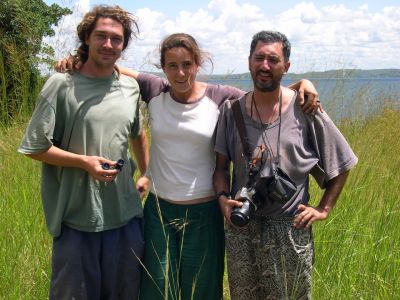
The first train — the one on Friday — is full. So we buy tickets for the following Tuesday. “We” means Ben, Caro, and me. Ben and Caro are a French couple from Orléans who are traveling around the world by bicycle over six years.
We choose third class… we are adventurers after all!
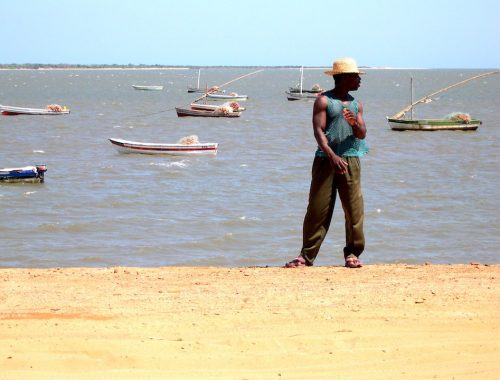
But then Henrik — the Danish motorcyclist living in Dar es Salaam, with whom I am staying (still following?) — invites us to spend four days in a small village in southern Tanzania. He had conducted sociological research there a few years earlier.
(It was during those few days that I took some of the most beautiful photographs of the entire trip.)
As a result, the departure is postponed to the following Tuesday. Still in third class.
Tuesday then.
Departure time: 5 p.m.
And guess what?
It left on time.
Can you believe it?
We couldn’t… so we were late…
And therefore…
WE MISSED THE TRAIN.
We now have two options:
• wait for the next train — Friday
• catch this one!
The train takes seven hours to cover the first two hundred kilometers, so we have time to overtake it by bus.
First we have to reach the bus station.
Two options:
- the dalla-dalla (shared minibus)
- a taxi
A tout offers us a taxi for 6000 shillings (6 dollars).
Too expensive.
We look for the dalla-dalla station.
The tout returns. 5000
Still too expensive.
We keep walking.
He comes back again. 4000 !
I offer 3000.
Not enough for him.
We keep looking.
He comes back again.
OK for 3000.
He takes us to the taxi station.
We get in.
The driver starts reluctantly and complains the entire ride: 3000 really isn’t enough.
So the journey begins like this:
• 1 hour to cover 10 km to the bus station
(Dar es Salaam is almost like Paris when it comes to traffic jams)
• then 3 hours by bus for 200 km (1500 shillings)
At one point a man almost gets lynched.
We literally catch him with his hand in the bag: he was trying to steal something from the bag of Saida, a friend traveling with us who had been hosting Ben and Caro.
Thieves are not treated kindly around here.
He gets away with “only” a severe beating — thanks to Saida, who saves him from the angry crowd.
A strange twist.
We arrive in Morogoro around 10 p.m.
The train is expected around midnight.
We stretch out in a corner of the station, among a cheerful mess of people waiting just like us.
This time we don’t miss the train.
I will let you imagine third class in Africa…
No.
Actually, you can’t.
It is beyond imagination.
We board for 1000 km.
Travel time: 40 hours.
Well… I exaggerate.
38 hours only.
On the second night we decide to occupy the restaurant cars to sleep. Normally they are reserved for staff.
A first ticket inspector comes by.
In a not very convincing tone he asks us to return to third class.
We pretend to be asleep.
Ben — who really was asleep, on the floor, wedged under the benches — pretends to wake up.
I order him to go back to sleep.
We will negotiate if the inspector insists.
Not a difficult man, he immediately falls asleep again.
Saved?
Not quite.
Another inspector returns with a policeman.
We must go to third class.
So I bluff.
I explain that when they reissued our tickets after we cancelled them, they made a mistake, and since we didn’t change them on the same day our seats are in different carriages.
And we want to stay together.
So what can we do?
The inspector grumbles.
Then finally says:
— OK… you can stay.
We fall asleep again.
Mwanza
In Mwanza, on the second evening, Ben, Caro and I celebrate our imminent separation in an excellent Japanese grill whose only two tables sit on a small floating platform on Lake Victoria.
Not bad at all.
In fact, excellent.
(I would later discover a much darker portrayal of this city in the film Darwin’s Nightmare. In reality Mwanza is far from as grim as the film suggests. Compared to places like Kinshasa, Luanda or Lagos, it is practically paradise.)
Stage 1 summary
1 hour taxi → 10 km
3 hours bus → 200 km
38 hours train → 1000 km
Total: 1200 km
Now I still have to reach Kigali.
Ben and Caro head in the opposite direction: they are eager to reach India, their next destination.
(I leave them my compass in exchange for a promise to photograph it on the Great Wall of China — a promise they will keep.)


No Comments