
Cet article est également disponible en :
Day One : Alphonse and CARA YAGUINE
“Mwaramutse,” Mathieu says as he opens the door.
Mathieu is the man who guards the entrance to COFORWA. He is the first person to welcome me.
I ask for Alphonse.
— Alphonse from CARA YAGUINE? he replies.
Without really understanding, I say yes.
COFORWA, CARA YAGUINE… I wonder what exactly that might be.
Mathieu leads me along a small path. A sign with an arrow points toward CARA YAGUINE. It appears to be a small house perched on the side of a hill. In front of it stretches a wide, deep-green valley. On the other side rise more hills.
The land of a thousand hills… the name fits perfectly.
Mathieu asks me to wait and disappears into the small house.
I wait.
Footsteps.
I see Mathieu coming back. Behind him is another man: Alphonse.
I had imagined him tall. And clean-shaven.
I was completely wrong.
Alphonse is short and mustached.
Not a large mustache, though — nothing like the grand mustaches of the Belle Époque. No, Alphonse’s mustache is extremely discreet, so discreet that an inattentive observer might not even notice it against his dark skin.
But in truth, what strikes you when you first meet Alphonse is neither his height nor his mustache.
No.
What you notice immediately are his eyes.
Or rather the kindness that shines from them.
Alphonse is a good man.
You can see it.
You can feel it within the first minutes.
Within the first seconds.
Alphonse welcomes me as well. We talk for a while, then he shows me my room: a small, very simple room in the CARA YAGUINE house.
Then he leaves again, apologizing — he has some business to attend to.
So I sit down on the terrace in front of the house.
Facing the hills.
And I watch.
I listen as well.
On these hills there is little forest, only a few scattered patches. Everywhere else there are fields, crops.
And yet these hills are incredibly steep.
But the farmers here seem to have taken great pains to plant banana trees, sweet potatoes, cassava, soybeans, or sorghum, almost in defiance of the most basic law of gravity.
Little by little another phenomenon becomes clear to me: the valley, the countryside, is extraordinarily noisy.
No machines.
No engines.
Only cows lowing, human voices, birds singing.
Perhaps a simple acoustic effect caused by the shape of the valley?
I know this phenomenon well from having observed it many times in the Pyrenees: when you stand on a mountainside, the sounds from the valley carry far.
That may also be the case here.
But it cannot be the only explanation.
There are so many different voices.
And as evening slowly falls, I suddenly become aware of the extraordinary population density of the Rwandan countryside.
Alphonse returns, interrupting my thoughts.
He is accompanied by Goretty.
She will be the one preparing my meals during my stay.
She disappears into the kitchen while Alphonse and I sit down on the terrace to talk.
Night falls.
And we are still talking.
About everything and nothing.
Getting to know each other.
At last Goretty calls us.
Dinner is ready.
The table is set.
We go inside.
On the table is an old oilcloth tablecloth, like the one my grandfather used to have.
And on that tablecloth sits a multitude of dishes.
Enough food to feed a regiment.
Alphonse and I sit down and, by the light of a candle — because there is no electricity — we begin to eat.
Day Two – First Encounters
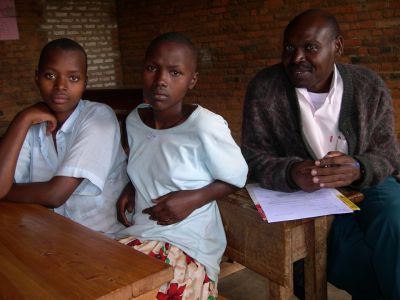
The young girl barely turns her head to speak. She is lying on a bed — well, if you can call it a bed: an old steel frame on which a straw mat has been thrown in place of a mattress.
Alphonse tells her that she can say it to me herself. She is in secondary school and is supposed to be able to speak French.
She says nothing.
Neither she nor the girls sitting beside her.
So Alphonse translates:
“She said: tell that white man to buy us some milk.”
I say nothing.
I find myself torn between annoyance and compassion.
Annoyance, because I am beginning to grow tired of the muzungu — the white man — so often being seen in Africa as nothing more than a walking wallet who must help the poor African.
Compassion, because here it is true: there is nothing.
We are in the Nyakabanda dispensary.
It was built in the 1960s and does not seem to have seen much renovation since then.
Led by a nurse, Alphonse and I walk from room to room.
Most of them are empty. No one wants — or can afford — to pay the 50 or 100 francs required for hospitalization.
And anyway, can you really call this hospitalization?
There is no doctor.
And no equipment either.
The staff consists of nurses and nursing assistants — ten people in total.
The next room is empty… and it stinks.
The smell reminds me of calf battery farms: a sharp, acrid odor that catches in your throat.
Apparently this is the men’s ward.
Another room. This one is the laboratory.
Well… if you can call it that.
The last room is the delivery room.
It is actually the best equipped room in the entire dispensary. There is a delivery table — certainly old, but still in good condition.
In one corner of the room I notice about fifty disposable gloves hanging up to dry.
Disposable gloves.
Really?
I leave the place with a certain sense of unease.
Our next visit is to the parish. We go to see the priest, but he is not there.
So we head to the secondary school — or rather, to one of the two secondary schools in Nyakabanda.
The first is run by the government.
The second is managed by a parents’ association.
Two secondary schools, then — and a multitude of primary schools scattered across the region.
This multiplication of structures is the only way to ensure primary education for as many children as possible. The population is scattered across the hills, and going from one hill to another takes time.
So schools have multiplied: almost every hill has its own school.
For secondary education, however, there are far fewer structures.
But in any case, only about 13 percent of children go on to secondary school.
So…
In the playground I notice several children with deep scars on their faces.
Rain interrupts our little visit.
It is almost noon, and Alphonse has planned lunch with a few of his friends.
In the street people whisper as we pass.
Alphonse tells me they are wondering where I come from.
Some of them even suggest that I might be Indian, others Lebanese.



No Comments