
Cet article est également disponible en :
I crossed from Ghana into Togo via a bush track in the north. It was quite an adventure, to say the least. Judge for yourself!
June 13, 2024
Lying on my self-inflating mattress, gazing up at the clouds, I notice bird droppings falling in front of me and landing with a sharp plop on the sheet of steel covering an old well.
The guinea fowl, perched in the tree directly above me, proudly cackles. Or perhaps it squawks—I have no idea what language African guinea fowl speak. I find myself thinking that I see fewer and fewer of them in French farmyards these days. Yet their meat is excellent, and I cannot help salivating at the thought. I’m hungry. The Greeks and Romans imported them from Africa. Among other things, they used them in offerings to the gods, reading their entrails for omens. Before they were called guinea fowl, they were known as the “Numidian hen,” “Turkish hen,” “Pharaoh’s hen,” or even “Indian hen.” It was only in the 15th century, in Spain, that they took the name “Pintado,” meaning “well made-up,” probably because of the red wattles around their beaks. In Ghana, where I was still just a few hours ago, they call them “Guinea Fowl.”
Just a few feet away, a rooster suddenly starts crowing at full volume. I should point out that I am lying between a chicken coop and some Honda 125cc motorcycles from Nigeria that were seized by the Togolese Gendarmerie.
Oh yes, an important detail: I have now been locked up for more than 24 hours in the barracks of the South Savanna Gendarmerie Company in northern Togo. The purpose of the investigation is to determine whether or not I am a terrorist.
First day – June 12, 2024 – The arrest
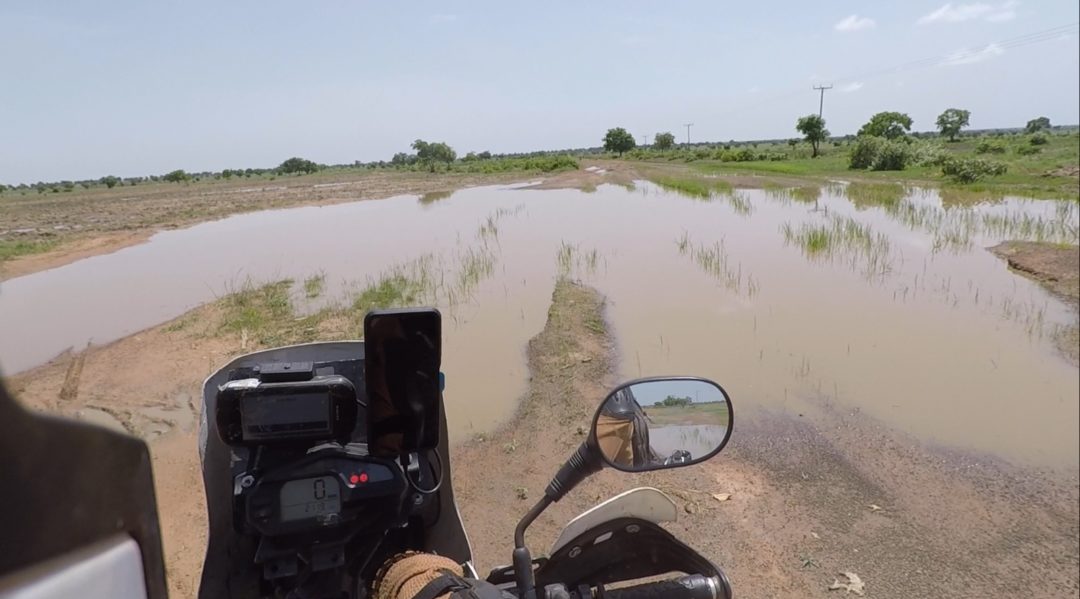
On the morning of June 12, after a night of intense tropical thunderstorms, I take some time to clean my camping gear before packing it away. It is relatively early, around 7 a.m., but the farmers are already out. They are surprised to see me, but do not seem frightened. Communication is difficult. They only speak Konkomba, a language I do not understand at all. Fortunately, a young herder arrives with his cattle. He knows a few words of English. At least we can introduce ourselves.
It must be around 8 a.m. when I get back on the track. It is soaking wet and, still not fully awake, I take a small tumble in a mud puddle. Nothing serious. Only my pride could have been hurt, but I lost that a long time ago when it comes to this particular subject. Still, starting the day with a fall does not seem like a very good omen. Perhaps I should have asked a marabout to check the entrails of a guinea fowl. But I didn’t, and simply carried on.
A few kilometres farther on, I reach the Ghanaian border post. Even though I am deep in the bush, far from any major road, it seems surprisingly well organised. Certainly much more so than the ones I encountered on the forest track I took two weeks earlier between Côte d’Ivoire and Ghana, which consisted of nothing more than wooden huts. The customs officers did not even have a stamp, and I had been forced to go to the nearest town to complete the formalities. At least these officers have all the necessary stamps.
As I start off again, the customs officer tells me to be careful: with the rain, the track is extremely difficult.
I fear the worst. When an African tells you something is difficult… it really is!
In fact, the track turns out to be quite technical, but Lady Pink, despite the weight of the luggage, handles it surprisingly easily. I do have an occasional hesitation when accelerating from idle, which forces me to work the clutch. I promise myself I will sort that problem out once I reach Cotonou.
A few kilometres farther on, I arrive at what looks like a police checkpoint under a tree. As I arrive, a man gets up and orders me to pull over. His tone is initially rather unfriendly, which is unusual. He asks for my papers and then tells me to open my luggage. I comply while calmly chatting with him. The man takes a quick look inside. His tone has already softened.
I realise that he is a police officer. The checkpoint is a joint one: police and immigration. This time, in addition to my passport, I show him my e-visa, a simple A4 sheet of paper.
— “Where is the original?” the officer asks me.
— “This is the original! There’s a QR code for authentication. You just need to scan it!”
The man looks unconvinced. He turns the sheet over and over. I have to say that the e-visa procedure is new. We are in the bush, far from any conventional tourist route. On the iOverlander app, the last recorded traveller seems to have passed through here in 2019. Five years ago. No white man ever comes through here.
The man decides to refer the matter to his superiors. In the past, he would not have had that option. But nowadays, GSM networks mean that even the most isolated checkpoint can contact its superiors instantly.
I am ordered to have my picture taken standing next to my motorcycle. I happily play along. However, I forget to remove my motocross body armour, which makes me look rather like Rambo.
Big mistake, I think.
Time drags on. I chat casually with one of the men while waiting for a decision to be made. If there is one thing I have learned in Africa, it is to let things happen and take your time.
I must have been waiting for about half an hour when a military truck arrives. A young Togolese infantry lieutenant gets out. It takes me a few minutes to understand that he is here for me.
From a distance, I hear the customs officer asking the lieutenant to sign a “transfer into custody” document.
What is this all about?
I ask the lieutenant what is going on. What’s happening?
— “I have orders to escort you to the gendarmerie.”
— “Sorry? But why?”
— “For an identification investigation. You are in an area under a state of emergency.”
Oh shit!
I knew that northern Togo, under threat from jihadists coming from nearby Burkina Faso, was classified as a red zone. But I thought I was just below that area. Besides, nobody in Ghana had objected to my presence. But every country has its own laws and rules.
I decide to comply with the order without arguing. I simply ask where he is supposed to take me.
— “To the Gendarmerie Brigade in Mango. They will conduct the investigation.”
I try to joke:
— “You think I’m a terrorist? Seriously, do I look like a terrorist?” I say, laughing.
— “You can’t know who is a terrorist.”
Hmm! I have to admit, he has a point.
Damn motocross armour. I should have taken it off for the photo!
— “All right, so I follow you on my motorcycle?”
— “No! We’re going to put the motorcycle in the truck!”
I look at him in disbelief.
— “What? But the platform is at least 1.60 metres high. And the motorcycle weighs more than 200 kilos with the luggage! You’ll never get it up there.”
— “There are plenty of us. We’ll do it!”
— “But someone could get hurt if it falls!”
— “Those are the orders!”
I stop arguing. The lieutenant is not aggressive at all, quite the opposite. He is actually rather friendly. But he has been given orders and must carry them out. In fact, deep down, he agrees with me. It would be simpler for me to follow them on my own. But orders are orders.
Barely ten minutes later, the motorcycle is indeed in the truck, lifted like a feather by more than ten men. Unfortunately, I am not allowed to film it, but it was quite a sight.
Thirty minutes later, Lady Pink is unloaded in front of the gendarmerie barracks.
As for me, I am told that I am under arrest and a gendarme makes me sit on a bench. Across from me, other people who have been arrested seem to have been waiting there for many hours already.
The lieutenant and a gendarme move aside to talk. A few minutes later, the gendarme comes out and aggressively tells me:
— “You entered Togo illegally!”
I stare at him in disbelief.
— “No, I have my passport and my visa. I presented myself at the customs post. The customs officers refused to stamp it, and the lieutenant brought me here in the truck. I had no choice.”
— “You are in Togo here. You have no stamp in your passport. You entered illegally!”
I calmly repeat my explanation, but I can sense that the man is hostile and obstinate. This is not looking good.
He goes back into the office where the lieutenant is.
Another gendarme takes down my identification details and carefully writes them in a notebook. I try, unsuccessfully, to lighten the atmosphere. But most of the non-commissioned officers present either do not want to or do not dare answer me.
I have no choice but to wait. The gendarme with the notebook continues taking down the details of the other people who have been arrested. A young woman appears to be there to act as an interpreter. It has to be said that we are at a border between several ethnic groups and several dialects.
Suddenly, a gendarme arrives. Everyone comes to attention, a sure sign that he is a senior officer. He invites me to follow him into an office. The lieutenant joins us and stands in a corner. Another gendarme sits down. They gesture for me to sit on a bench.
The bench for the arrested!
The officer—I still do not know his rank—addresses me. Whereas the first gendarme was hostile, this one is jovial, almost laughing. I would put him at around thirty. I greet him and ask him his rank.
— “I’m in uniform!”
— “Yes, but I don’t know your rank!”
— “But I’m in uniform, you can tell!”
— “Yes, but I don’t know the ranks, so I can’t tell.”
He laughs without answering and begins with the usual questions: surname, first name, nationality, where I come from, what I do.
I answer without protest and explain my journey over the previous eight months. The second gendarme, acting as clerk, carefully writes down everything I say.
The questions become increasingly precise, even though the atmosphere remains apparently friendly. I have to give him the numbers of all the SIM cards I have used since setting off. He also asks me to provide the contacts I might have in Togo who could vouch for my identity.
I give him the contact details of a friend’s sister, a Togolese woman, from whom I am supposed to collect my tyres for the rest of the journey. He decides to call her to verify what I have told him.
The conversation he has with Lola, my friend’s sister, is surreal, and I can sense that she is becoming a little panicked on the other end of the line. In fact, she will try to reach me nine times over the following hours. In vain, since the captain—such is his rank—will confiscate my phone as soon as the interrogation is over.
I gradually lose track of time. I have not eaten anything for more than 24 hours, apart from a few dried fruits.
Finally, the captain gets up and leaves the office. The others follow him. I do the same. A gendarme stops me:
— “When you are arrested in France, do you leave the room without permission?”
I answer, laughing, that I had never been arrested in my life. But obediently, I return to the office and sit back down on my bench.
Another gendarme makes me stand with my back against a wall so he can photograph me.
A few moments later, the captain says to me:
— “I’m taking you home!”
And he invites me into his car, a BMW.
I am surprised, but I soon understand that “home” is actually the barracks of the South Savanna Regional Gendarmerie Company.
At the entrance, truck tyres stacked on top of one another and filled with concrete serve as a guard post, occupied by armed and helmeted guards holding submachine guns.
The captain has me sit in the courtyard and assigns a young non-commissioned officer to keep me company. At least that is what he says, but it is clear that his real job is to keep an eye on me.
I still have not eaten anything.
The young non-commissioned officer and I start talking. He is 28 and has been enlisted for seven years already. He is intelligent and pleasant company. He tells me that the situation has become complicated because of the jihadists.
Since 2020, around forty members of the security forces, from all branches combined, have been killed. Among them was one of his friends, the brother of his girlfriend at the time.
A particularly horrific detail: when the man died, he was not allowed to tell her that her brother had been killed and had to wait until the death was officially announced.
I spent almost three days waiting in this barracks courtyard in northern Togo for the investigation into my case to be completed.
The day drags on, dull and uneventful. Suddenly, I say to him:
— “What if we played cards?”
He looks up.
— “Do you know how to play Crazy Eights?”
— “No, but you can teach me.”
He calls two of his colleagues and we start a game. I even manage to win one round.
Evening falls. I am getting hungrier and hungrier. It has now been 36 hours since I last ate. My guard companion kindly gives me a packet of biscuits.
When the captain finally returns, it is already completely dark. He says:
— “We’re going to get something to eat, then we’ll go and get your motorcycle, then you’ll take a shower and sleep here.”
To which I reply:
— “Yesss! Those are all good ideas. But first, let’s go get my motorcycle. All my belongings are on it, and I’ll feel more comfortable if it’s inside the barracks.”
He agrees and takes me on the back of a motorcycle, and we speed off into the night, wind in our hair.
Once the motorcycle is safely inside, he takes me to a kind of huge concrete hall hidden behind a large wall next to a petrol station. You would never find it if you didn’t know it was there. Women sell their cooked meals there.
As we sit down, I turn to the Captain:
— “Captain, I have two questions!”
— “Yes?”
— “First: do we use ‘tu’ or ‘vous’ with each other?”
— “Hey, we’re brothers now. We use ‘tu’!”
— “Okay. And so, what’s your first name?”
— “Marcel!”
Privately, I reflect that if someone had told me that morning that I would be having dinner that evening with a Captain named Marcel who had arrested me a few hours earlier, I would never have believed them.
Two other gendarmes come and join us. One of them is a lieutenant in the gendarmerie special forces who had been assigned to escort me to the Colonel, the group commander, 70 kilometres to the north.
But orders had changed in the meantime, and the Colonel was supposed to come here the following day.
Back at the barracks, I pitch my tent next to the chicken coop and fall asleep like a log.
Second day – June 13 – Life in the barracks
In the morning, I am awakened by the hubbub of the young gendarmes getting ready. The courtyard is covered with helmets, shields and bulletproof vests. The Opel cars that have been seized and parked next to my tent apparently serve as wardrobes for some of the recruits.
They all get ready, without hurrying, but quickly nonetheless, and then leave. I have no idea whether they are going for training or on an operation.
I find myself alone in the courtyard with the guinea fowl.
On the right is the main building. At the back, an unfinished building serves as an open-air shower room for the gendarmes—and for me on this occasion. In the foreground on the right is a well covered with nothing more than a sheet of metal.
The courtyard is fairly large and enclosed by cinder-block walls. On one side, where I am staying, the seized vehicles—cars and motorcycles—and a chicken coop are lined up.
So I have set up my living area, tent and tarpaulin—which serves as my living room—under a tree between the cars and the chicken coop.
On the opposite side is an unfinished cinder-block building. It serves as a storage room and shower area. The privacy it provides is rather relative, and the previous day I had seen several young gendarmes showering there in the simplest possible attire.
On the right is a small two-storey building that serves simultaneously as the officers’ offices and quarters, as well as the briefing and training room. A tap comes out of it. It provides water both for the soldiers and for women who regularly come to fill large yellow plastic jerrycans.
The bathroom.
Around mid-morning, Marcel, the captain, comes to visit me. He has just returned from his morning jog. I make coffee, which we drink together while sitting on a huge wooden plank serving as a bench.
He tells me that the Colonel is on his way to Mango. My fate should therefore be decided fairly quickly.
At least, theoretically!
As he gets up, he says:
— “Okay, I have to go arrest someone!”
— “An arrested person like me?” I reply, laughing.
— “No, you are free here. Him, I arrest and then I lock him up!”
— “Ah, then give me my phone back!”
He laughs and leaves without answering.
Orders, always orders!
I am free, yes, inside the barracks, and I am not allowed to communicate with anyone. A rather relative form of freedom, even though I am not complaining.
The morning passes, somewhat dull and slowly. I read and observe life in the barracks. Young gendarmes occasionally pass through, either to drink from the tap and fill a bottle, or to retrieve an item of clothing from one of the car-wardrobes.
As for me, running short of water, I decide to fill one of the buckets and filter the water so I can fill my jerrycan.
It is past noon when the captain comes back to go and have lunch.
I ask him:
— “Where is the Colonel?”
— “He came, but he went back out on reconnaissance by helicopter!”
— “Heyyy, you should have told him to take me with him. We could have talked in the helicopter!”
He laughs.
A gendarme I do not know joins us. He is a lieutenant, and the three of us leave in the BMW.
They spend lunch talking to each other. For a moment, I feel a little out of place. But the meal, typically African—chicken in sauce with tô, accompanied by a huge 60 cl Coke—is excellent.
The captain pays for it, just as he did the previous day. I had not had time to withdraw any money before being arrested.
Back at the barracks, the Lieutenant signals for me to follow him into his office. A young gendarme joins us and remains standing guard beside us.
The Lieutenant begins a new interrogation.
I am surprised. I already answered all these questions yesterday for the Captain.
He then explains that he is the deputy and acting commander of the Mango Gendarmerie Company. The Captain, meanwhile, is the commander of a Mobile Gendarmerie Squadron, responsible for maintaining public order.
In fact, he had only interrogated me in the absence of the lieutenant, whose actual role it was.
(Note: In the Gendarmerie, the Groupement is the command level at departmental level, commanded in this case by the famous Colonel. It comprises several Gendarmerie Companies, which are themselves subdivided into territorial Brigades. In this particular case, I am in the Mango Company barracks, which resulted from the division in two of the former South Savanna Company.)
Very quickly, the interrogation turns into a friendly conversation. The lieutenant is intrigued by what motivated me to undertake such a journey.
So I tell him the story of Odile, which marked the beginning of my life as a long-distance traveller 20 years ago.
What interests me about travelling is meeting people, understanding how they live, far removed from the image Western media may give of them.
My credo is people, humanity.
He is receptive to my arguments, and the friendly conversation gradually turns into a more personal exchange.
His family is far away, in Lomé, and he has three children. He had five, but two died.
Out of the corner of my eye, I watch the young gendarme standing guard. He is completely silent, but I can see that he is not missing a word of the conversation.
At the end of the interrogation, I finish with a joke. The lieutenant bursts out laughing. The sentry tries hard not to laugh out loud.
As I leave, the lieutenant tells me not to worry, but that I will have to wait a little longer for the Colonel to make his decision.
He has once again gone out on reconnaissance by helicopter.
— “Heyyy, but he has to take me with him!!!”
The Lieutenant laughs.
My summer living room. Shoes forbidden.
During the afternoon, I can watch the gendarmes training on the grounds adjoining the wall. They also sleep there, in simple large white canvas tents.
I take advantage of the quiet of the day to have a shower. Like the gendarmes, I strip naked in the courtyard after filling a bucket with water.
In the evening, they all return to relax and take their own showers.
One of the scenes I witness is rather funny. In the foreground, four young men are playing football. The first is wearing flip-flops, the second is barefoot, the third is wearing socks, and the last one has only one trainer.
In the background, a completely naked gendarme is washing himself.
Evening comes without me receiving the slightest news from the Colonel.
Marcel comes to pick me up in the car to go and eat. During the night, he has to weave between goats that consider the laterite road to be their bedroom.
During the journey, I am an unwilling witness to a telephone conversation between the Captain and his wife, who has remained in Lomé.
The life of a soldier far from his family is clearly not easy.
During the meal, I can sense that he is worried and we talk very little.
When we return, we wish each other goodnight. I go back under my tent for my second night in the barracks.
Third day – June 14 – Heavily protected escort and release
This time, it is the rooster that wakes me at 5:30 a.m.
Damn creature!
As if it weren’t enough that it had started crowing in the middle of the night, setting off all the roosters in the surrounding area for a good half hour.
I get out to fetch some earplugs from the motorcycle and go back to sleep.
It is the heat that eventually forces me out of the tent.
Everyone has already left and I am alone, or almost. Two women have come to fill up with water. And of course, the guinea fowl are still there, along with countless geckos.
Around 10 a.m., the Captain arrives, looking delighted:
— “Get ready! They’re coming to escort you to Benin!”
What?
Escort me? To Benin?
I do not try to find out more. The important thing is that I am finally moving!
At last!
The escort indeed arrives an hour later. It consists of five special forces men, including the young lieutenant I met on my first evening, who is in command.
In addition to him, there is a driver and three armed, masked men who take their places in the back of the pickup. Two of them face forward. The last one faces backwards.
Before leaving, I try to negotiate with the Captain.
Why take me to Benin? It would be enough to get me out of the red zone and then I could manage on my own.
I also point out to him that my passport still does not have an entry stamp!
It seems fairly important to me if I want to leave the country!
He assures me that it is not necessary, but asks for my passport.
He also has my two bags of luggage loaded into the pickup.
Then he hands my passport and phone to the Lieutenant and turns to me with a mischievous grin:
— “New procedure: in case you feel like giving the escort the slip, the Lieutenant will give your belongings back to you at the border!”
— “Ah, okay, so trust is running high!”
I laugh heartily despite everything.
After saying our goodbyes, the convoy sets off.
The road is excellent, and we drive at 120 km/h most of the time over the 150 kilometres separating us from Benin.
In town, the unfortunate people who try to squeeze between me and the pickup are imperiously pushed aside.
A submachine gun is quite persuasive, and they all obediently fall in behind me.
When we reach the border, the lieutenant signals for me to follow him. He presents my passport to a female customs officer and explains the situation.
The journey to Benin is made at high speed under the escort of special forces, whose job is both to protect me and make sure that I actually leave the country.
— “But he doesn’t have an entry stamp! And without an entry stamp, we can’t give him an exit stamp! And without an exit stamp, Benin won’t let him in! You have to go back to Mango to complete the formalities!”
Then, turning to me:
— “Do you have a visa?”
— “Yes, yes!” And I hand her the famous A4 sheet that is my e-visa.
Ten minutes later, the customs officer, the lieutenant and I are in the office of the head of customs.
She listens to the explanations and examines my documents.
Everyone gets a dressing-down. Literally everyone.
Calmly, she begins by reprimanding the lieutenant:
— “This is ridiculous. You should have made sure the entry formalities were completed in Mango. Besides, you have no reason to make him leave Togo. He is legally in the country with a multiple-entry visa. He has the right to travel throughout Togolese territory!”
The lieutenant can only hide behind his orders.
Then she turns to me and continues:
— “Next time, you have to go through a proper border crossing. Not through the bush! They don’t have the equipment there to issue you the final visa stamp!”
I nod.
In the end, she agrees to have the famous exit stamp applied.
As she hands my passport back to me, she repeats:
“If you come back, go through a proper customs post!”
— “Yes, yes, ma’am!”
As I cross the border, everyone—the lieutenant and the head of customs—wants to have their picture taken beside me and the motorcycle.
As for the Lieutenant, I tell myself that this is probably his way of proving to the Colonel that he successfully completed his mission!
If the Captain or the Lieutenant ever happens to read these lines, I want them to know that I thank them for their hospitality, which, although somewhat forced, was extremely friendly!
And also:
“I’ll be back!”
Written in Djougou, Benin, June 17, 2024.

No Comments