
Cet article est également disponible en :
Warning: When the previous post was originally published (May 2026), the last few days of May were inadvertently omitted. I have just updated the publication. It is important to read those entries in order to understand what follows.
June 2, 2026 – Akwanga, Nigeria
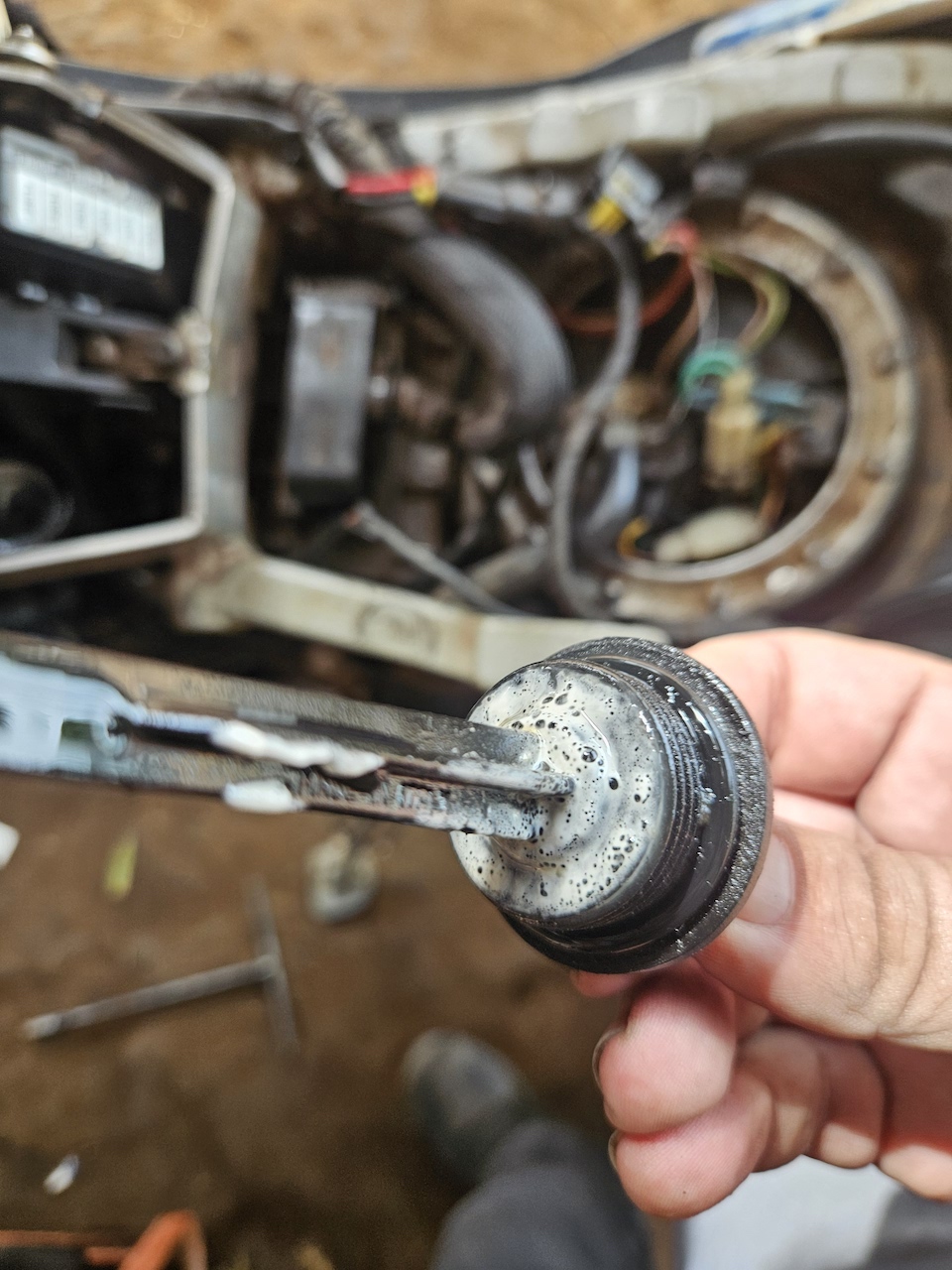
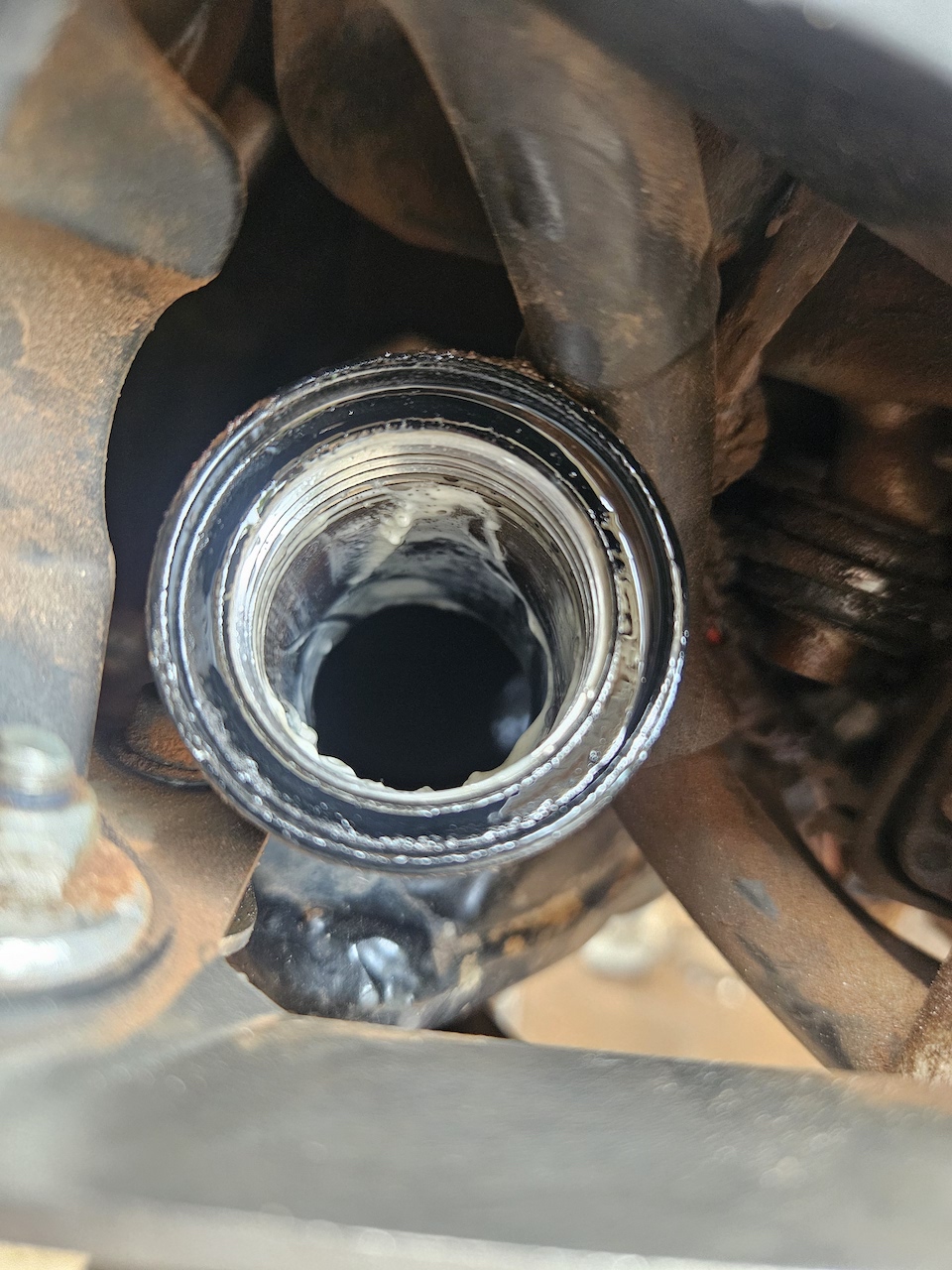
Today I have serious doubts about the origin of the mayonnaise-like sludge that has reappeared around the oil dipstick.
This morning, I am genuinely torn between two explanations:
The first one—the one I initially considered—is that water entered the engine while crossing the ford, or more precisely the deep water hole I rode through with the motorcycle. Despite the oil change carried out in Abuja, some residual water may have remained inside the engine.
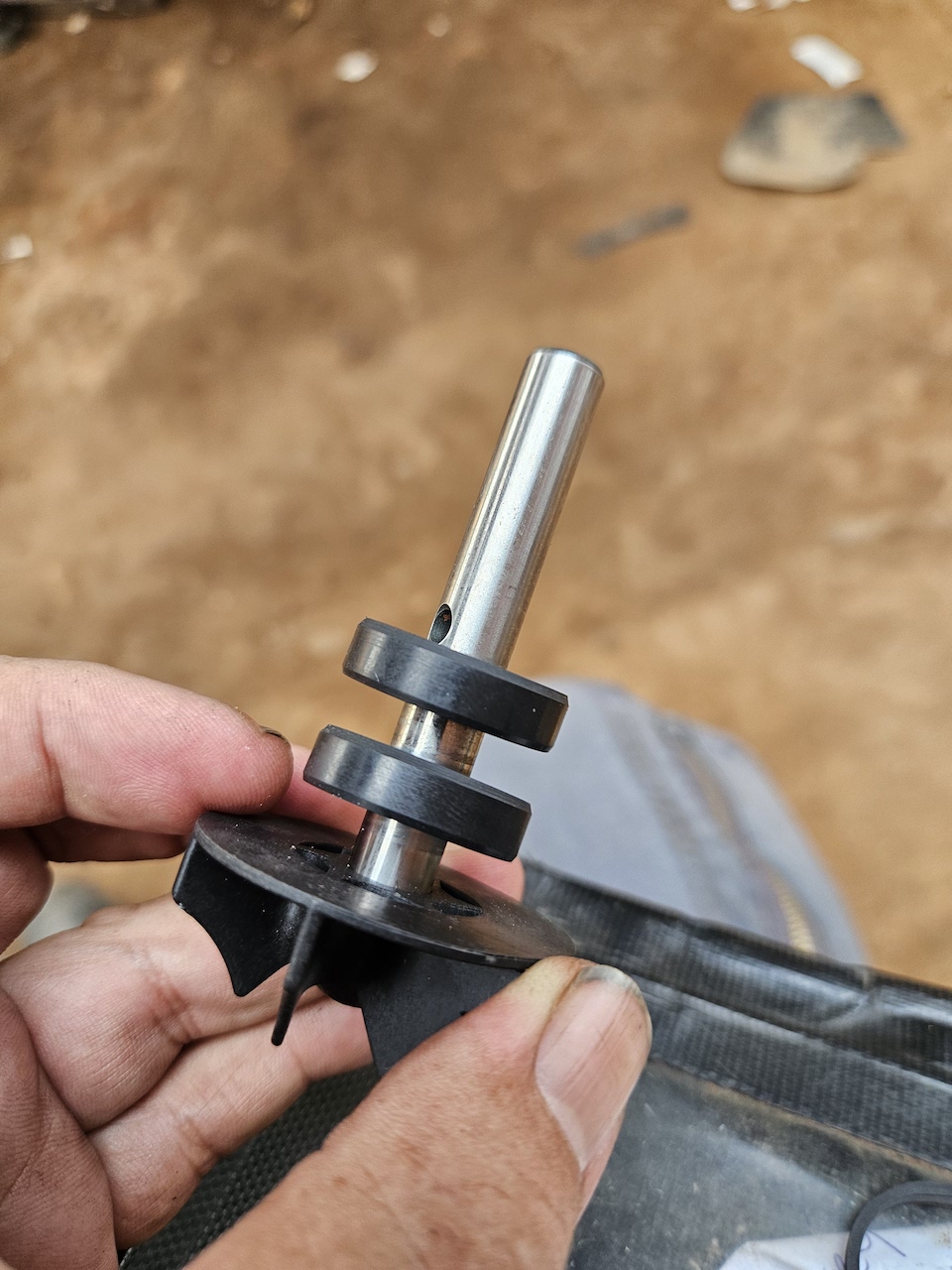
The second possibility is a failure of the water pump, one of the known weak points of this motorcycle because of its plastic impeller blades, which eventually wear out.
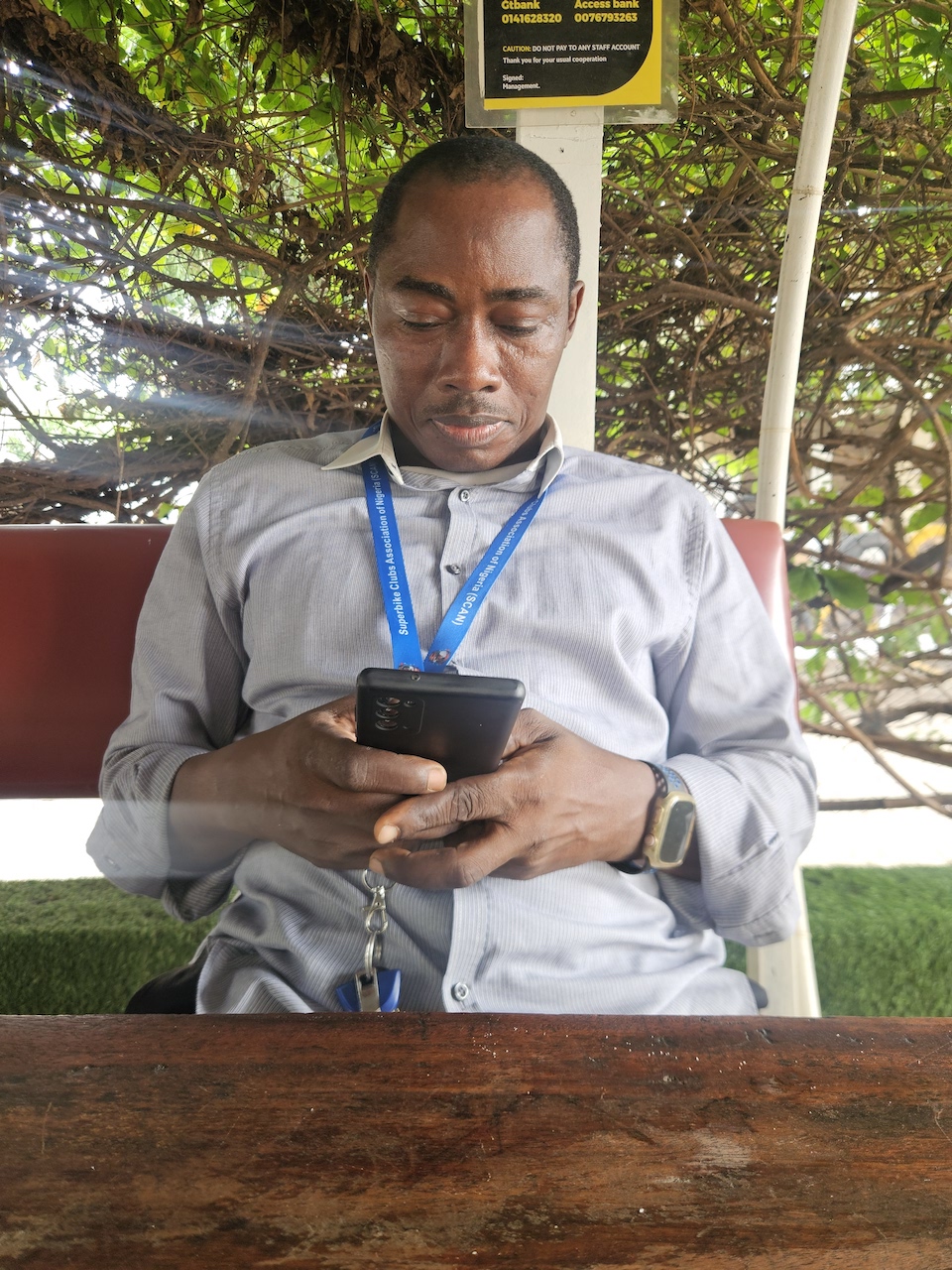
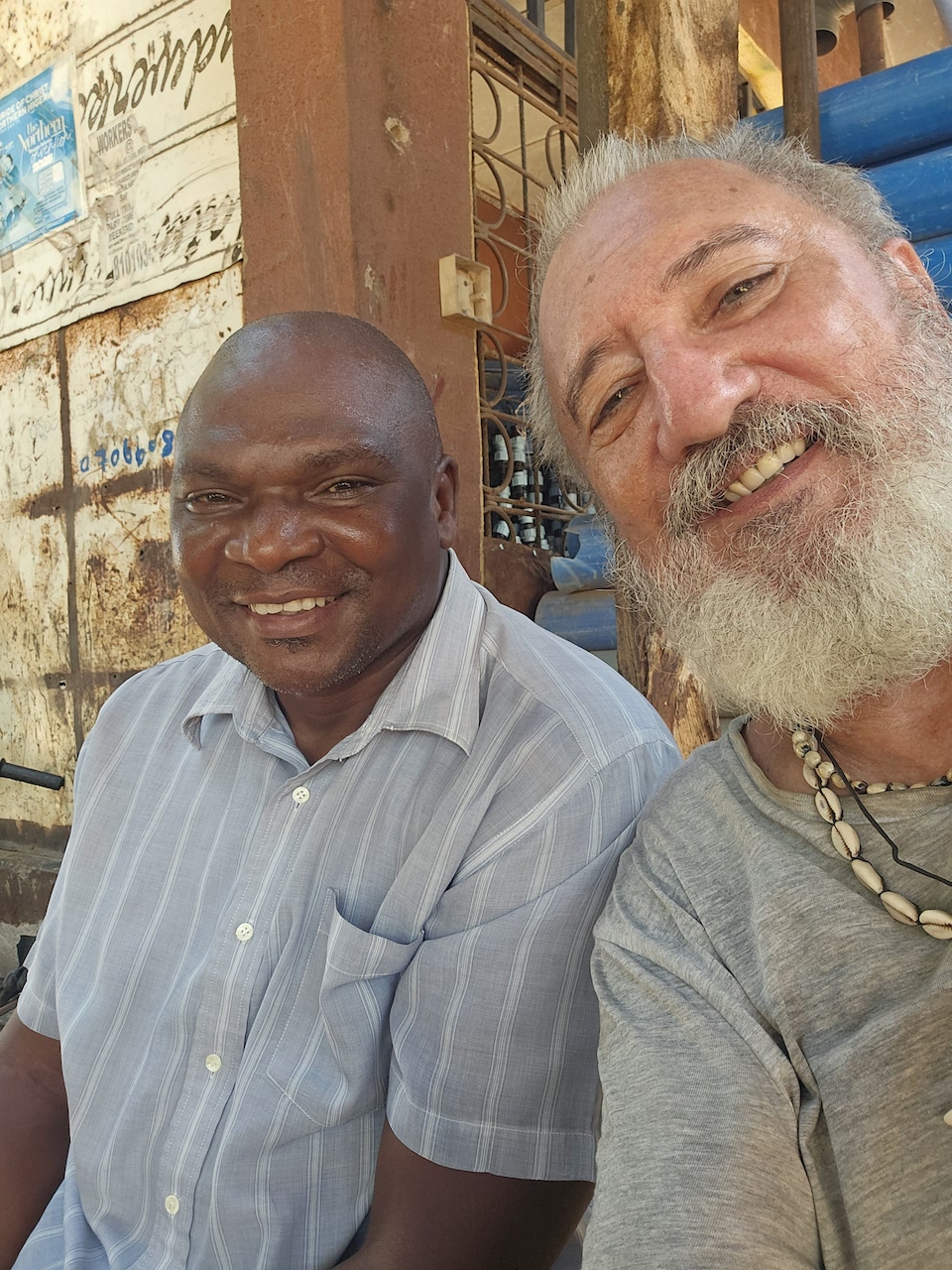
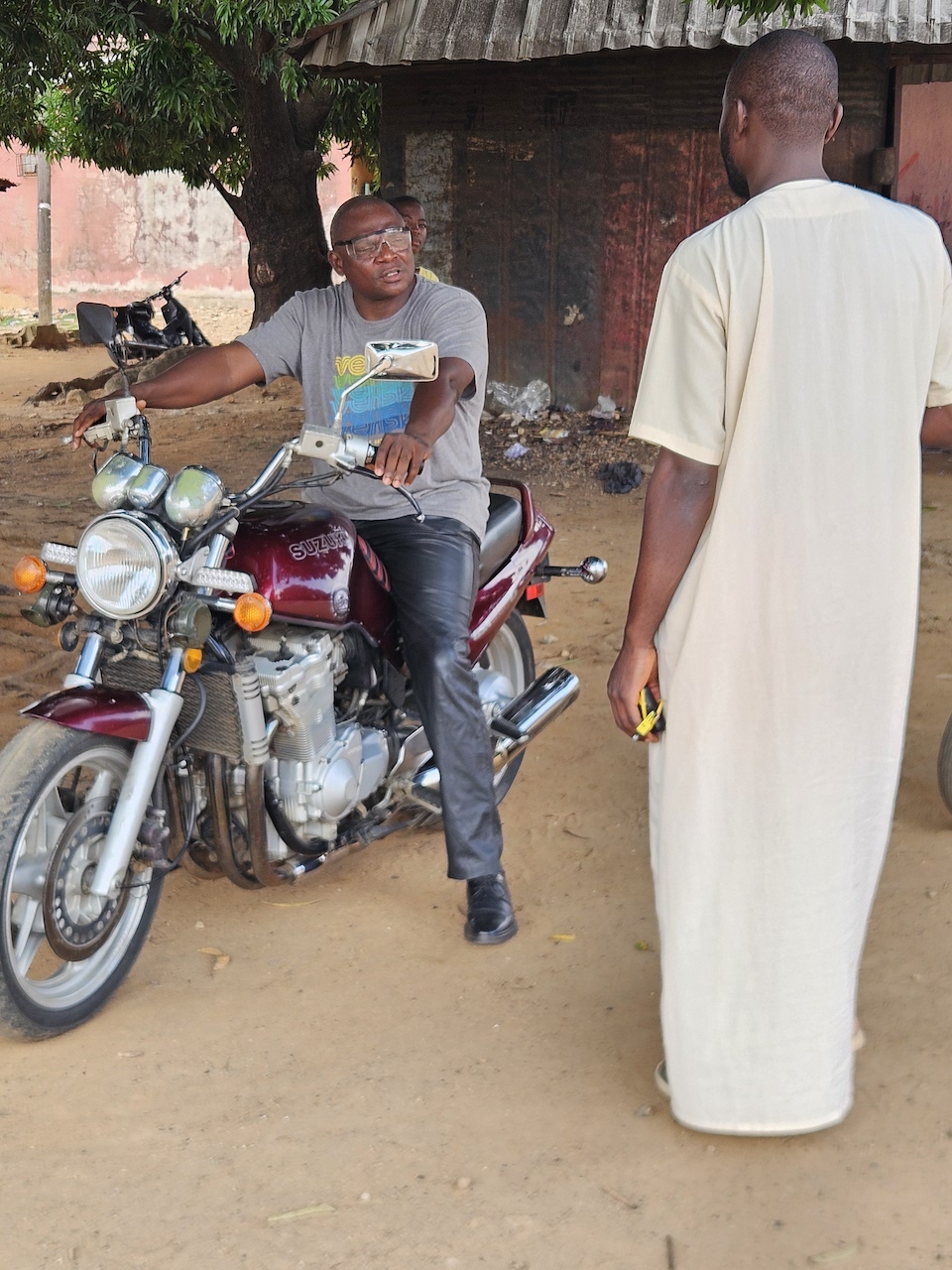
Gomez, president of SCAN, arranges for two members of the club (Superbike Clubs Association of Nigeria) to come to the hotel: Abdou, the teacher, and Peter (pronounced “Pita”), the mechanic.
I explain the situation to them.
The original idea is to have the bike repaired in Makurdi, the next major city. My main concern is how to get there. It is about 150 km away. If the problem really is the water pump, I fear it could worsen along the way and eventually damage the engine.
The safest solution would therefore be to transport the motorcycle in a pickup truck. The remaining question is the cost.
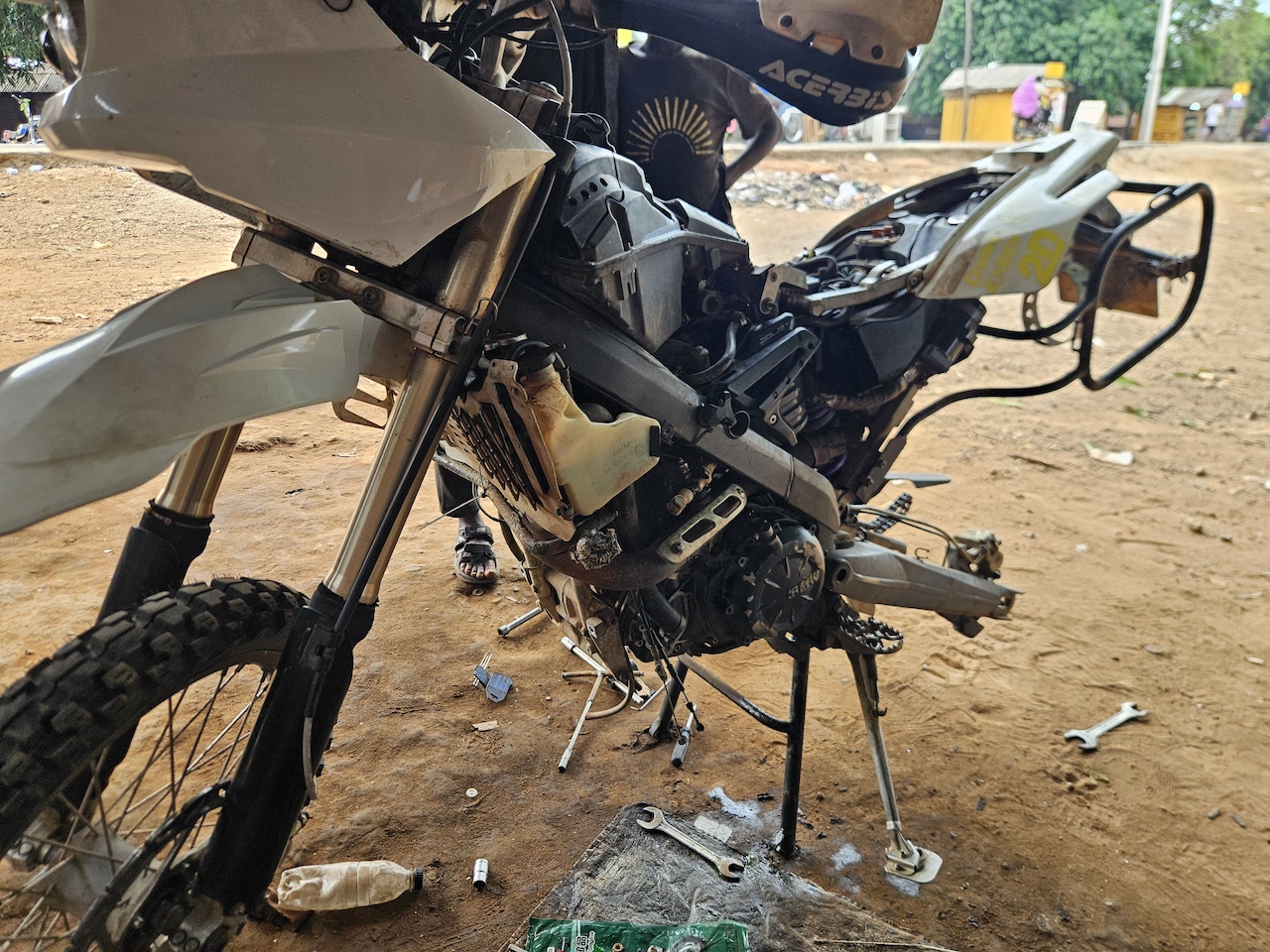
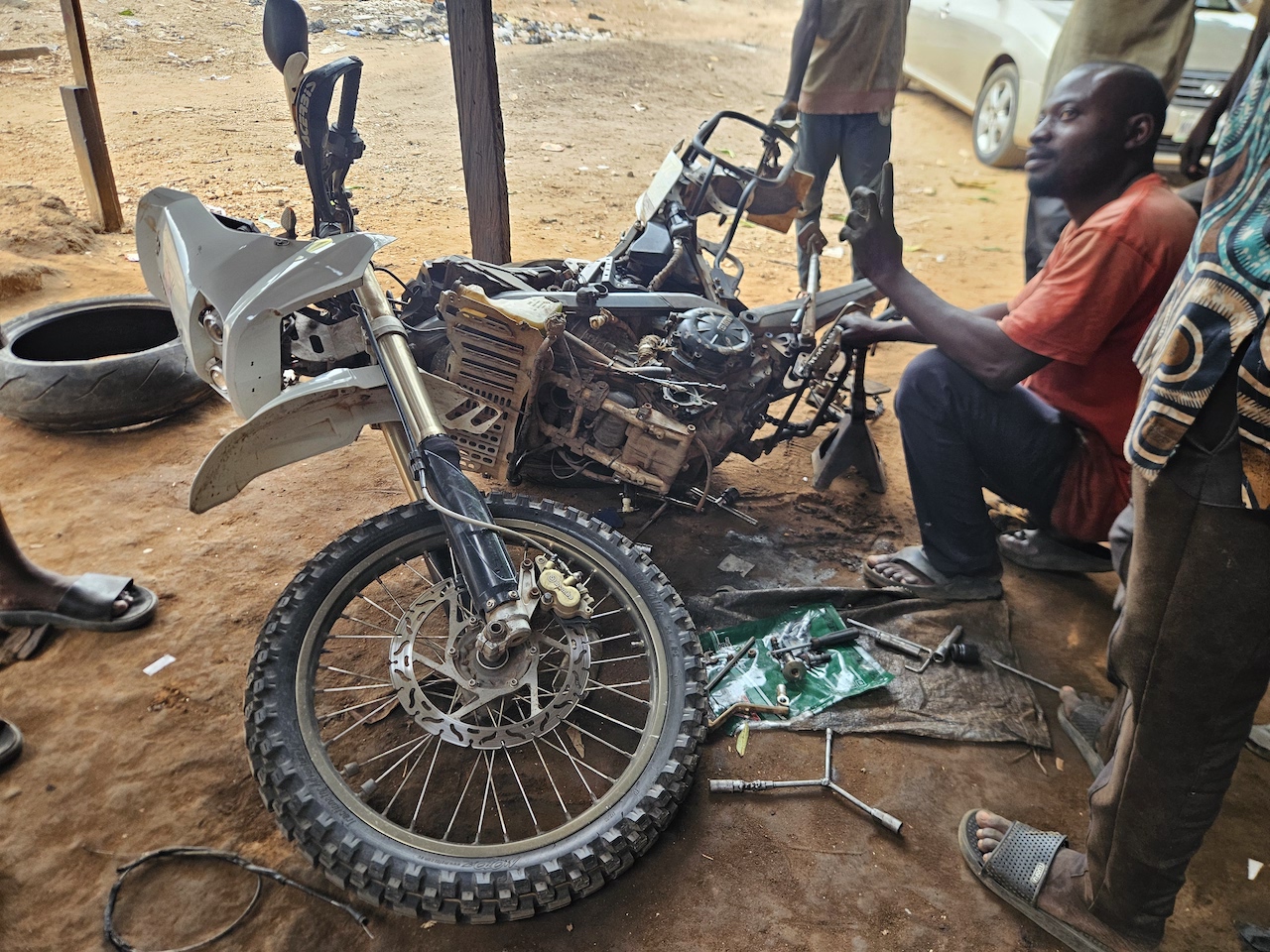
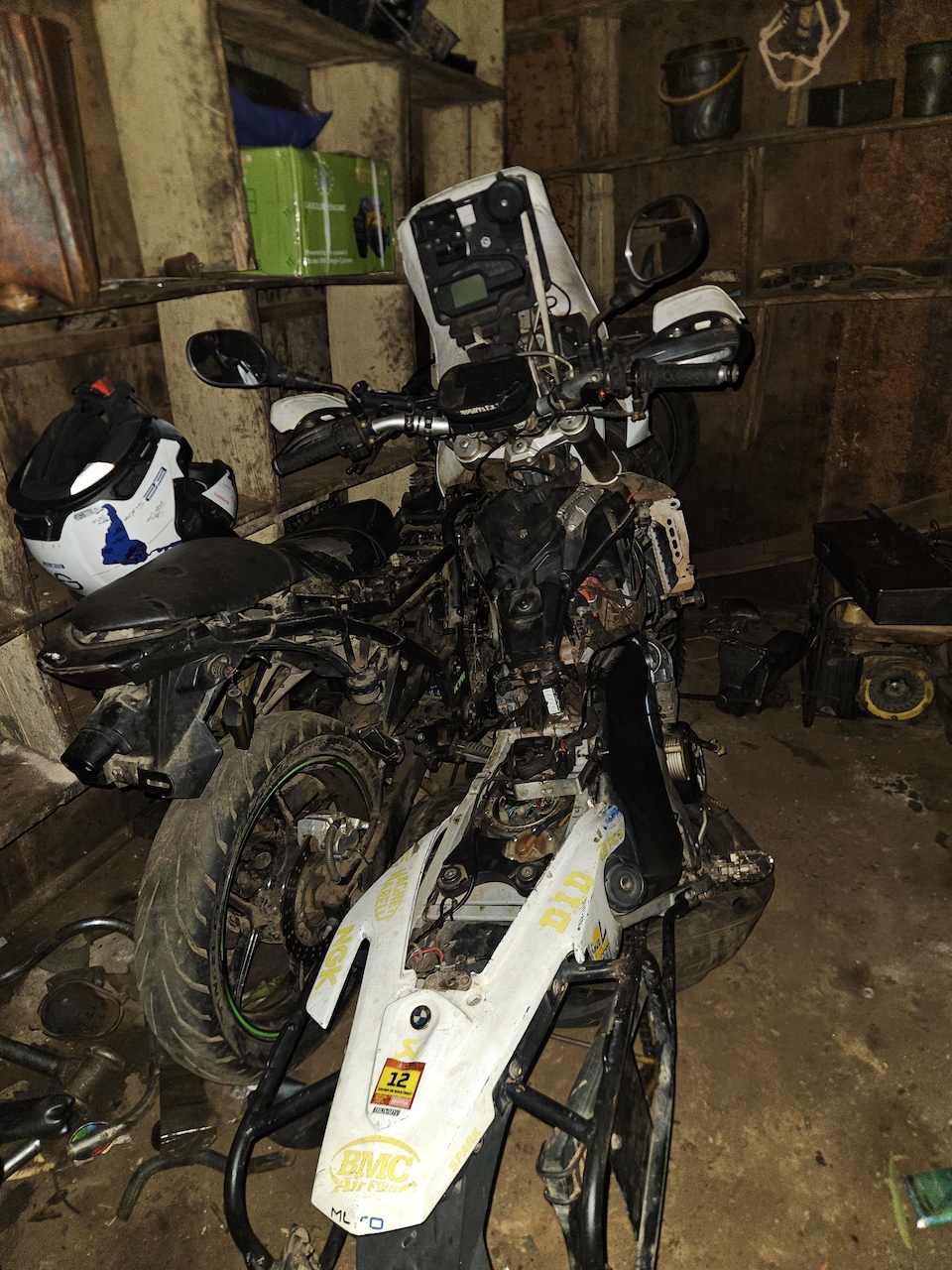
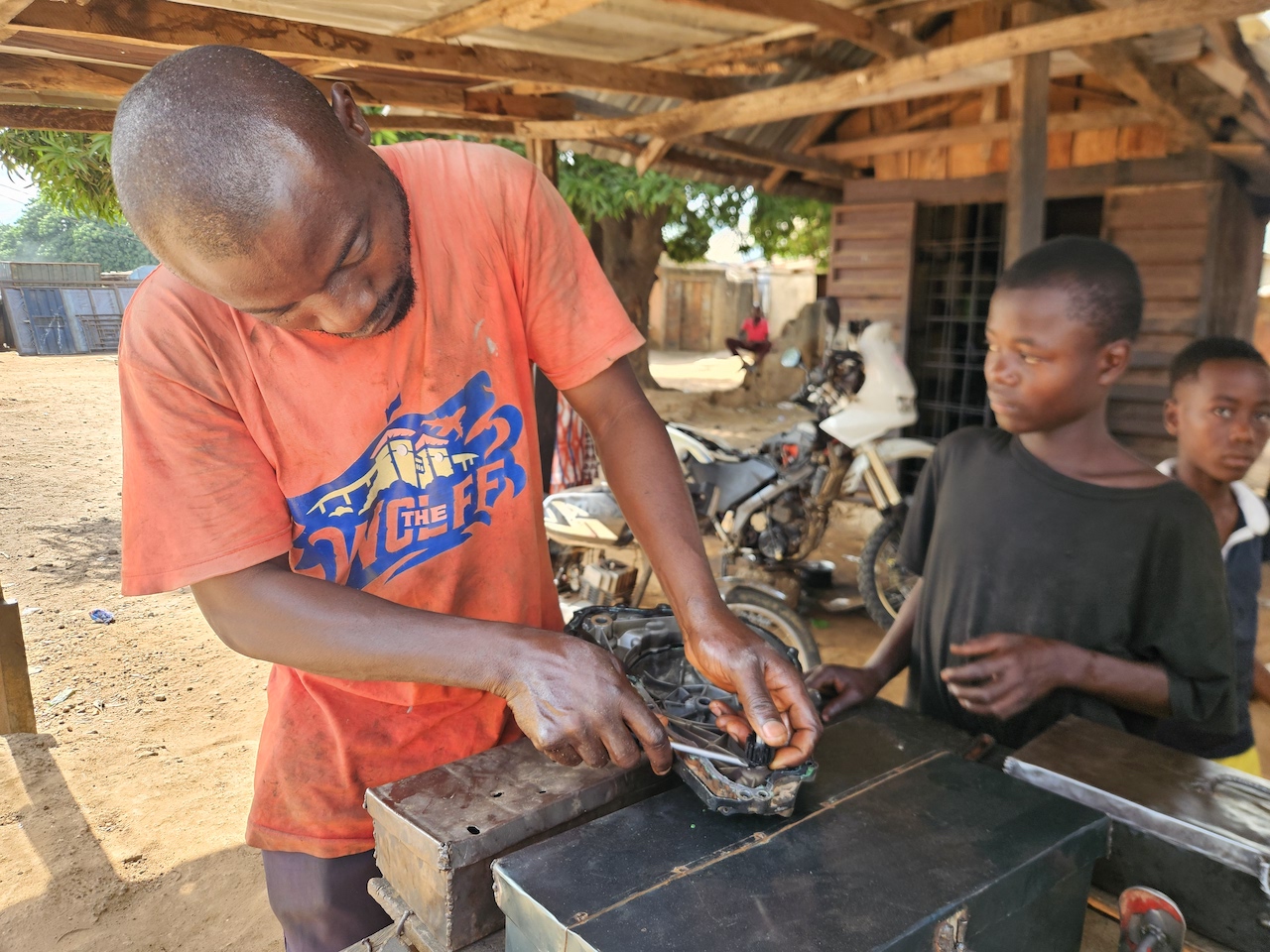
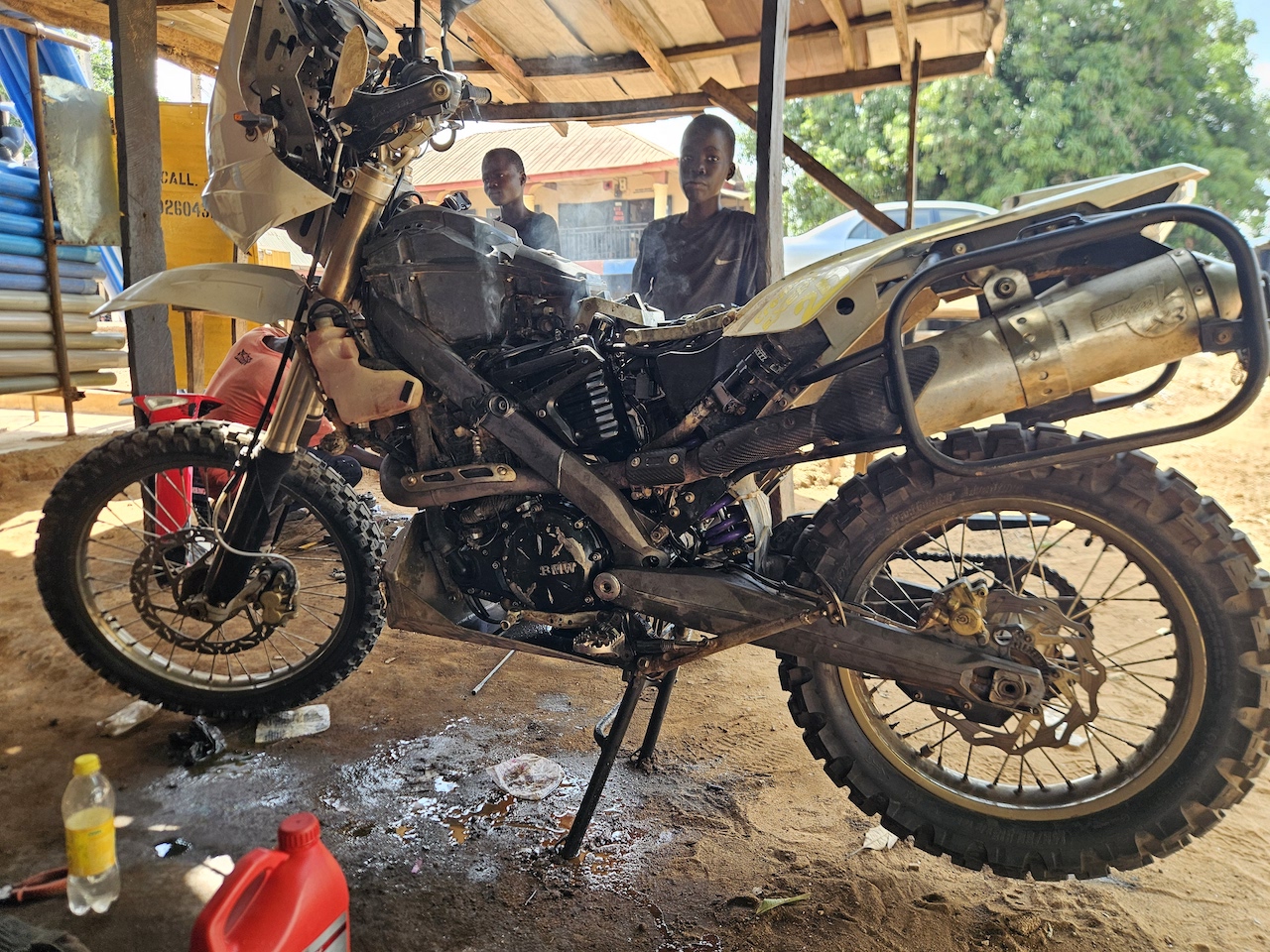
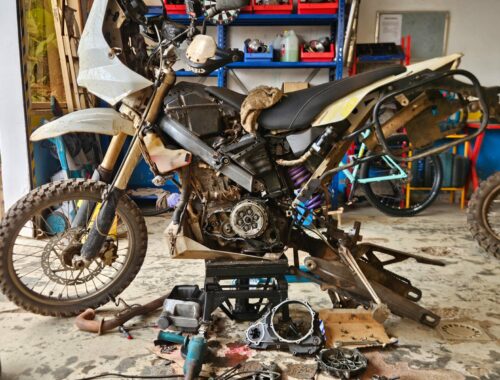
However, as the discussion progresses, Peter assures me that he can carry out the repair himself. On this motorcycle, replacing the water pump requires almost complete disassembly because of a bolt located behind the frame.
After discussing the various options, I decide to trust him.
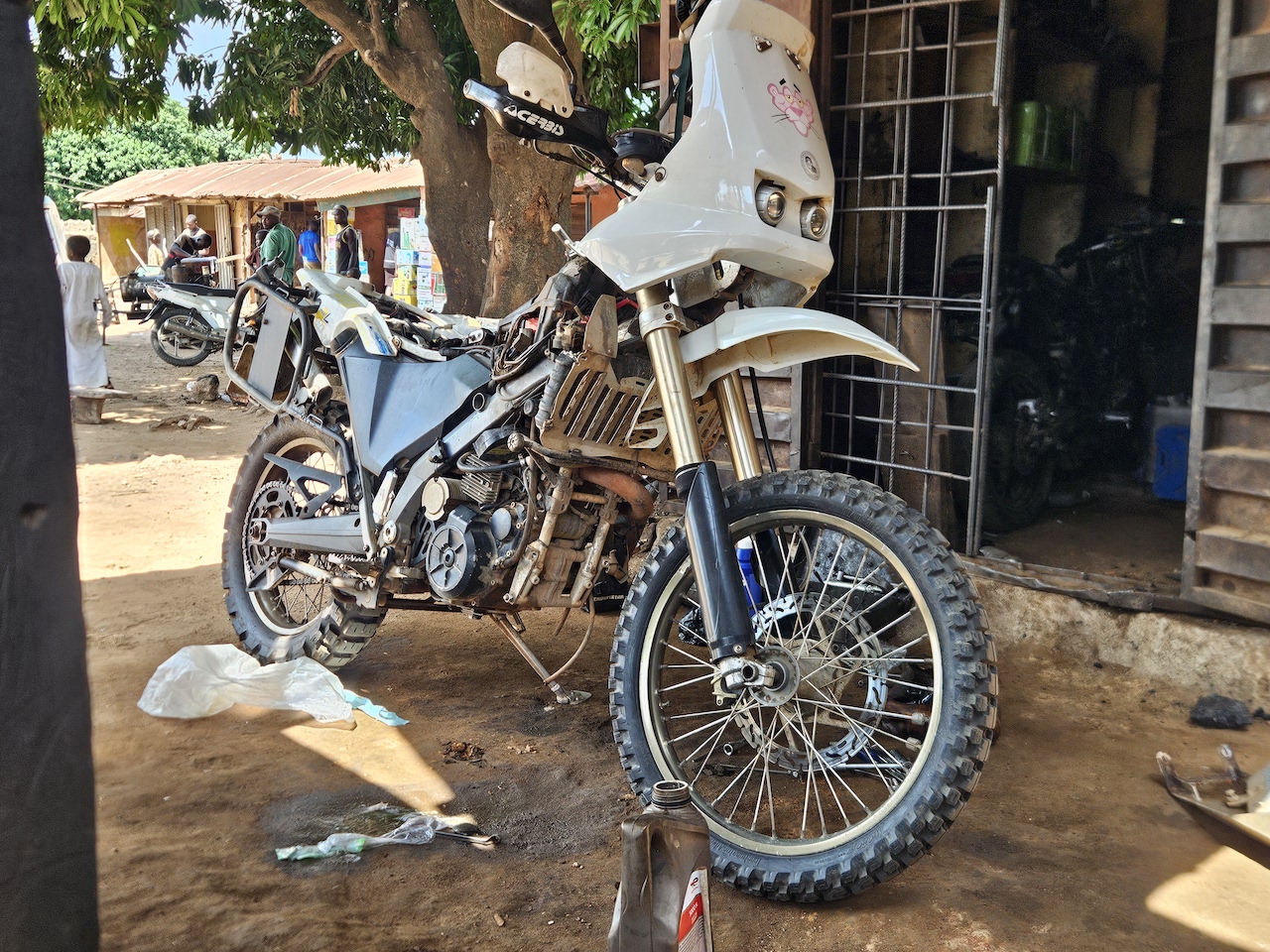
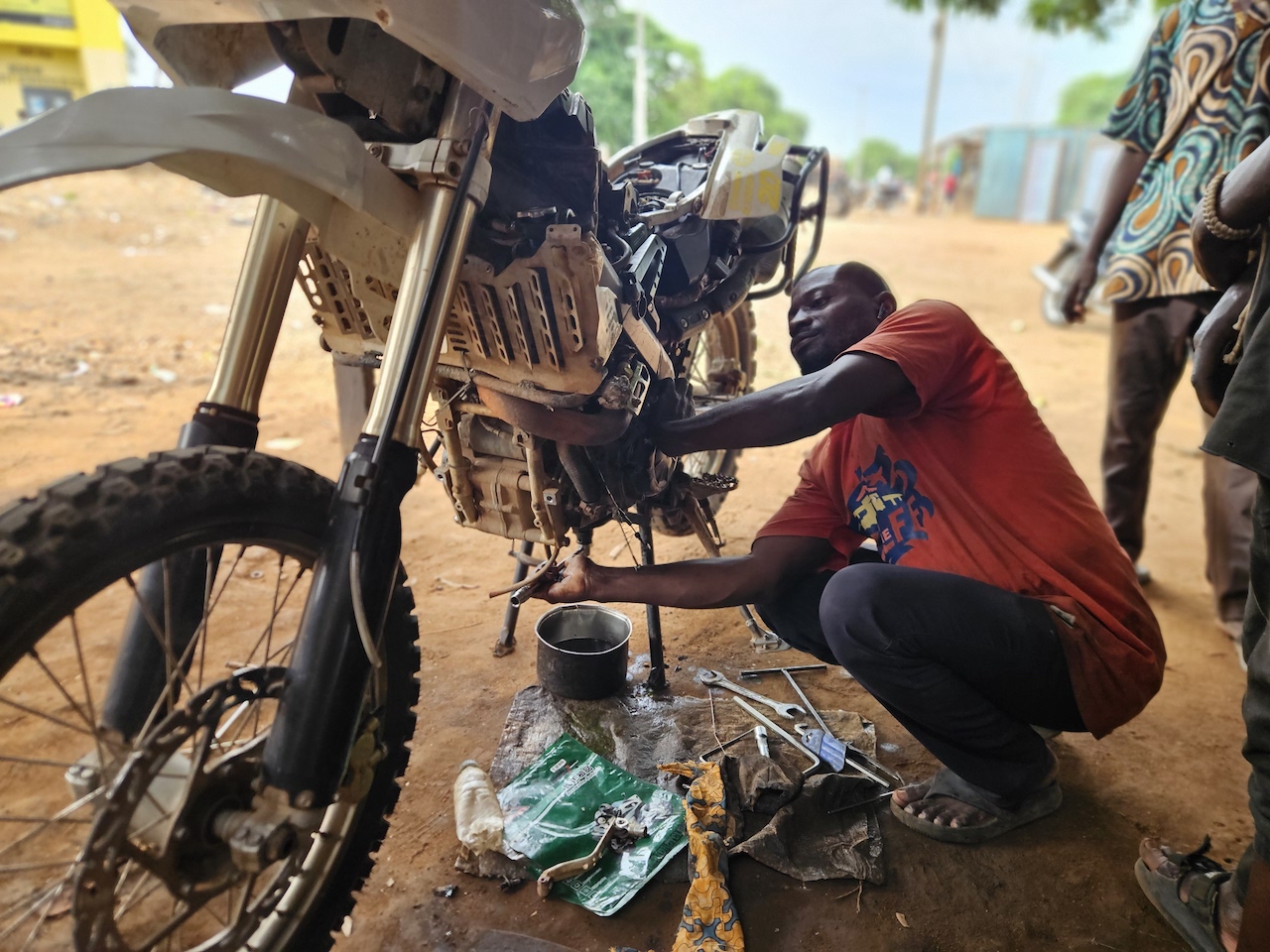
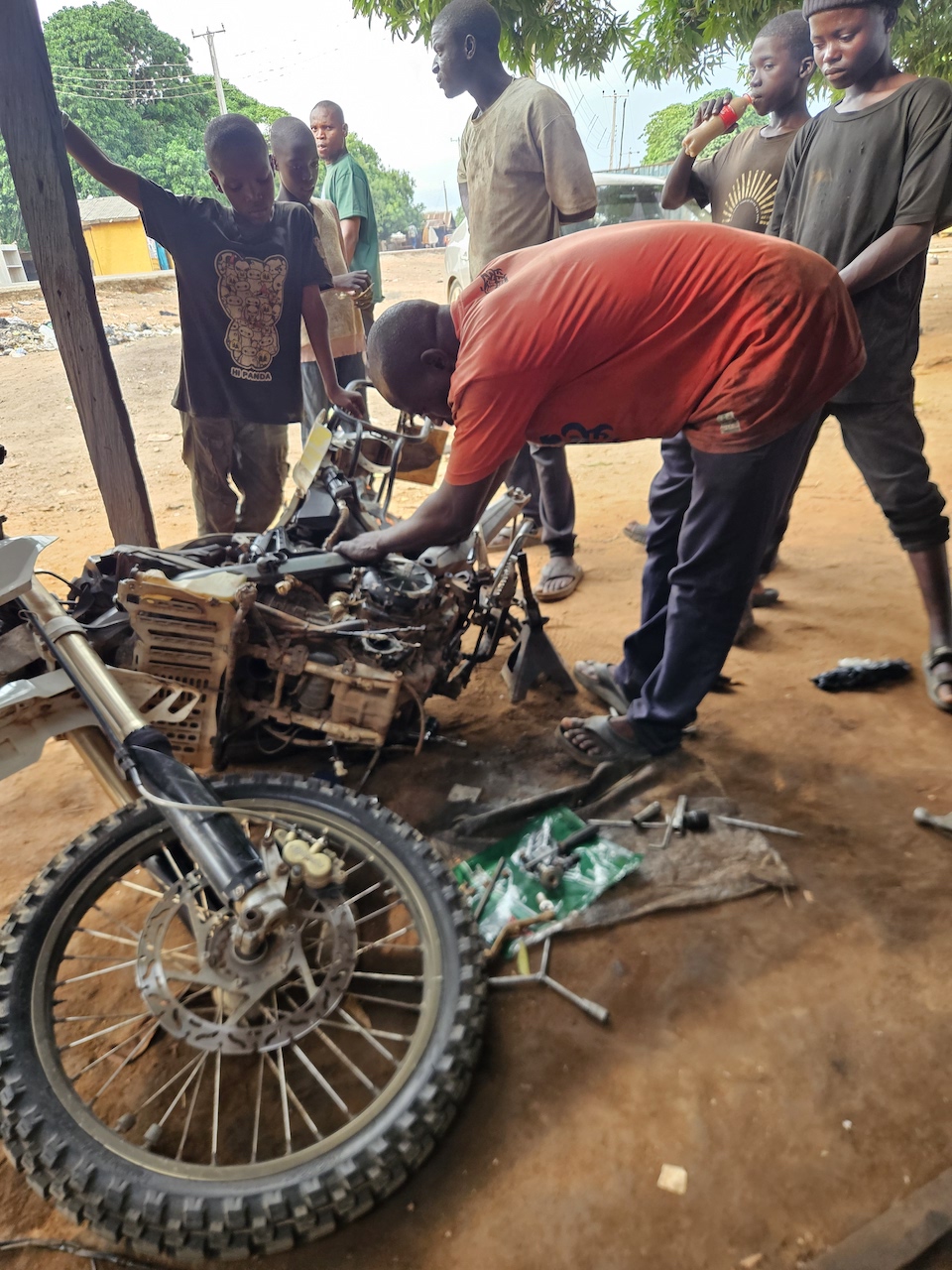
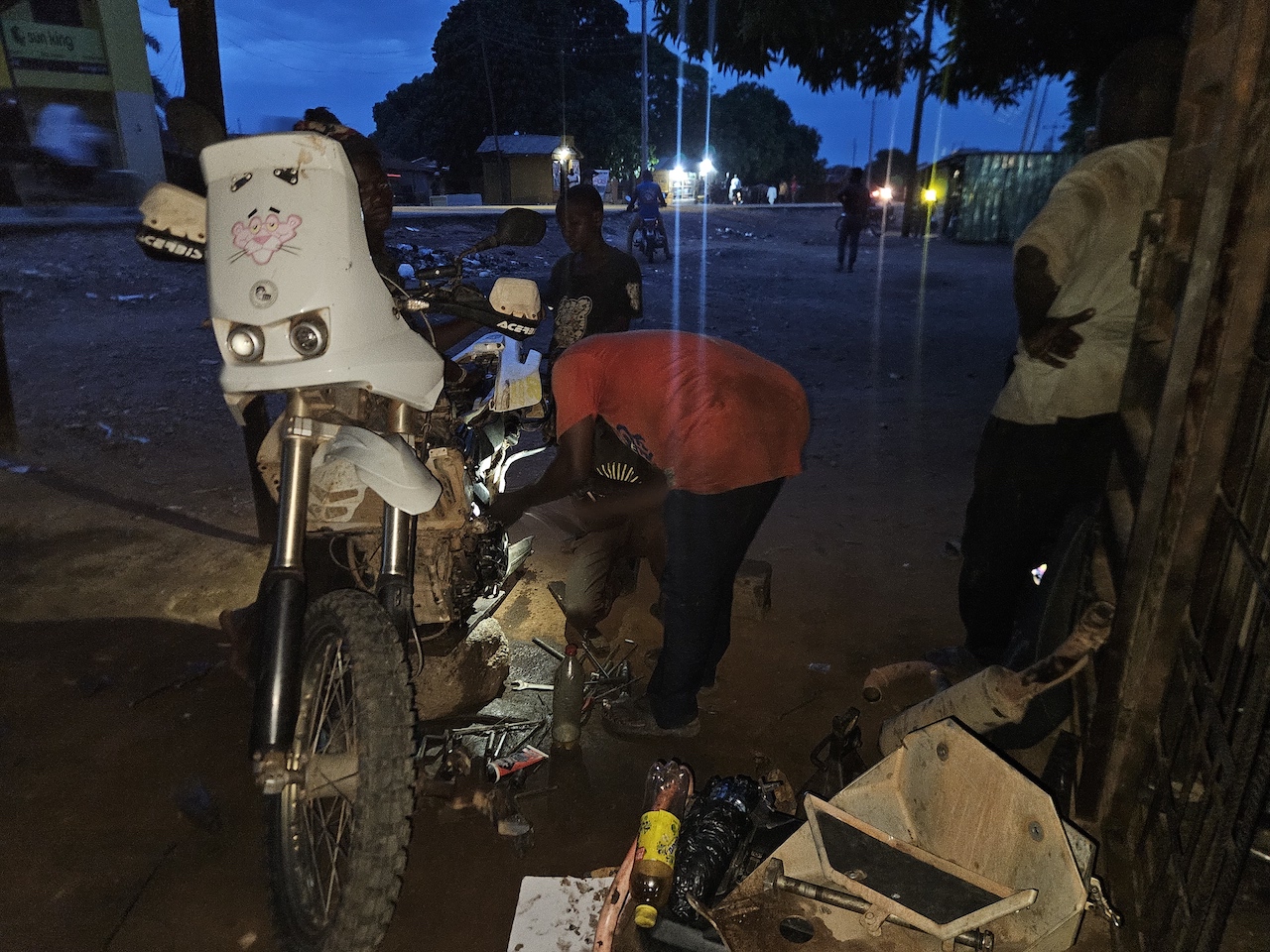
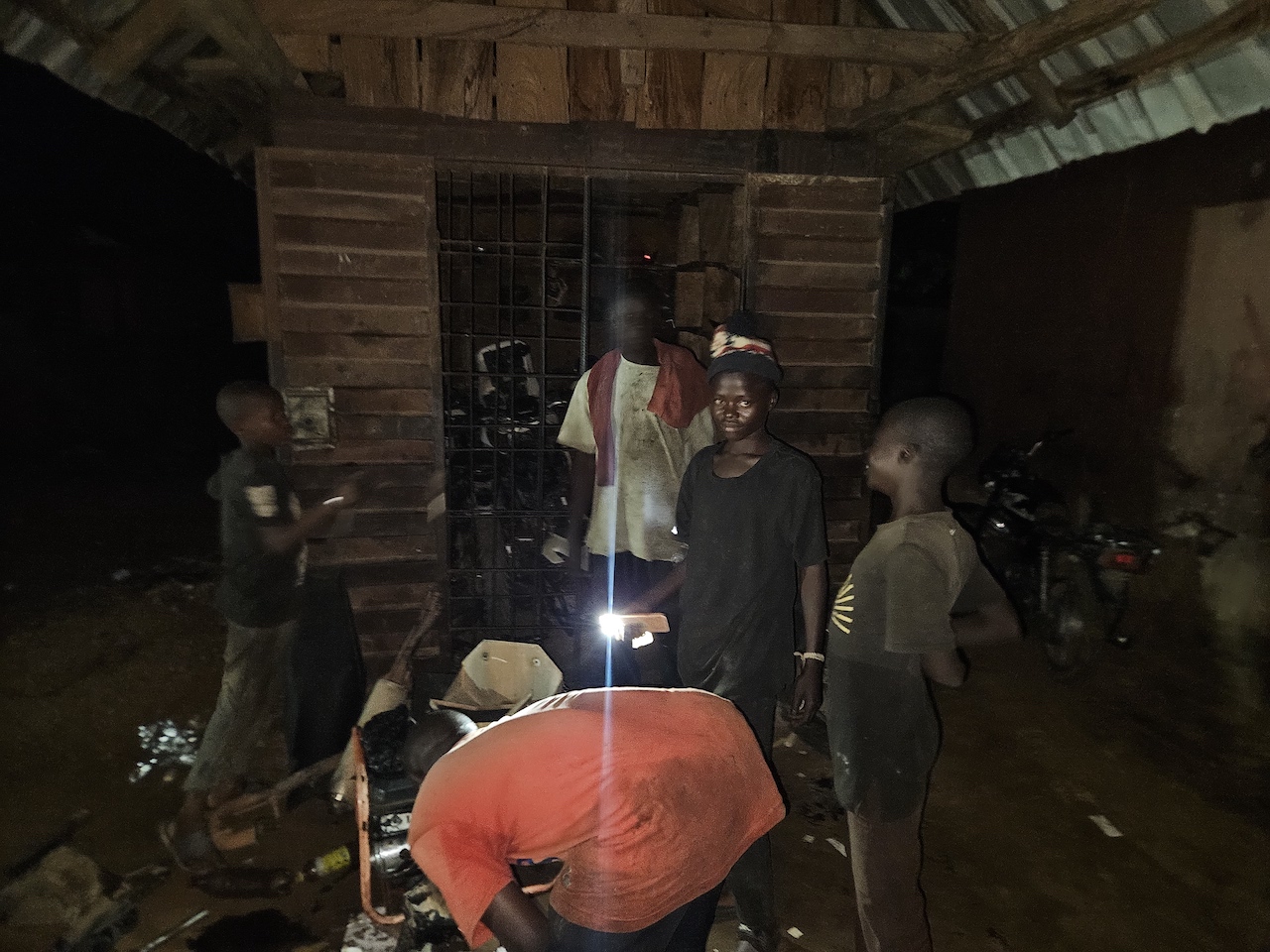
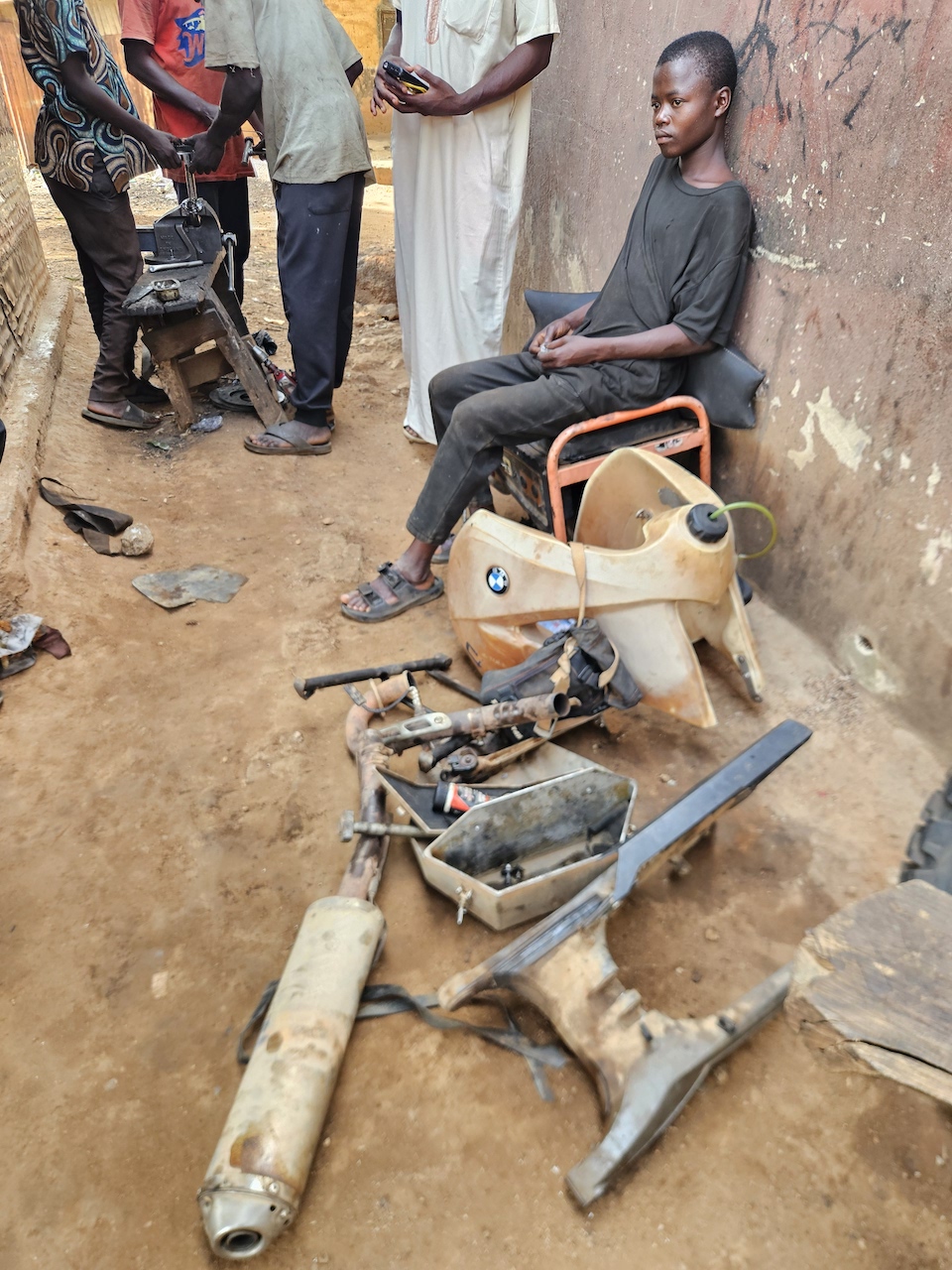
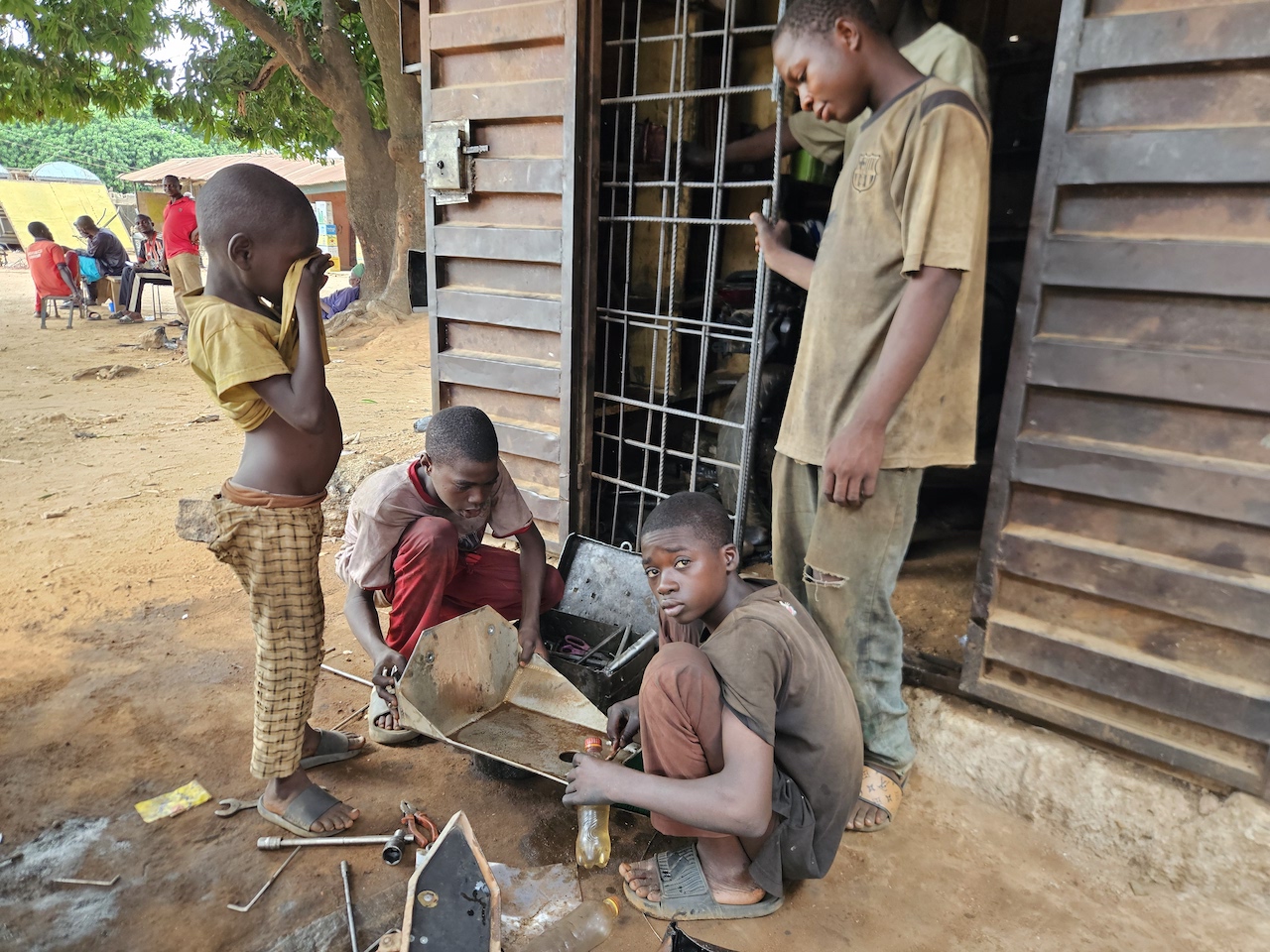
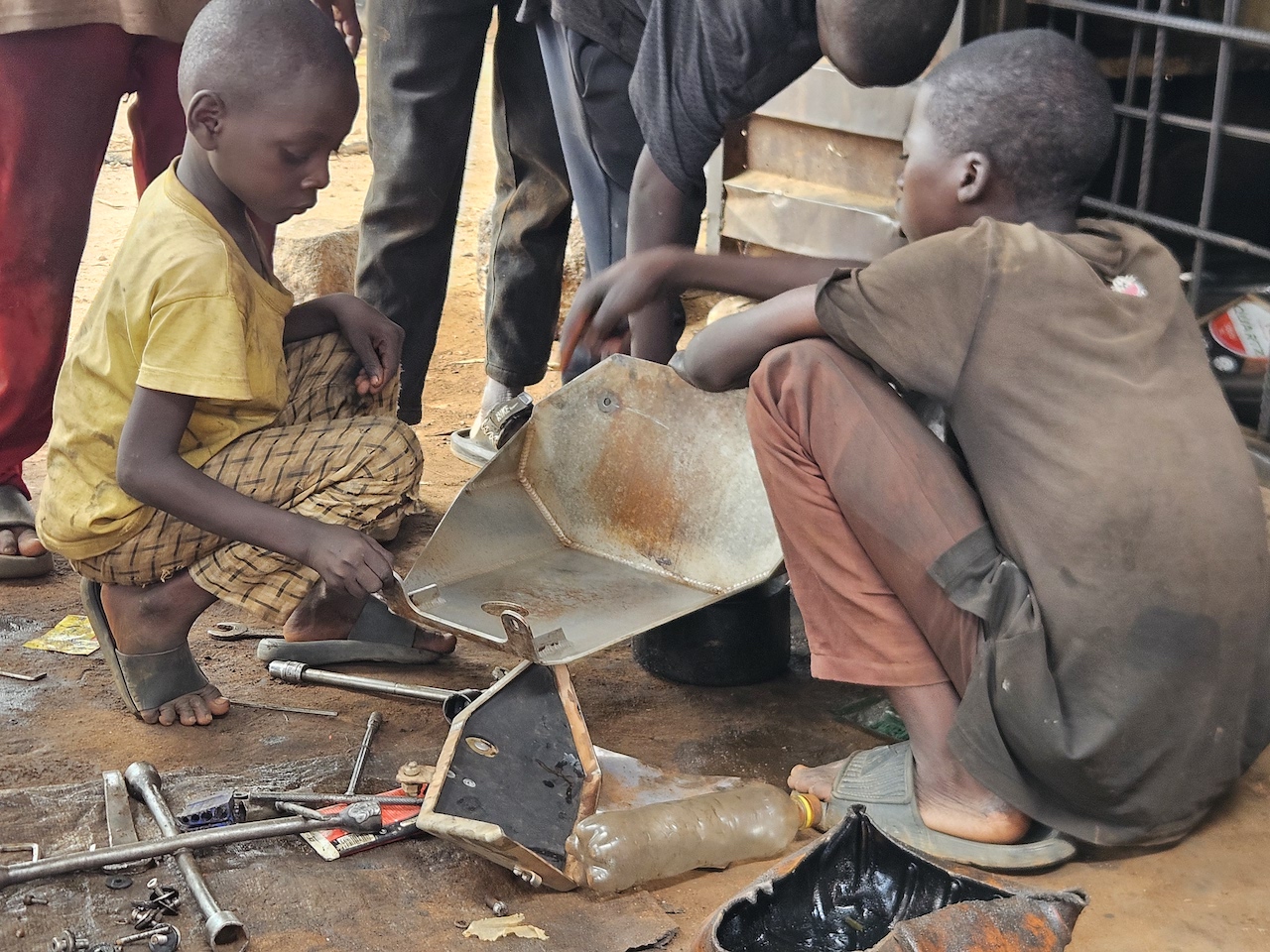
We head to his workshop: a small shipping container with a wooden awning built in front of it, all set on packed earth.
While Peter works on the bike, I chat with Abdou.
A little later, Peter joins us. He has checked the oil and, according to him, there is no problem.
Even so, I remain skeptical. The sludge I found the previous day could indeed be nothing more than residual water left inside the engine despite the oil change. On the other hand, replacing the water pump is a major undertaking, and it is best not to start such a job unless the diagnosis is certain.
We therefore decide to carry out another road test of about 40 km.
First, the motorcycle must be made roadworthy again: refill the cooling system with fresh coolant and top up the oil, since Peter drained a small amount to check whether water had settled at the bottom of the engine.
Once everything is ready, Abdou and I set off for a short ride.
Freed from its auxiliary fuel tank and luggage, the motorcycle feels like a toy.
Strangely, I have the impression that the engine is struggling a little.
When we return, the first observation is that there is no trace of sludge.
The second observation is that I added too much oil while topping up what Peter had drained.
That probably explains the strange sensations I felt from the engine.
So I remove the excess.
At this stage, it is decided that no further intervention is necessary.
Meanwhile, someone reassembles the bike and, with the help of an electrician friend, fixes two other minor issues I have been carrying for some time: the headlight (this is the fourth time I have tried to solve that problem) and the fuel reserve warning light, which stopped working a few days ago.
In the end, it has been a rather pleasant day. I am almost reassured regarding the possibility of a water pump failure.
One doubt remains, however: were forty kilometers enough to be certain? Especially since the excess oil may have prevented the sludge from reappearing.
I will probably know for sure tomorrow.
I now have another problem to solve: money.
I am running out of cash. ATMs refuse my card and, in any case, withdrawals are limited to 20,000 naira—about €13.
Tomorrow I will either try to exchange dollars at a bank or have money sent through Western Union.
PS
My friends burst out laughing when they saw everything I carry on the motorcycle: spare parts, tools, and so on!
The concept of “not spicy” is highly relative!
June 3, 2026 – Akwanga, Nigeria
Back in Akwanga for a mechanical operation I had been dreading somewhat: replacing the water pump.
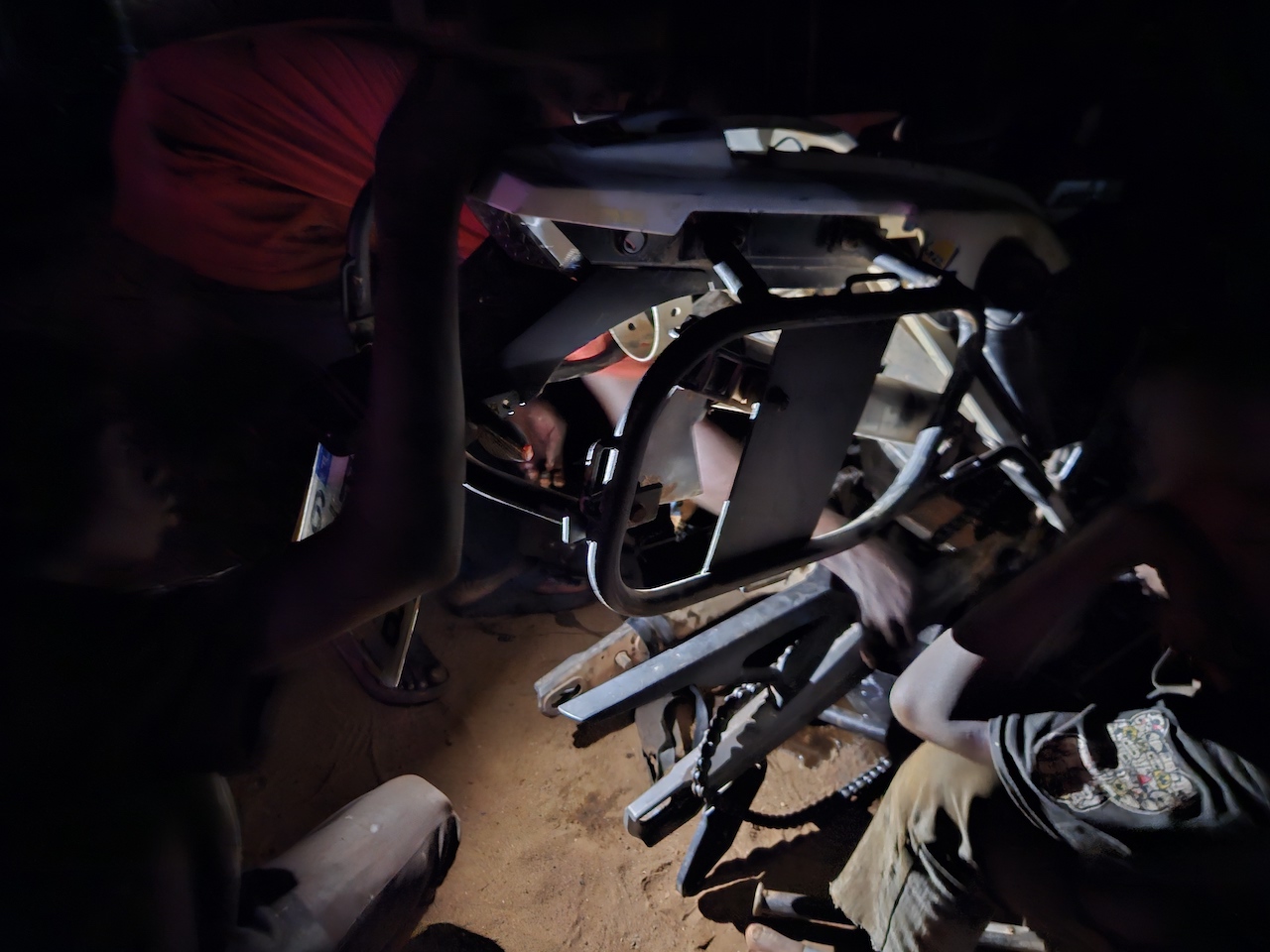
On this motorcycle, BMW had a brilliant idea: placing a bolt in such an inaccessible location that you have to dismantle nearly half the machine to reach it. Swingarm included.
Considering everything the bike has been through over the years, I was worried about the condition of the pivot shafts and whether everything could be disassembled without breaking anything. At one point, watching Peter struggle with the swingarm, I started sweating a little.
Fortunately, he is very good. Everything came apart without damage.
I provide the water pump I have been carrying for months “just in case.” As is often the case when traveling, the famous “just in case” item eventually proves useful (well, some more than others… I have been carrying a spare voltage regulator for years, and I still haven’t needed it).
After several hours of dismantling and reassembly, night falls. The motorcycle spends the night in Peter’s little sheet-metal workshop, and he resumes work the following morning.
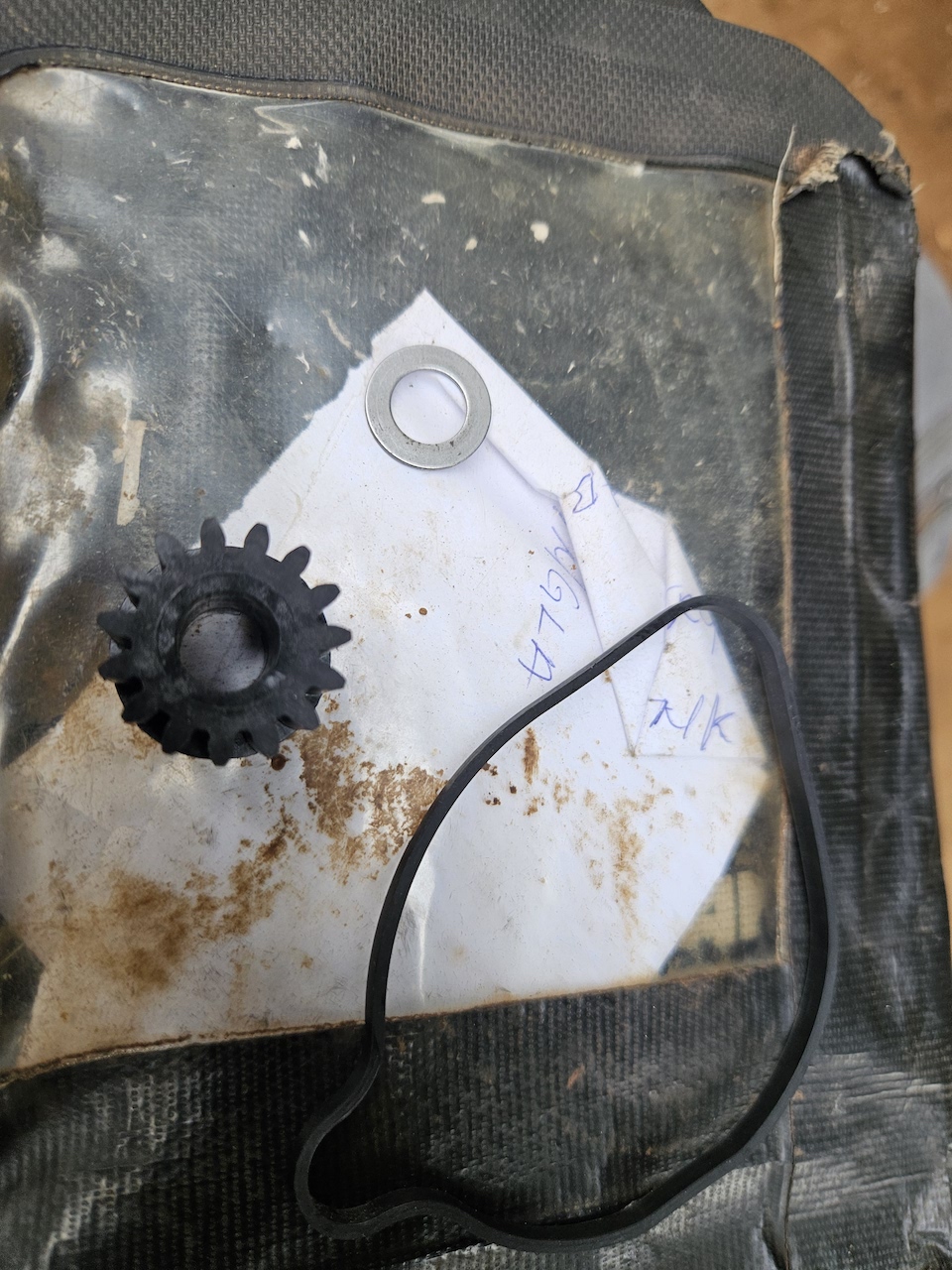
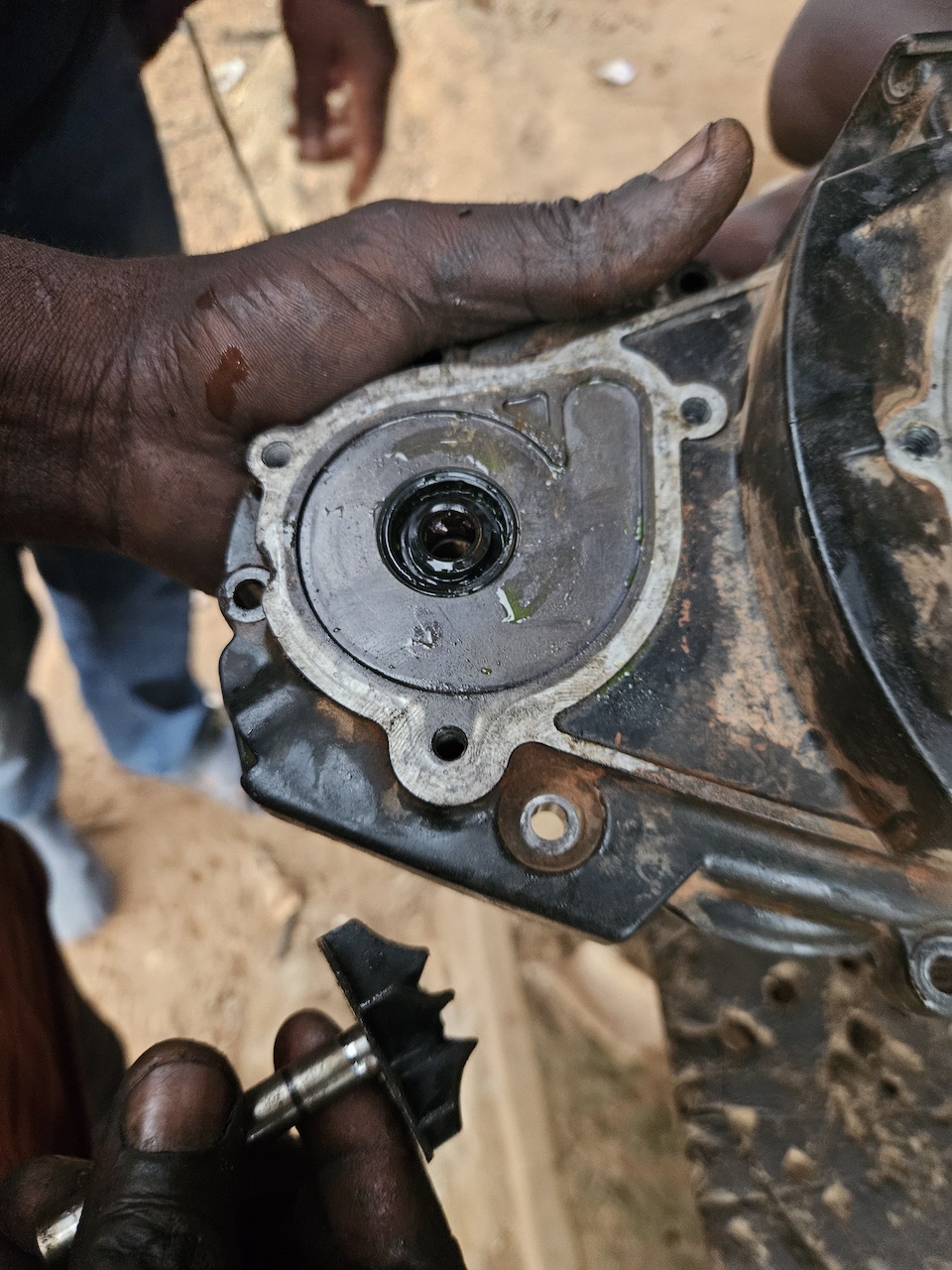
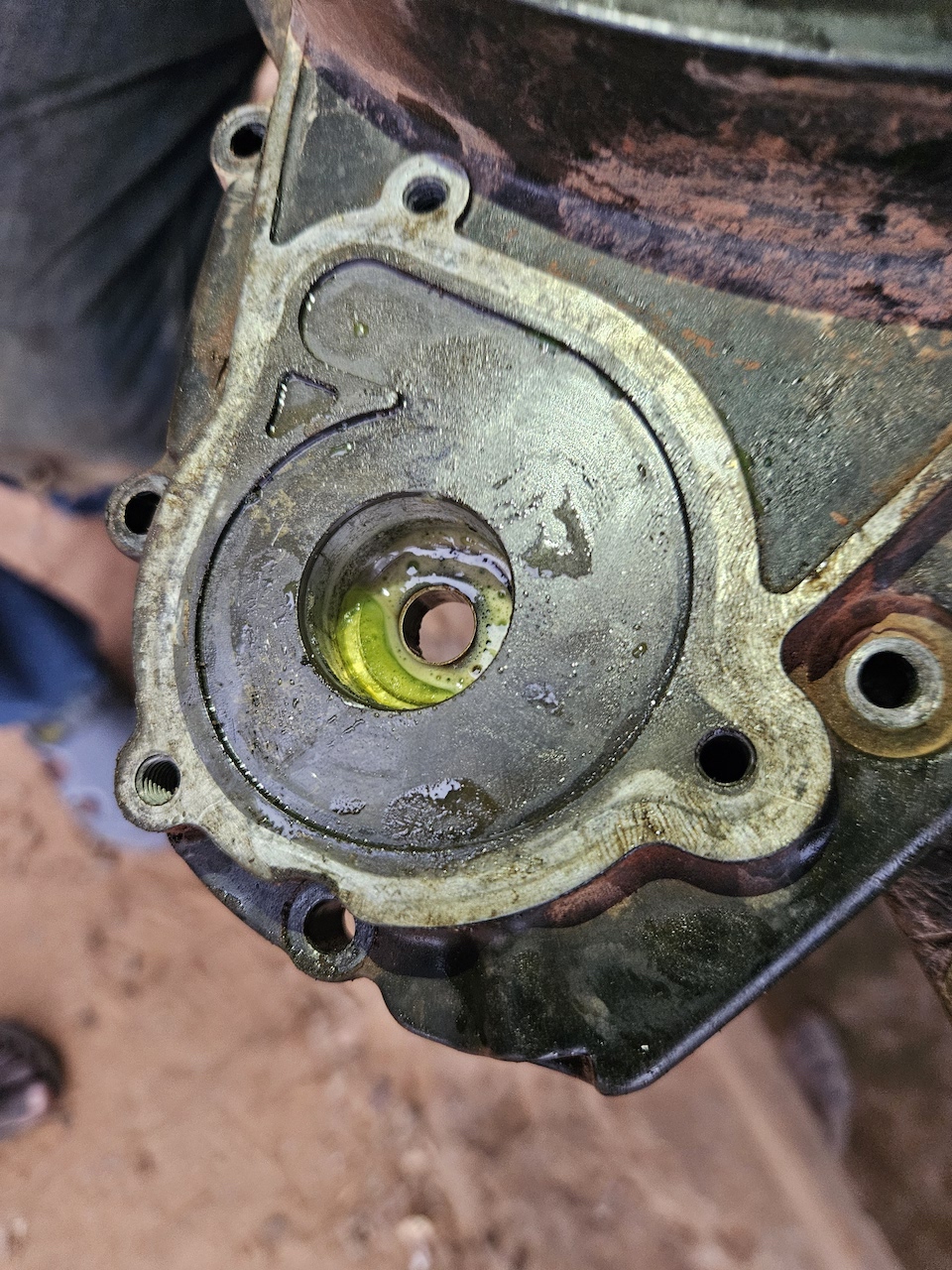
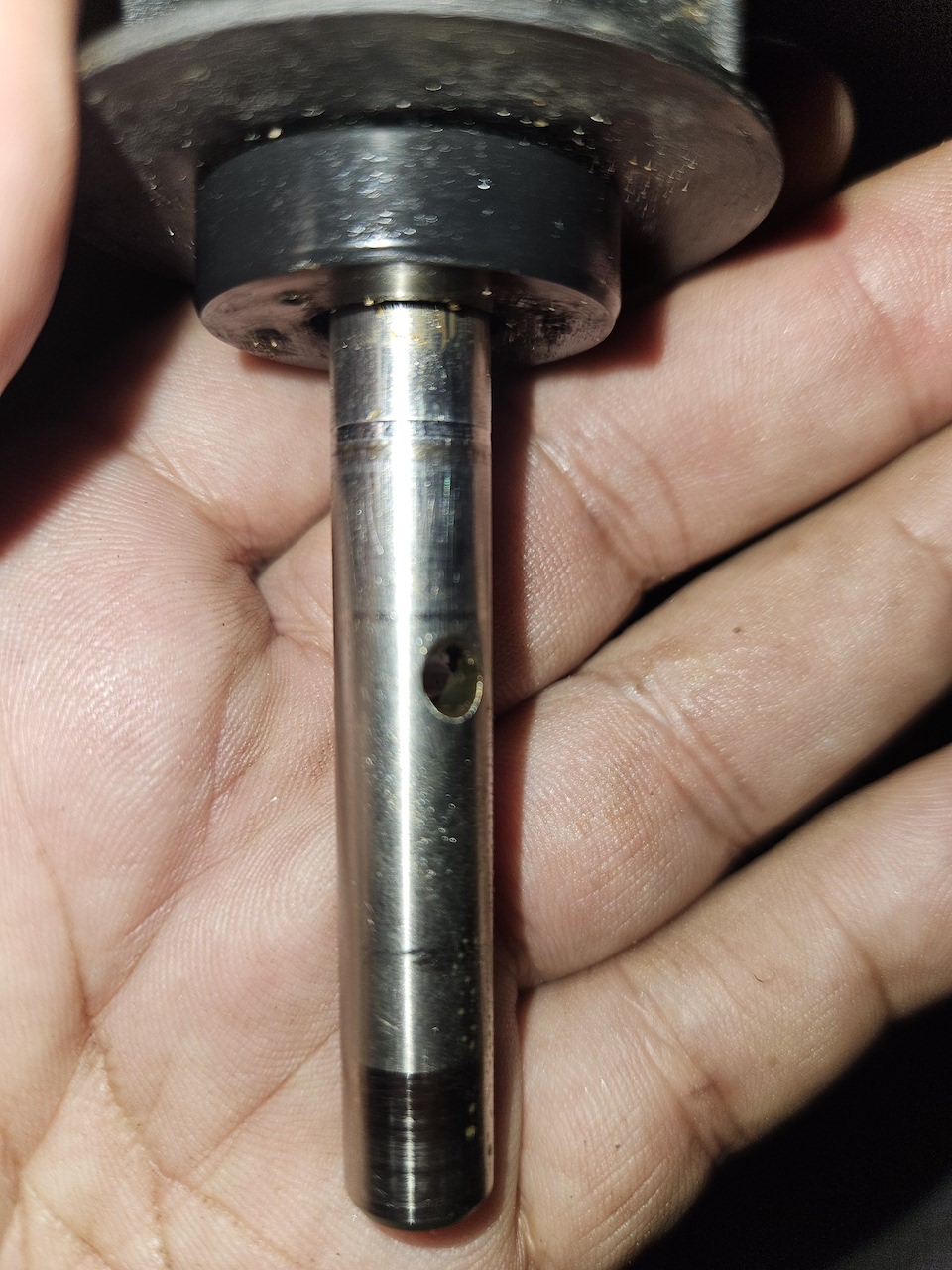
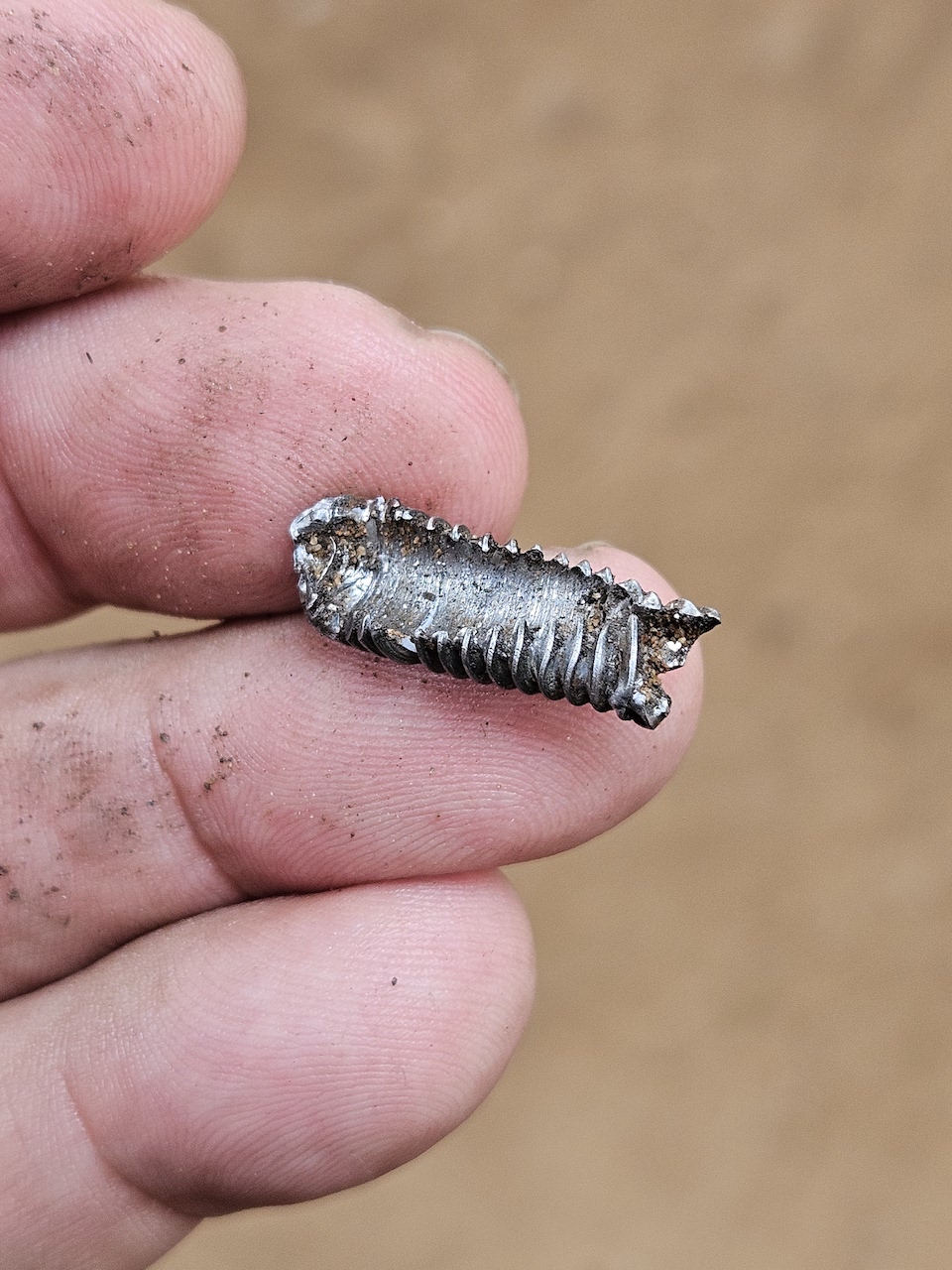
Meanwhile, friends familiar with this engine point out an important detail: a small drainage hole (weep hole) located between the two pump seals must remain completely unobstructed.
I pass the information on to Peter, who agrees to dismantle everything again to check.
And then we discover that one of the seals partially covers the hole.
While I check the specifications and try to gather more information, Peter disappears.
A rather lonely moment.
I start imagining all sorts of modifications.
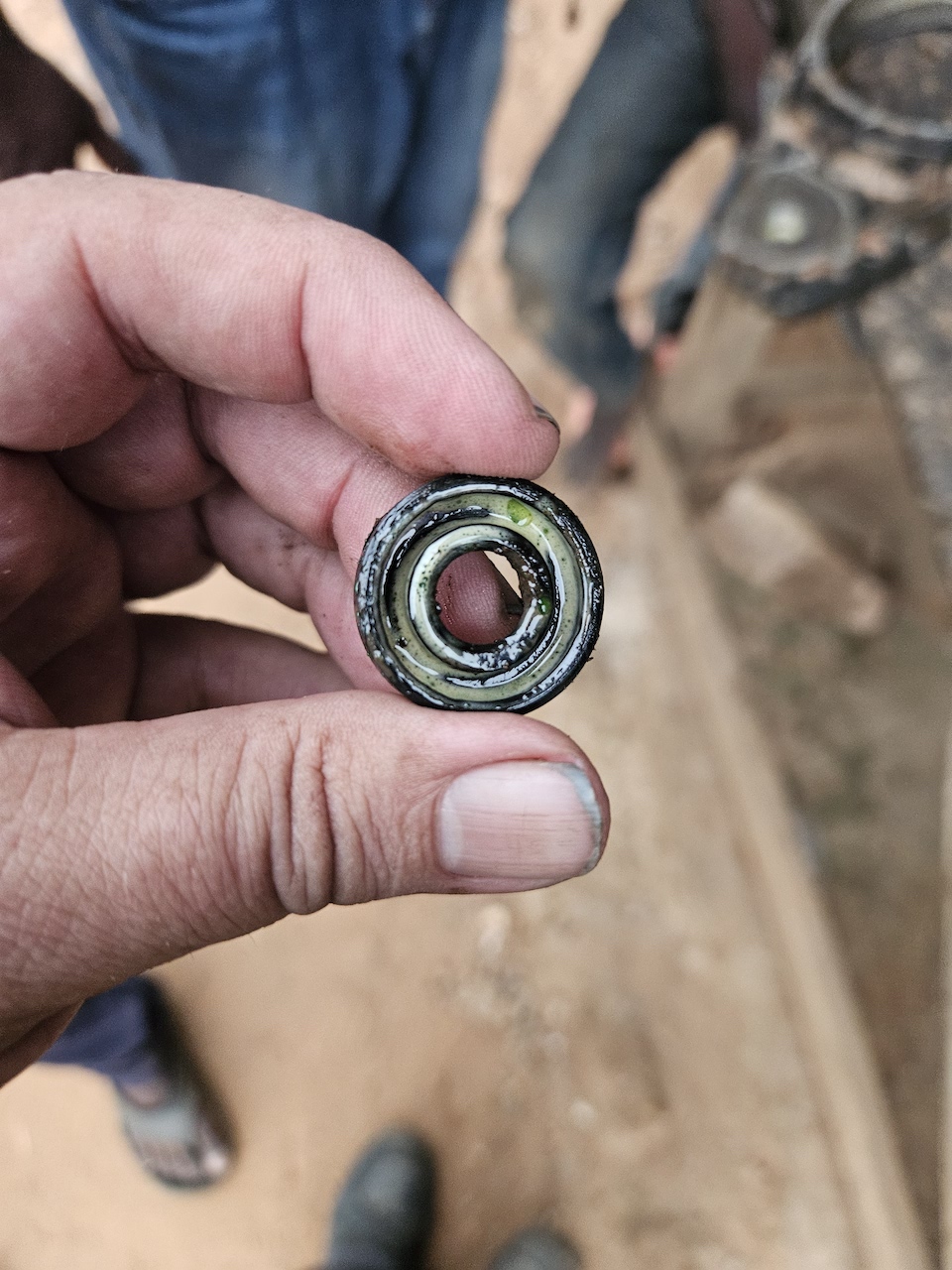
That is indeed what he has done: he slightly reduced the thickness of the seal without touching the sealing lip itself.
I must admit I am only half convinced by this modification, but friends who know mechanics better than I do tell me it should be fine as long as the lip itself has not been altered.
That reassures me somewhat, but I still order a new set of seals, which Laurie’s mother will bring to Namibia in a few days. At least I will be able to replace them if necessary.
For now, once reassembled, the hole is perfectly positioned.
Abdou and I go for a first 40 km test ride.
The test is successful.
I decide to carry out a longer test (100 km) the following day, at a faster pace.
No issues at all.
For the first time in a while, I begin to breathe easier.
I then take the motorcycle to be washed so that any traces of oil are removed and any new leak can be easily detected.
The official price is about €0.60.
The young man handling the wash tries his luck by asking for three times that amount. In the end, we reach a compromise that satisfies both of us.
While the bike is being washed, I chat with another customer, a 72-year-old retired civil engineer.
Honestly, I would have guessed him ten or fifteen years younger.
At one point, a man with his arm in a sling comes over and speaks to him in Hausa.
After he leaves, my companion explains that the man was wounded by gunfire during an attack by highway bandits.
That is also Nigeria: very calm and welcoming regions, peaceful countryside, and then stories that remind you some areas remain complicated despite a strong police presence.
PS
The repair carried out by Peter cost €40 for nearly two full days of work.
I added a generous tip.
June 6, 2026 – Akwanga / Makurdi – Nigeria
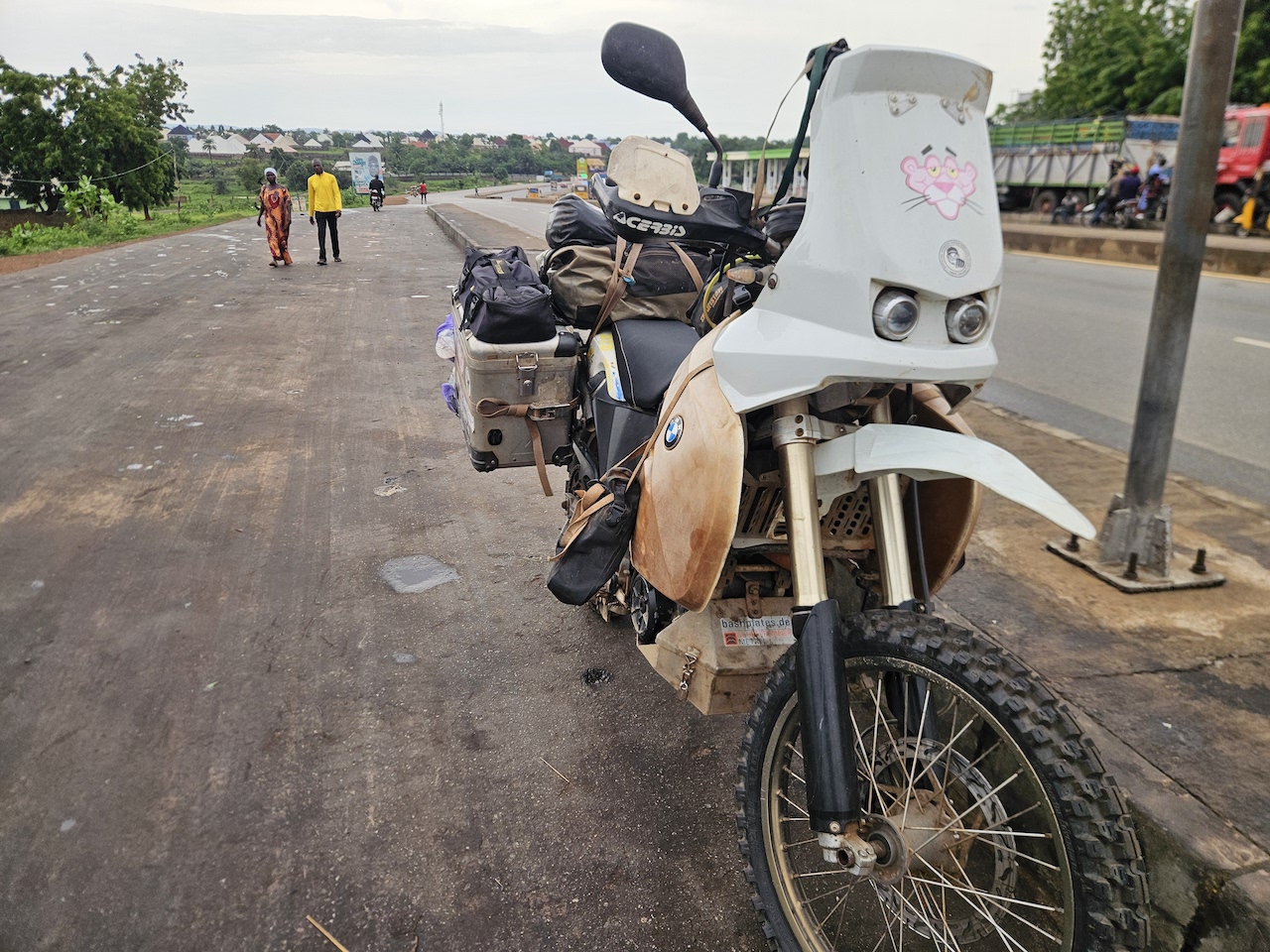
After the mechanical issues of the previous days, I decide to play it safe. The goal for today is simple: a short stage of about 160 km to Makurdi so that I can once again check the oil level.
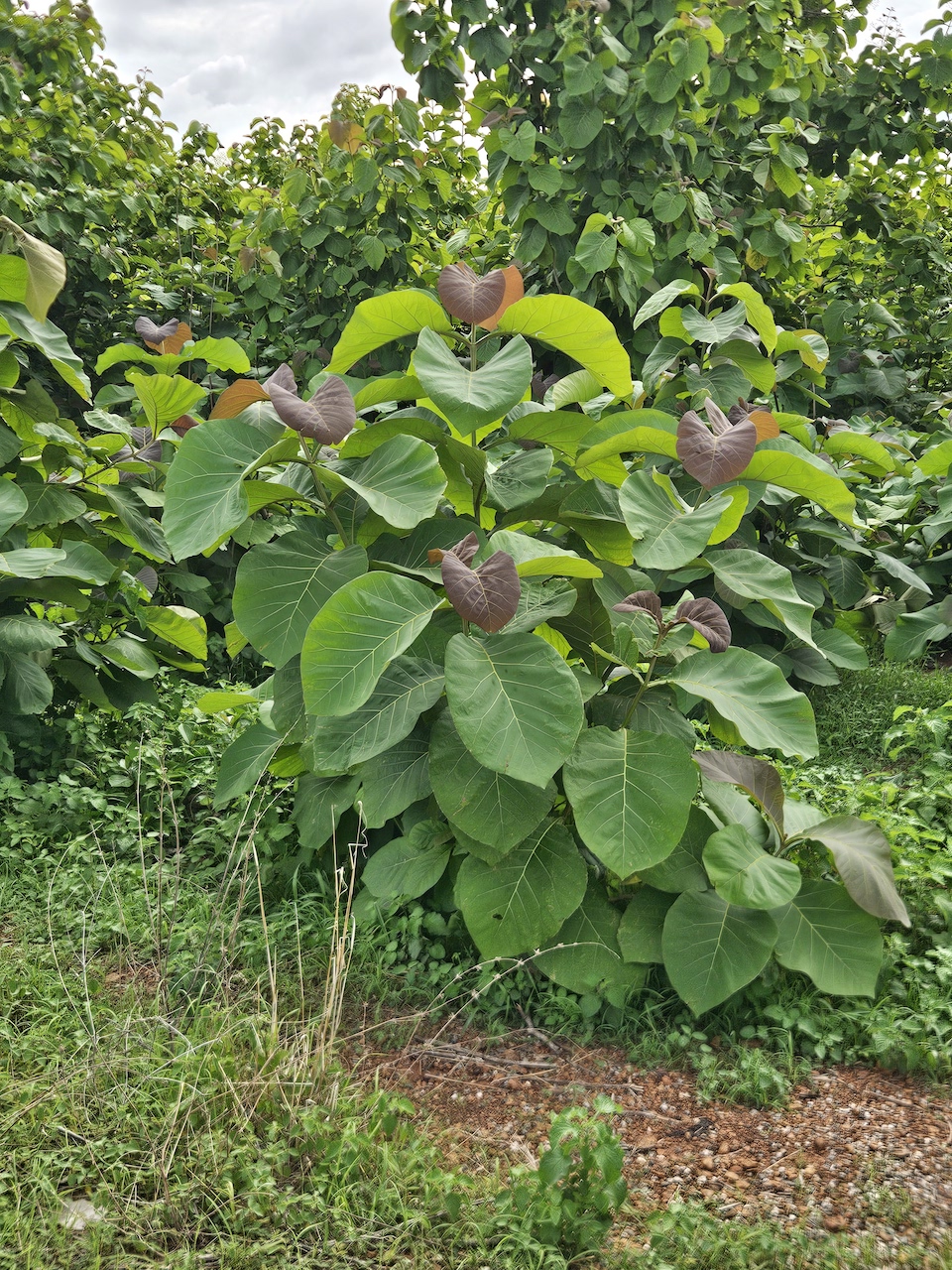
The road crosses particularly lush countryside. Mile after mile, fields, teak plantations, piles of charcoal by the roadside, mango trees, and cashew trees follow one another. The housing is just as varied. Without warning, you pass from rectangular houses with galvanized metal roofs to more traditional African huts. Two worlds often coexisting in the same village.
The atmosphere is peaceful—almost too peaceful at times. A calm that feels somewhat deceptive when you know that certain regions of Nigeria still face security issues.
This reality regularly reminds travelers of its presence: checkpoint after checkpoint lines the road. Police, anti-drug units, military personnel… I lose count. Several times I also pass armored vehicles topped with machine guns.
Yet the inspections always take place in a relaxed atmosphere. As often happens, curiosity quickly takes precedence over administrative checks. Questions about the journey, conversations, photos, and a few selfies later, I am back on the road.
I arrive in Makurdi in mid-afternoon.
My first instinct is to check the oil.
Everything is perfect.
At last, I can breathe again.
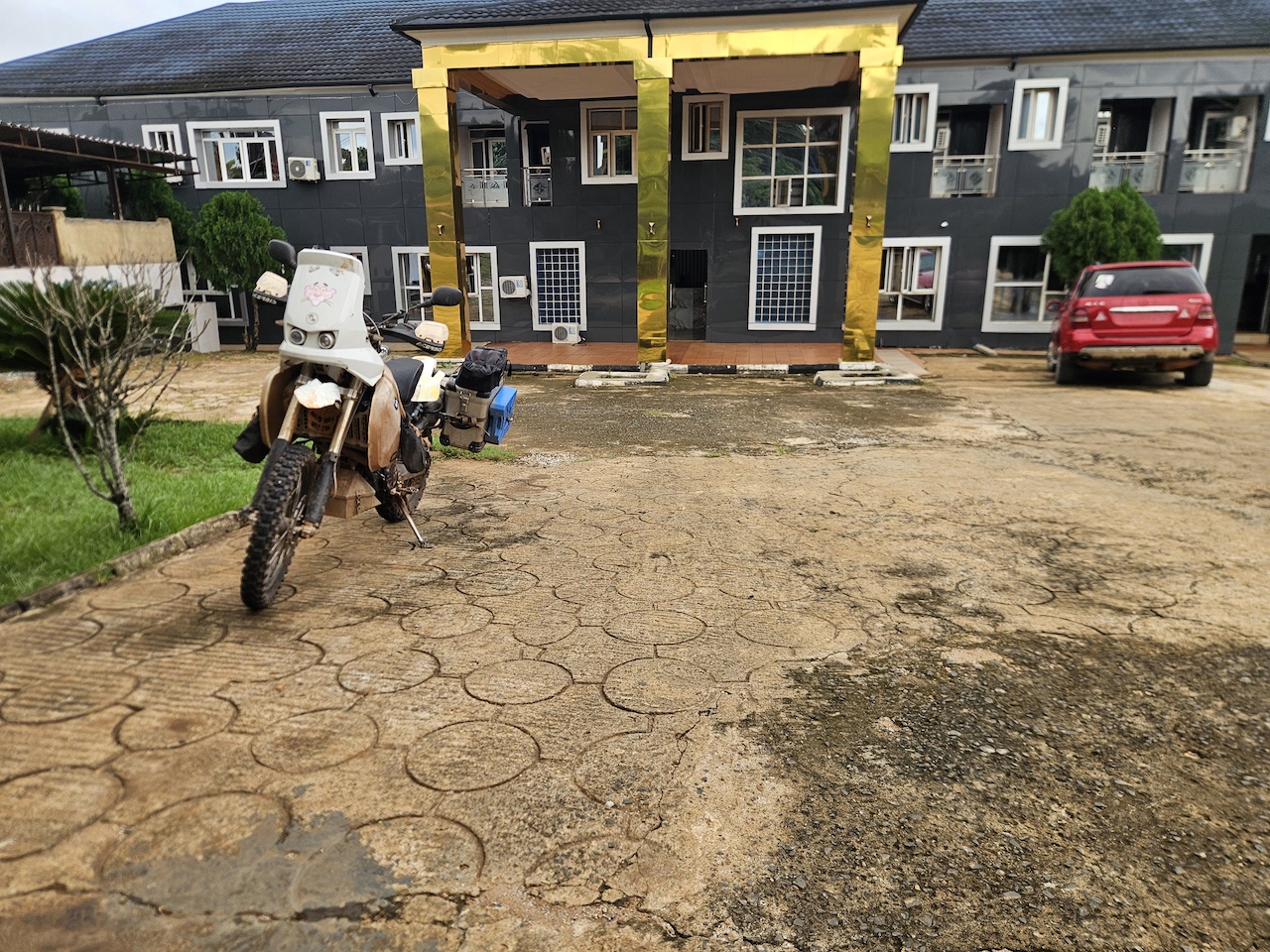
For the night, I settle into the Rwanda Hotel. The initial price is 37,000 naira. After some negotiation, we agree on 30,000 (about €20).
That is more than my usual budget, but sometimes the motivation to keep looking for another hotel simply isn’t there.
Still, I can’t wait to start wild camping again. Even though hotels in Nigeria generally cost around €10, they put a noticeable dent in my usual budget.
June 7, 2026 – Makurdi / Ikom (Cameroon Border) – Nigeria
Today’s objective is to reach the town of Ikom, about thirty kilometers from the Cameroonian border.
Roughly 260 km are on the agenda, including a section that is supposed to be dirt road.
The first kilometers are uneventful. A few roadworks, some traffic, nothing too serious.
Then I reach Aliade, where I have two options: to the right, a major detour but paved roads; to the left, about fifty kilometers of dirt track.
As I hesitate, several locals come over and ask where I am heading.
“Oju.”
They immediately point left.
“The road is new!”
At the moment, I strongly prefer asphalt. The rainy season has started, and I am also trying to make up time in order to keep a comfortable margin before my DRC visa expires.
Convinced, I take the famous “new” road.
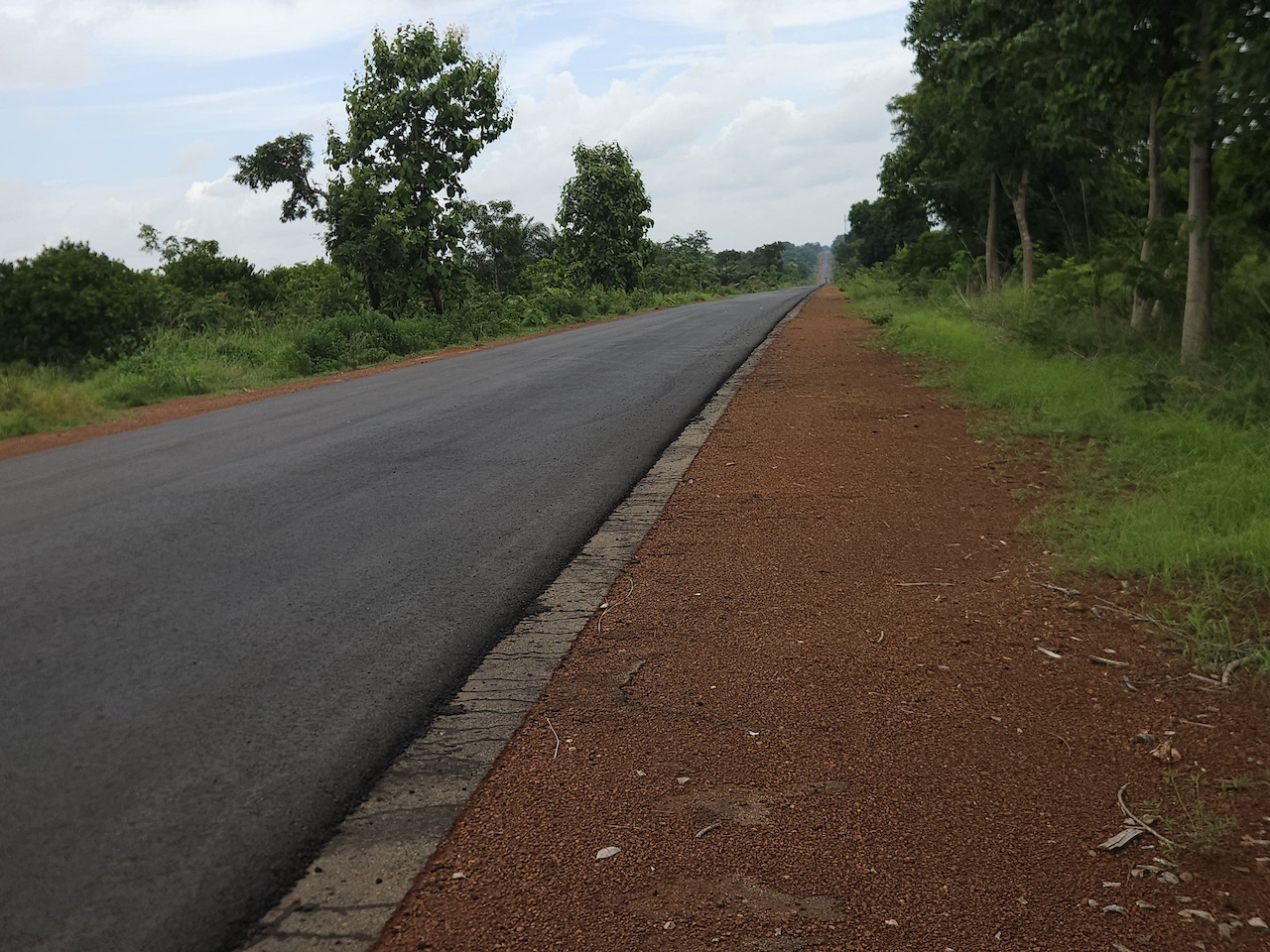
Indeed, for about twenty kilometers it is perfect. A billiard table.
Then the asphalt disappears.
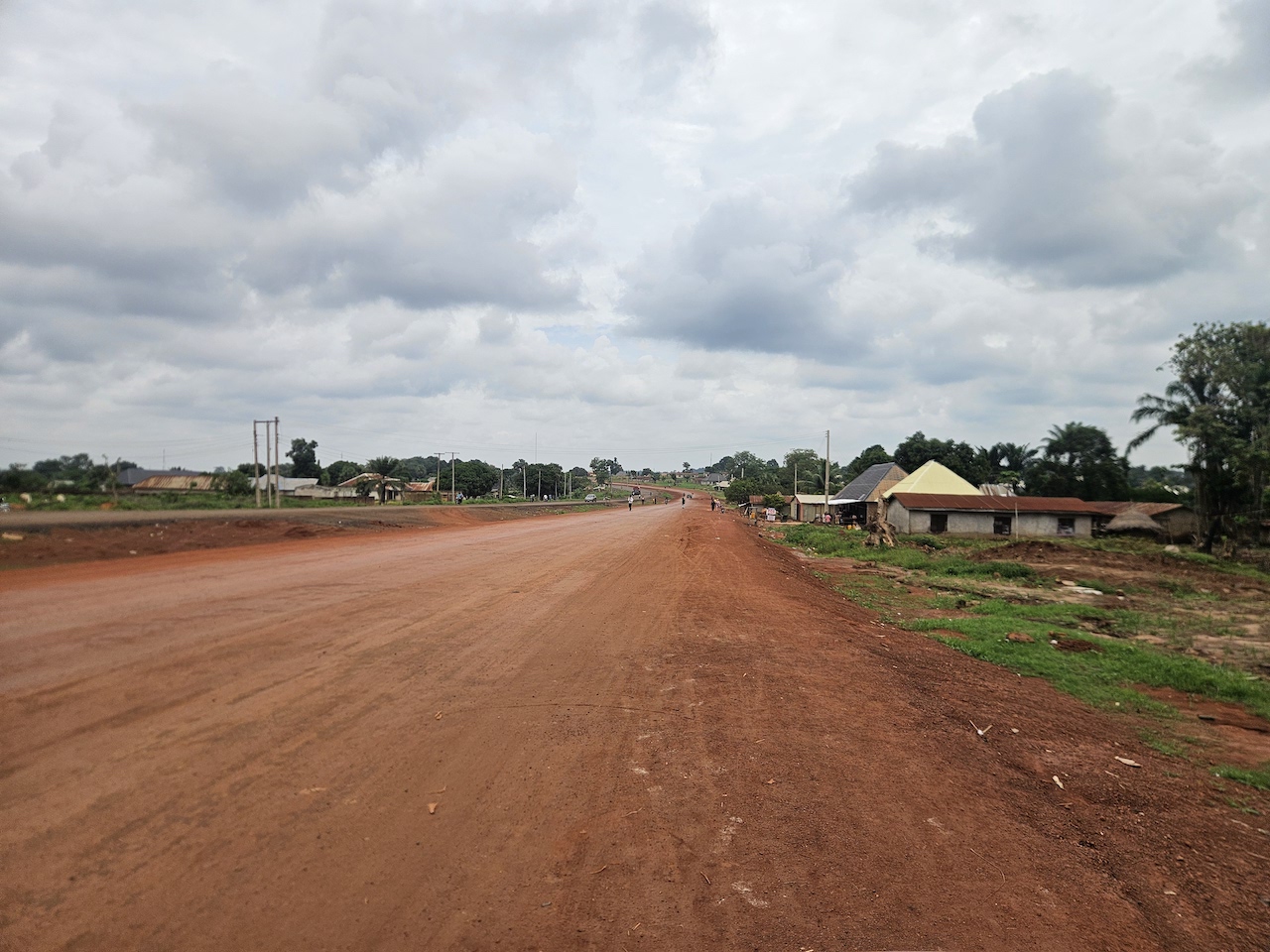
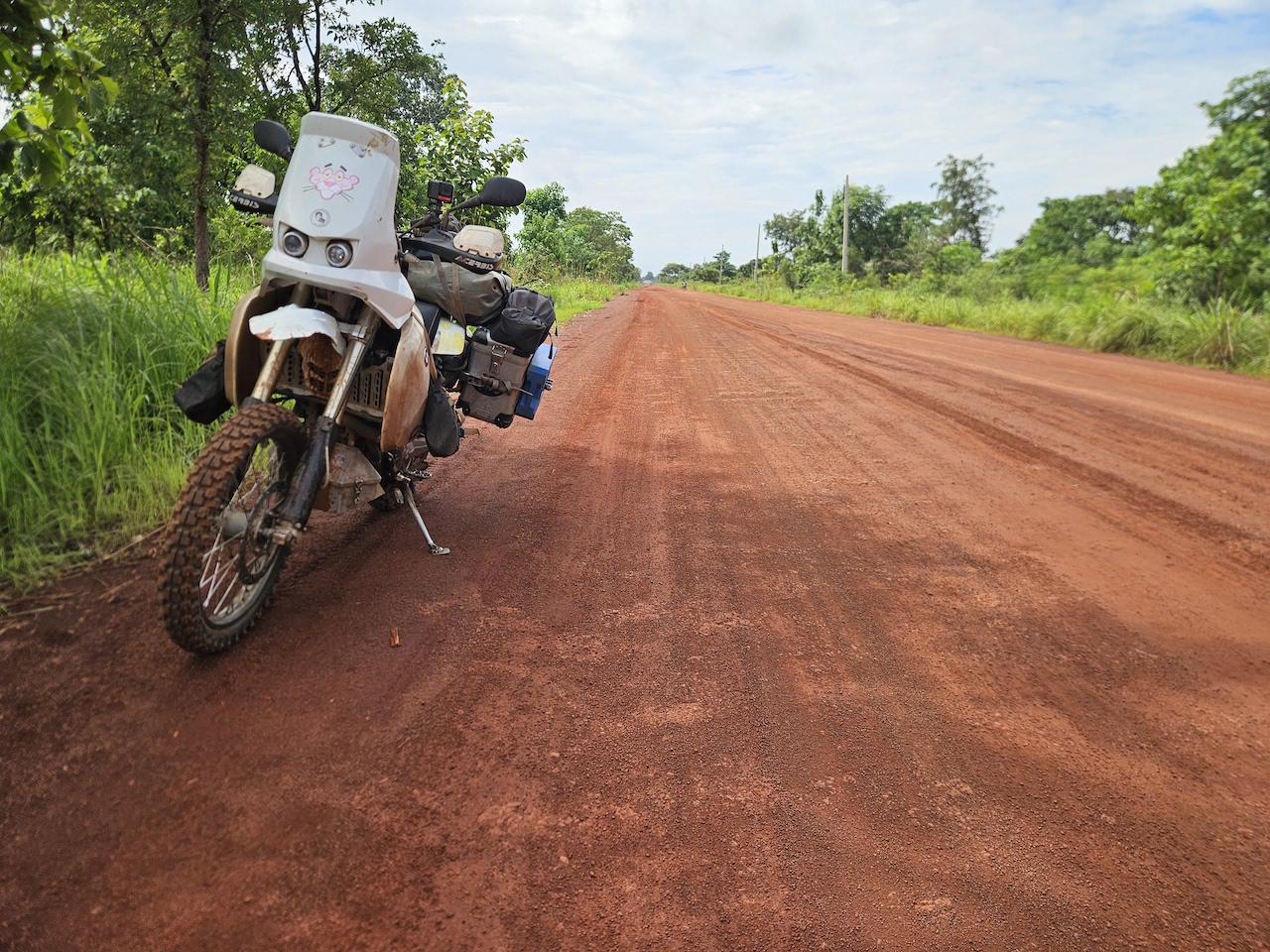
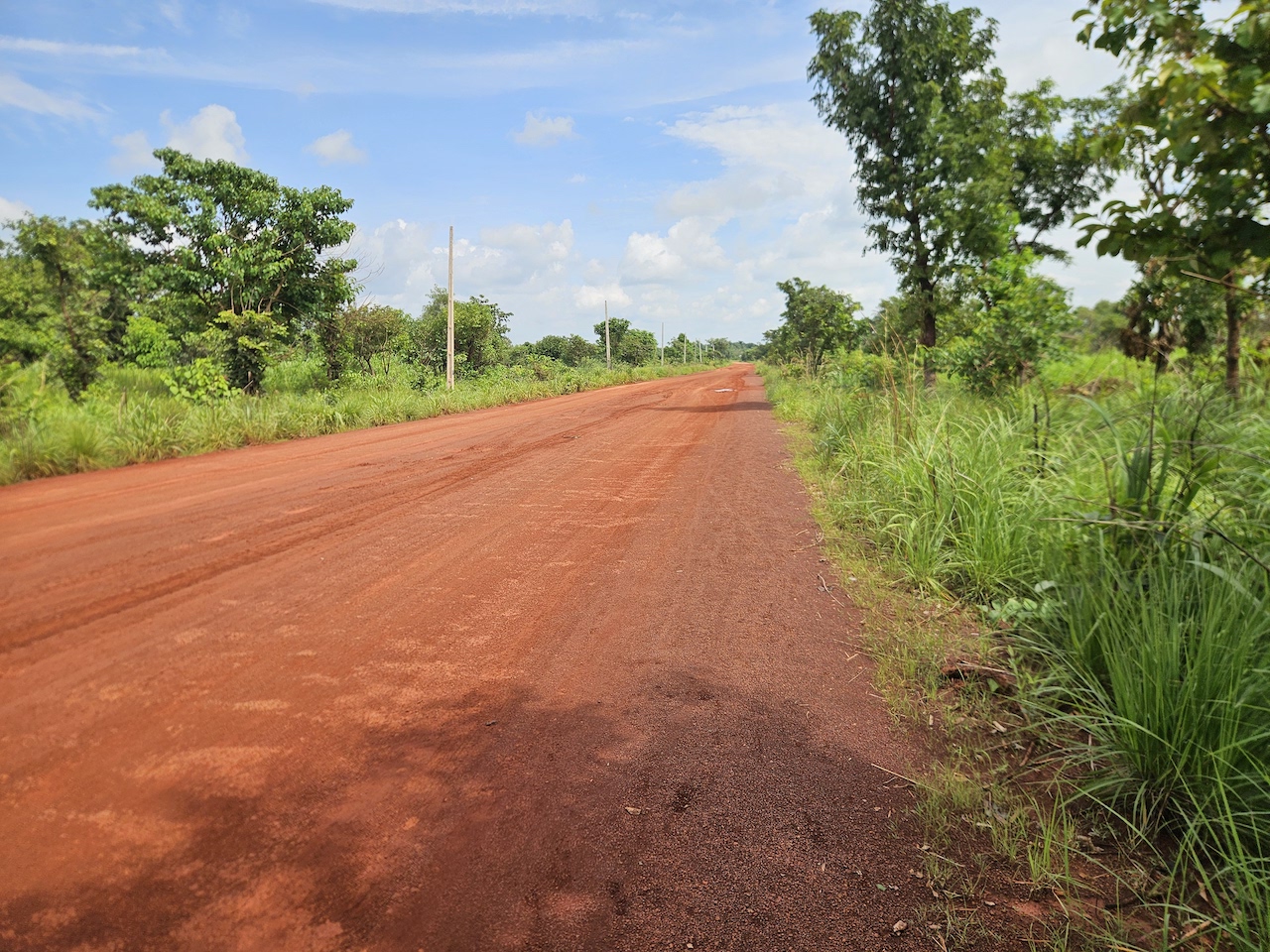
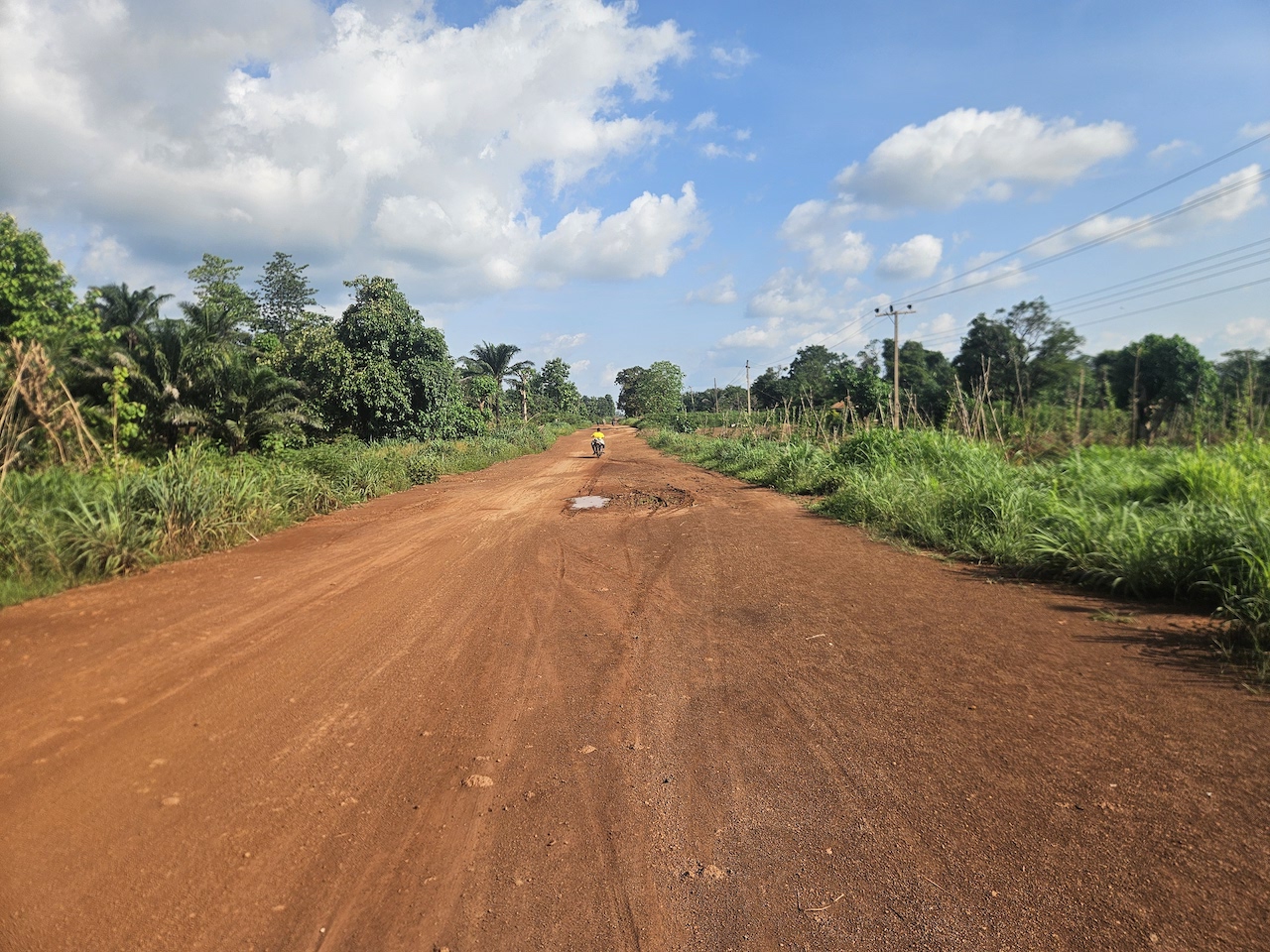
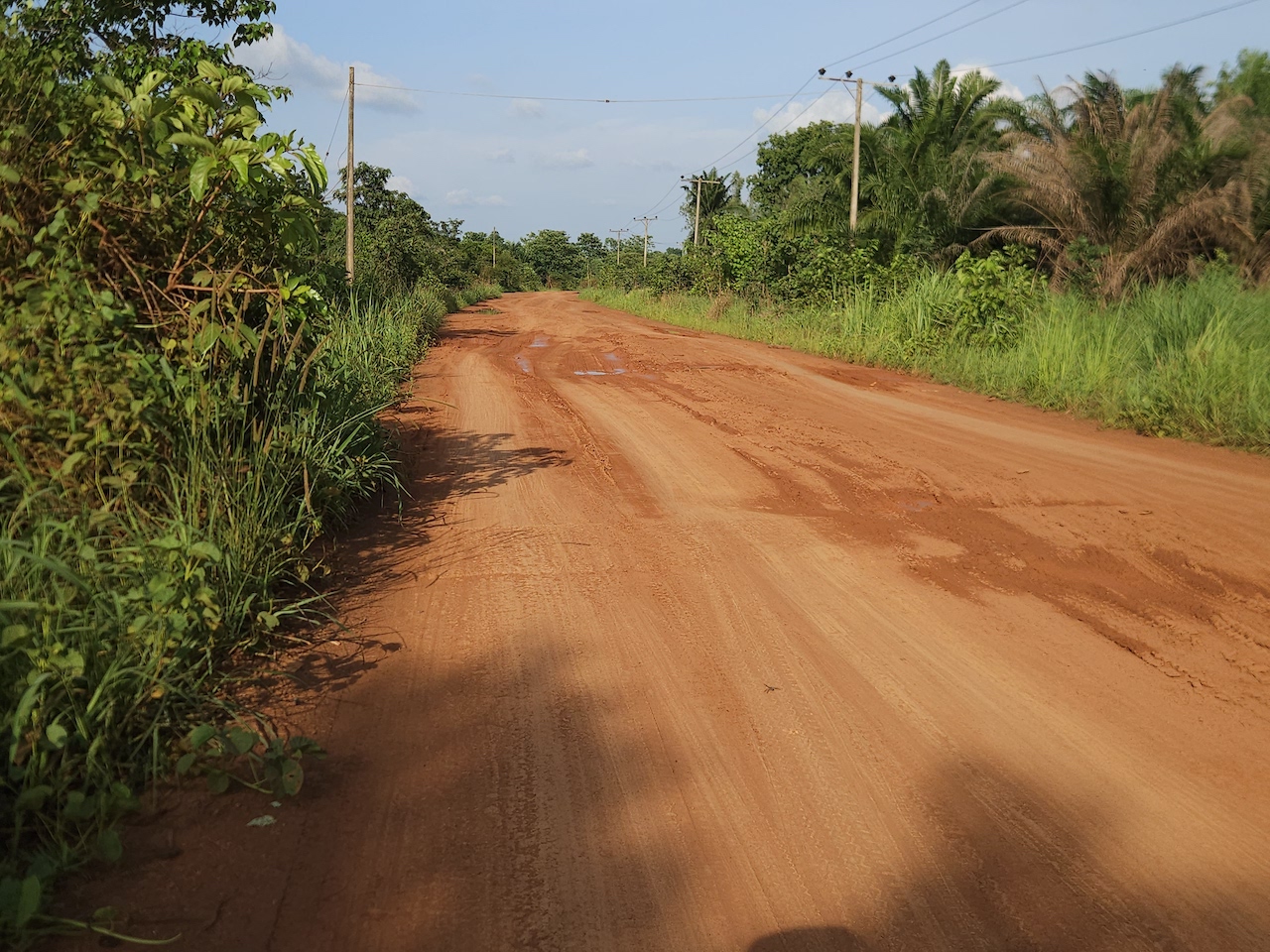
Welcome to laterite.
At first, the track is wide and easy. Then come the gullies, truck ruts, and a few rougher sections.
Fortunately, the terrain is relatively dry and muddy sections remain limited.
The track is not particularly difficult, but my overinflated tires—ever since my rim problem—make things more complicated. The bike feels heavy and clumsy.
I stop and adjust the tire pressures.
While I am busy around the motorcycle, several villagers stop to check whether everything is all right and offer their help.
The atmosphere is relaxed.
As the kilometers pass, mosques gradually give way to churches, and the people seem far less suspicious than in some regions I crossed earlier.
I do not know whether there is a direct connection. It is true that the terrorist groups operating in the north claim an Islamic affiliation, unfortunately. The same old problem: a handful of idiots casting a shadow over everyone else.
I lower the tire pressure to 2 bars.
The effect is immediate: the bike becomes agile and enjoyable again.
The only problem is that I thought the asphalt would return after fifty kilometers.
Apparently, nobody informed the road.
The track continues, and continues, all the way to Yala (Lyahe).
I finally arrive there in the evening and find a small room for 10,000 naira, about €5 or €6.
Simple, but more than adequate after a dusty day.
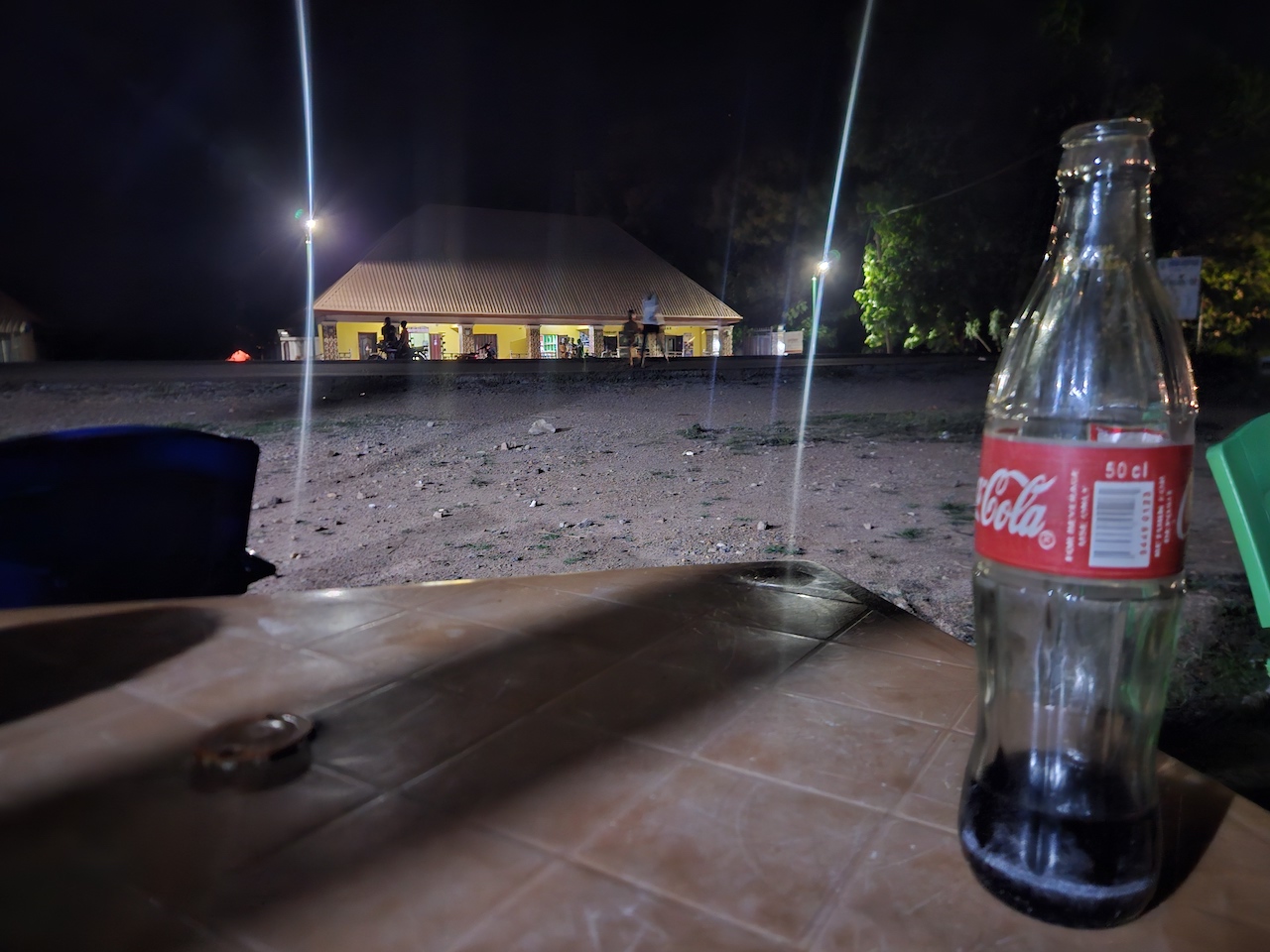
That evening, I cross the road to eat at a makeshift restaurant.
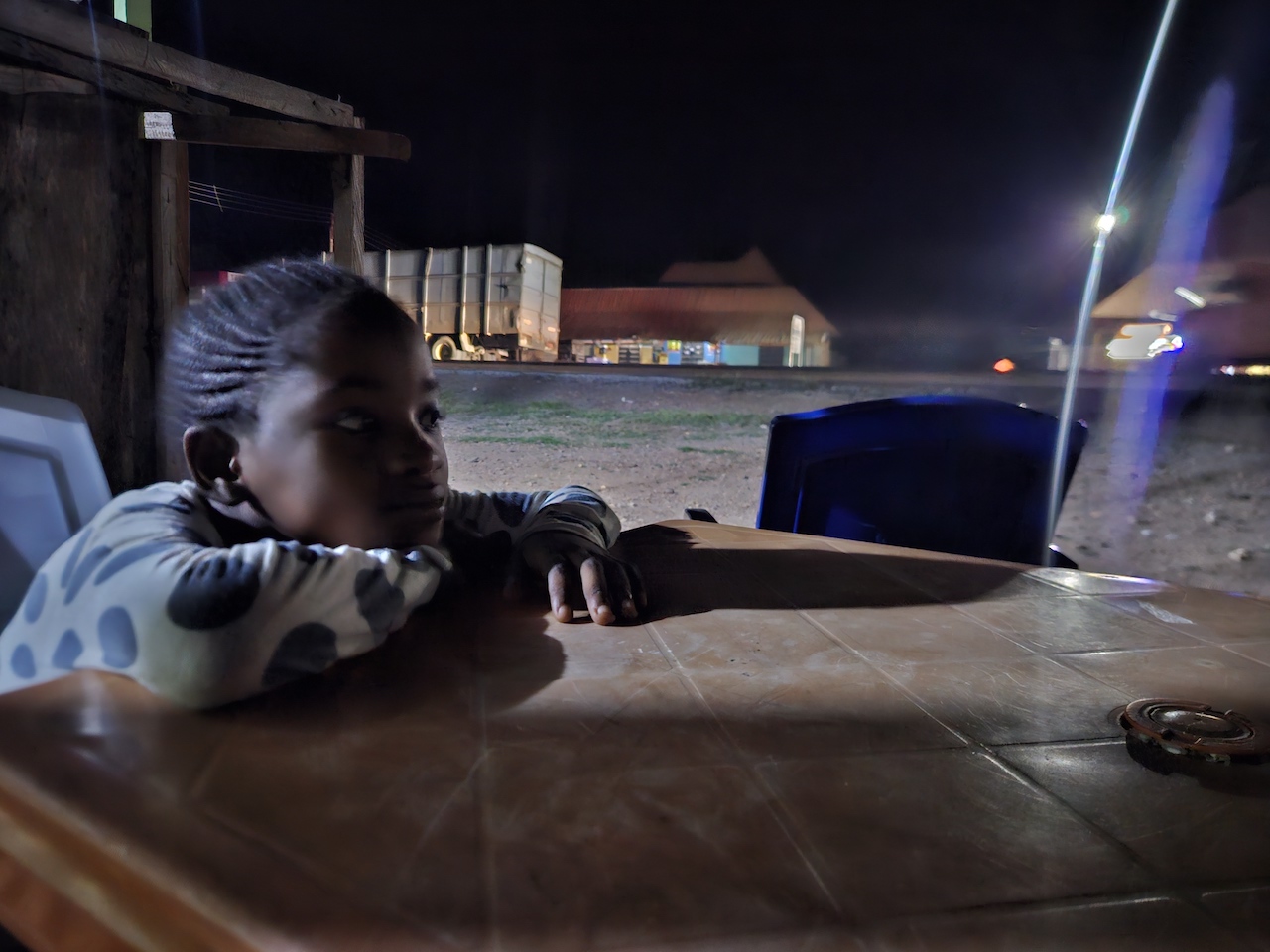
Three children run the place.
The oldest cannot be more than ten years old. The young waitress, Stella, is probably eight.
All of them are extremely serious about their work, like true professionals.
My meal costs 3,500 naira with a Coke (just over €2).
In the end, I leave a 4,000-naira tip.
A little later that evening, someone knocks on my door.
It is the children’s mother.
She came all the way to my room simply to thank me for the tip I left for her children.
June 8, 2026 – Ikom / Ekok – Attempt No. 1
I leave my hotel in the morning with about 120 km to cover before reaching the Cameroonian border.
A formality, I thought.
On the road, I encounter several rather surreal livestock trucks.
The trailers are packed with cattle right up to the last available centimeter.
But apparently that is not enough.
A rack has been built on the roof with railings, and more cows are tied up there, lying down.
And among the cows are human passengers.
When people talk about transport optimization, some are clearly playing in a different league.
The road on the Nigerian side is excellent: new, flowing, and passing through beautiful scenery.
At the border, the procedures unfold smoothly.
First checkpoint, second checkpoint, third checkpoint…
Until an officer notices that I have my Cameroonian e-visa, but not the famous sticker placed inside the passport.
I explain that a Cameroonian contact assured me that it would not be a problem.
The Nigerians decide to verify before officially allowing me to leave the country.
Which makes sense: once the exit stamp is placed in the passport, there is no going back.
A few minutes later, I find myself riding behind a Nigerian officer toward Cameroon.
We cross a magnificent border bridge and arrive at the Cameroonian immigration office.
The officer is friendly.
Very friendly, in fact.
Then he tells me exactly the same thing:
“No sticker, no entry.”
I explain that the printer at the Cameroonian consulate in Abuja is broken.
He replies that I will therefore have to go to Calabar to obtain the precious sticker.
A 500 km round trip.
While he phones his superiors, I try to reach my contact.
Unfortunately, the categorical refusal arrives before they even have a chance to speak.
When they finally do talk, they discover they belong to the same ethnic group.
Between military personnel and members of the same community, I begin to seriously believe the situation is about to be resolved.
But it is already too late.
When the boss says no, the boss says no.
My contact then tries to involve a colonel.
Failure.
Back to square one.
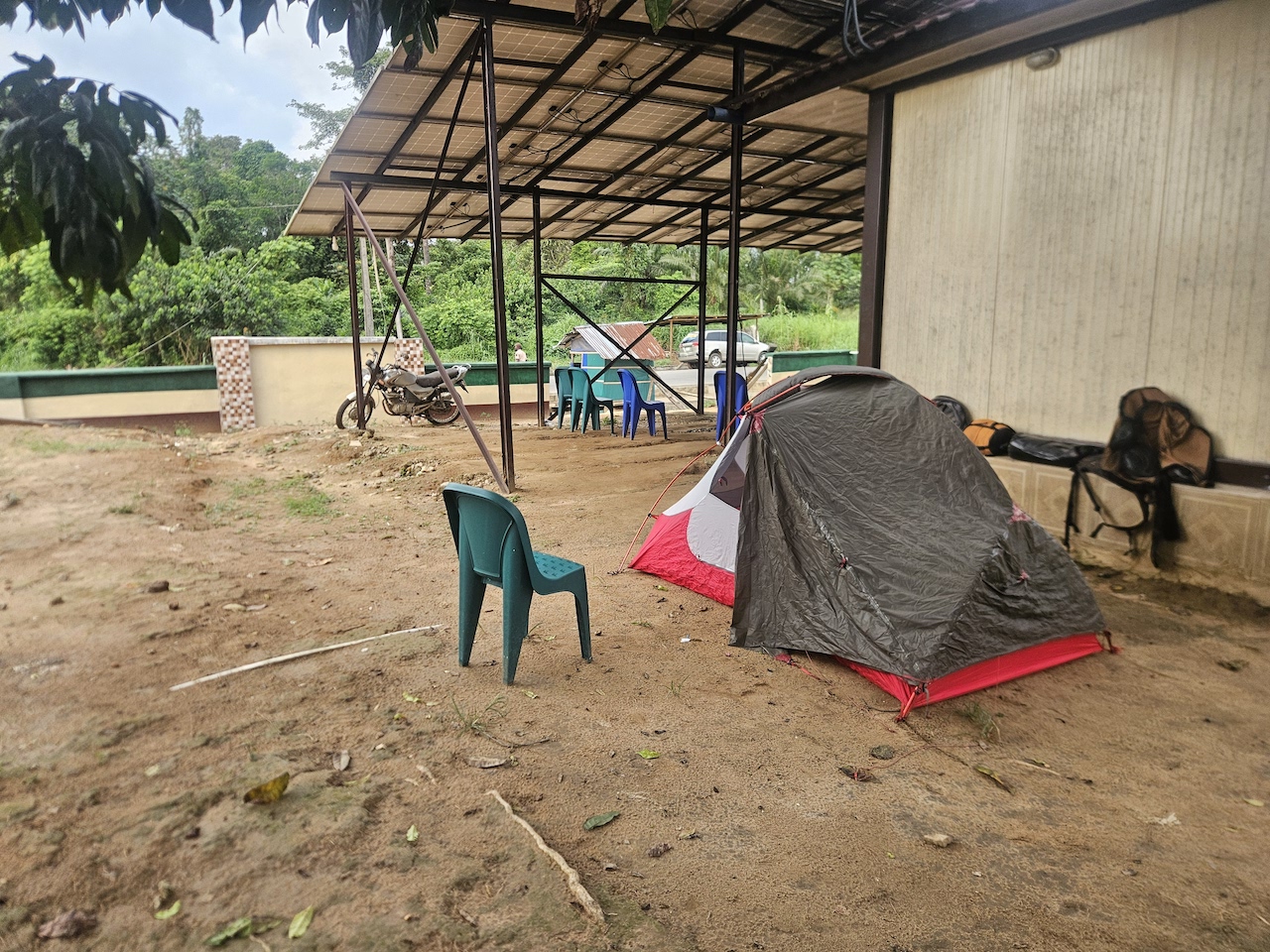
So I cross the bridge once again in the opposite direction and return to the Nigerian side, where the border officers, who are very friendly, help me find a place to pitch my tent.
Tonight, I sleep only a few hundred meters from Cameroon.
Tomorrow there are two possibilities: either an administrative miracle occurs, or I head to Calabar in search of the famous sticker.
Three potential days lost because of a simple sticker.
I am utterly discouraged.
June 9, 2026 – Ekok – Checkmate
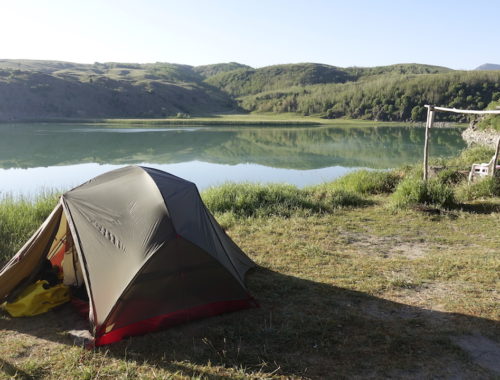
I spent the night in my tent right next to the Nigerian border post.
It was a particularly restless night because of the traffic. Since the border operates 24 hours a day, the constant passage of trucks made sleep almost impossible.
When I wake up, I am exhausted, grumpy, and in a very bad mood.
It must also be said that I have not eaten anything for nearly twenty-four hours.
At that moment, I seriously consider turning around and abandoning the idea of crossing Africa.
After all, I have already done it once, and for the past two months the setbacks have kept piling up.
The blockage imposed by the Cameroonian authorities, requiring me to travel all the way to Calabar to obtain the famous sticker, represents a detour of roughly 500 kilometers round trip, which strikes me as completely absurd.
Rather than making a decision in the heat of the moment, I decide to spend a day at a hotel in Ikom.
The establishment is a bit run-down, but it offers enormous rooms with fans, all for €9 a night.
A good opportunity to stop and think.
I contact several acquaintances to find out whether it might be possible to obtain the sticker without traveling there in person.
Unfortunately, the answer is always the same:
You have to go to Calabar.
As the hours pass, the idea of turning back keeps crossing my mind.
I begin to wonder seriously whether the whole thing is still worth it.
Yet after a decent night’s sleep, a proper meal, and a few hours of perspective, things already seem a little less dramatic.
There is still one solution left.
It is annoying, absurd even, but it exists.
Tomorrow morning: Calabar.
June 10, 2026 – Morning – Departure for Calabar
This morning, I set off for Calabar.
I decide to leave some of my belongings at the hotel, particularly the rear duffel bag, to lighten the motorcycle.
While I am getting ready, a small sunbird (a hummingbird-like bird) comes to visit me.
The hotel staff are genuinely wonderful.
On the other hand, my dislike of pointless bureaucracy is not about to disappear.
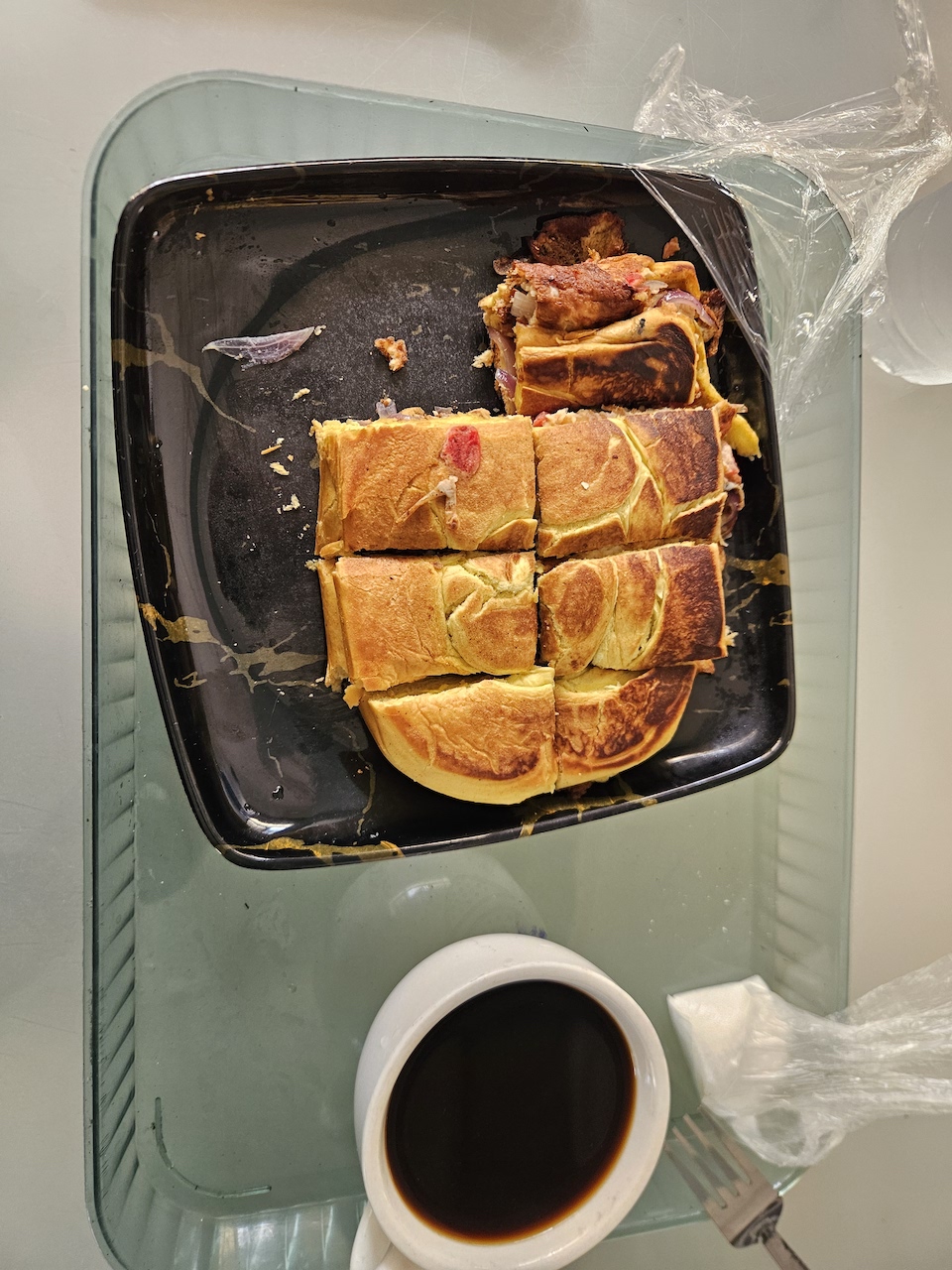
Before leaving, I order a coffee, an omelet, and some toast.
The omelet and toast eventually turn into a sort of sandwich made from a few lightly toasted slices of sandwich bread with the omelet stuffed inside.
Since the hotel did not serve coffee, I lent them my moka pot and explained how to use it.
When the coffee took an unusually long time to arrive, I went into the kitchen to see what was happening…
And I burst out laughing.
They had placed the moka pot… in a bain-marie.
June 10, 2026 – Evening – Calabar
I finally have the Cameroonian visa sticker.
The whole procedure took five minutes…
After four hours of riding.
That said, the journey itself was quite pleasant. The road, generally in good condition, wound its way through lush vegetation, although there were still a few severely damaged sections.
One of them rewarded me with a serious jolt to the back. For once, I was not wearing my lumbar support belt.
I hope I will be fine tomorrow.
With the rear duffel bag removed, the motorcycle feels like an absolute toy.
I really should find a way to travel using only the side panniers.
I do not think it is a matter of weight—the bag contains nothing particularly heavy—but rather of center of gravity.
Once the sticker is obtained, I settle into a small hotel right next to the consulate, recommended by Didier and Nelly.
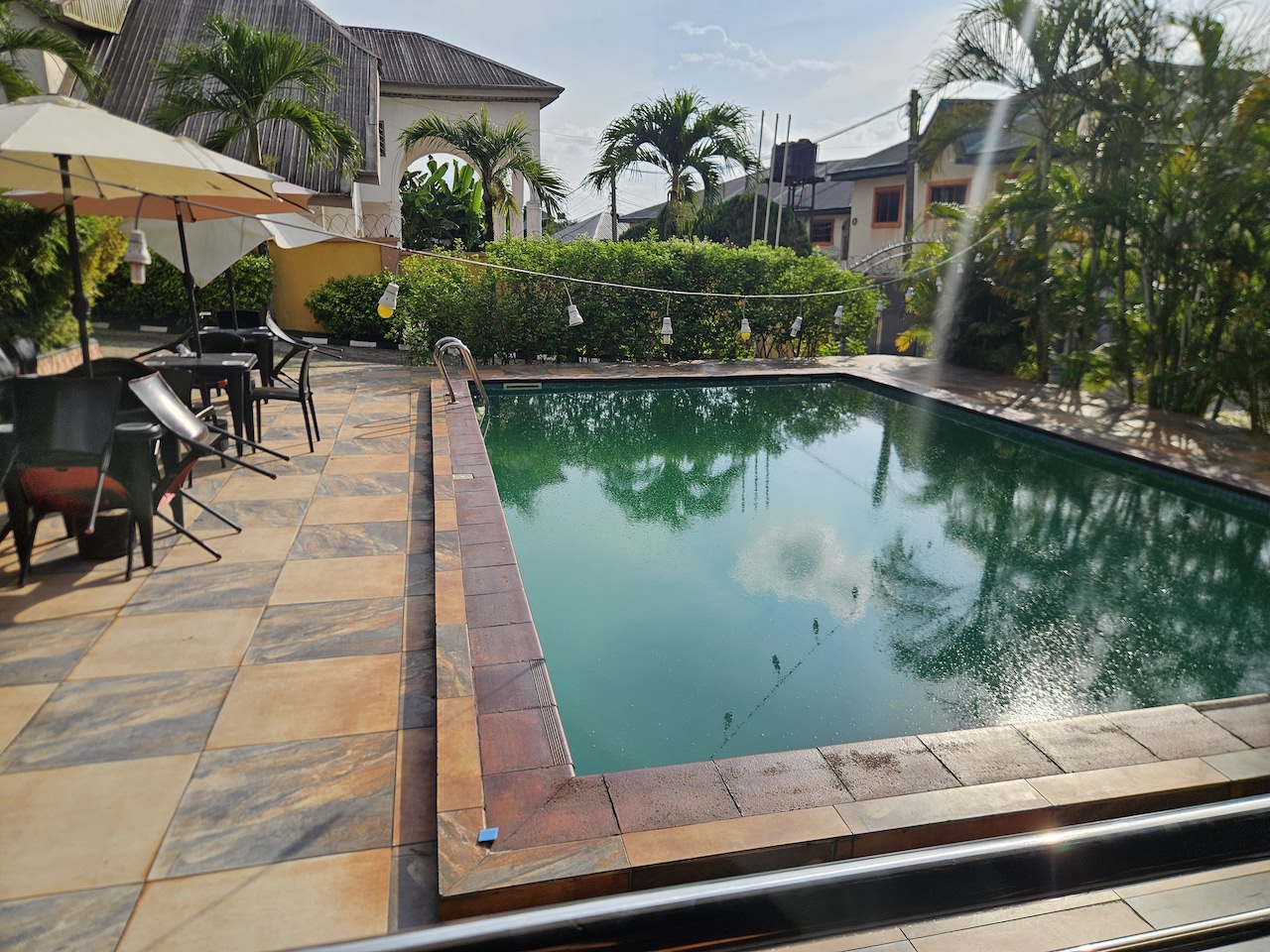
For around 20,000 naira—roughly €15 per night—I get air conditioning and even a swimming pool.
Along the road to Calabar, I witnessed two memorable scenes.
And these days, it takes quite a lot to surprise me.
The first: a man sharpening his machete directly on the asphalt road surface.
The second was even stranger: a small motorcycle transporting a corpse.
A simple plank fixed across the rear served as a support, and the deceased lay across it sideways.
After funeral homes, I had now discovered the funeral motorcycle.
Anyway, now it’s time for Coke and the swimming pool!
Well… not the swimming pool.
It clearly looks like it could use some treatment.
Planning the Next Stage
I am currently studying my route to the DRC.
I need to be there before June 30.
In theory, this is entirely feasible, but:
- I no longer have the luxury of wasting time.
- I must take the fastest route possible.
- There absolutely must not be any further delays.
From Yaoundé to Brazzaville—even though I probably will not actually pass through Brazzaville itself but only nearby—there are approximately 1,600 km of paved roads.
While studying the route, I cannot help comparing it to the one I followed twenty-three years ago.
In 2003, the journey from Yaoundé to Brazzaville exceeded 2,300 km via Gabon, of which fewer than 500 km were paved.
Everything else was dirt track.
The only paved sections were:
- Leaving Yaoundé.
- About fifty kilometers before Libreville.
- Between Oyo (the president’s hometown) and Brazzaville.
Evening Reflections
Nigeria is a country where, in the same day, you can see:
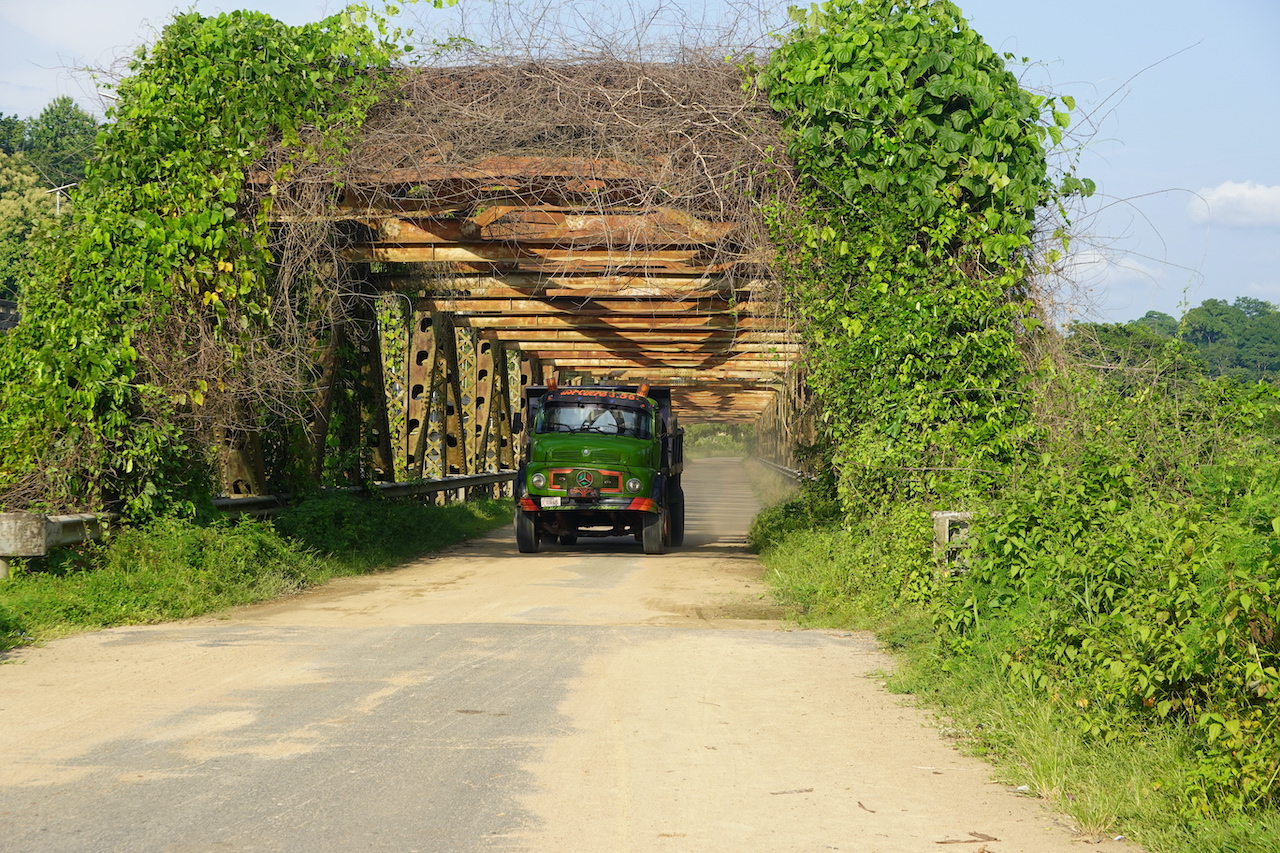
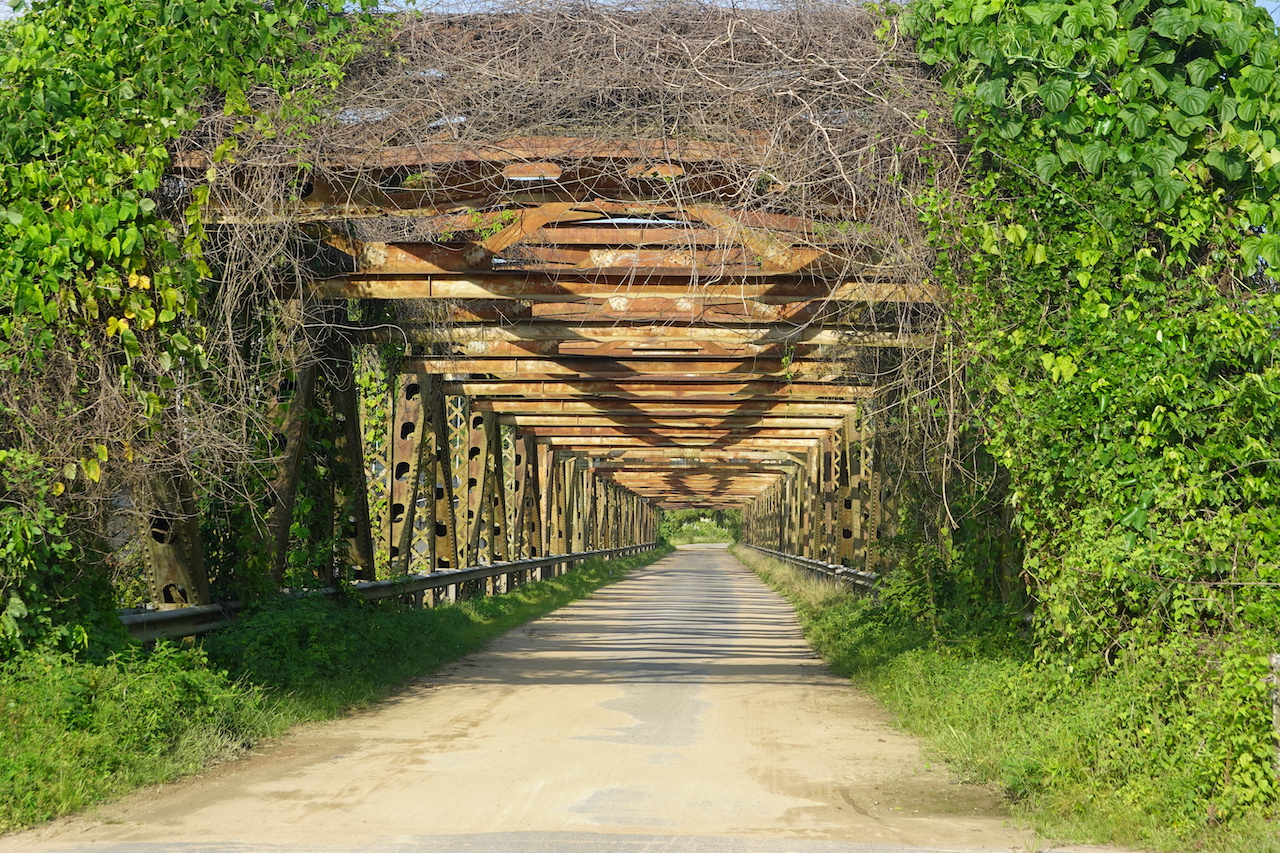
- A highway being slowly reclaimed by vegetation and laterite.
- Cows tied to the roof of a truck, with men sitting among them.
- A dead body transported on a simple plank attached to the back of a motorcycle.
- Rural scenes that seem barely different from those of a century ago.
- Someone offering you dog meat at a roadside shack where you stopped for a Coke.
- A woman roasting corn over a small charcoal brazier and selling it for a handful of cents.
- And then finish the day sipping a whisky-and-Coke by a swimming pool while watching Batman on television.
In short, I feel good in Nigeria.
My only real regret is not having been able to wild camp in the villages.
(That said, I deliberately avoided following the coast. From everything I have seen and heard, it is apparently hell.)
June 11, 2026 – Return to Ikom
It is a shame that I am pressed for time.
I would gladly have stayed in Calabar a little longer to explore the city.
It looks like a pleasant place.
The return ride is uneventful.
We are in the middle of palm fruit harvest season.
All along the road, men and women are busy producing oil, just as I had already seen in Guinea.
By the way, did you know there are two types of oil extracted from this fruit?
- Palm oil, extracted from the pulp.
- Palm kernel oil, extracted from the seed. It is lighter in color.
June 12, 2026 – Ekok (Cameroon)
This time, I arrive in Ekok, Cameroon, without any problems.
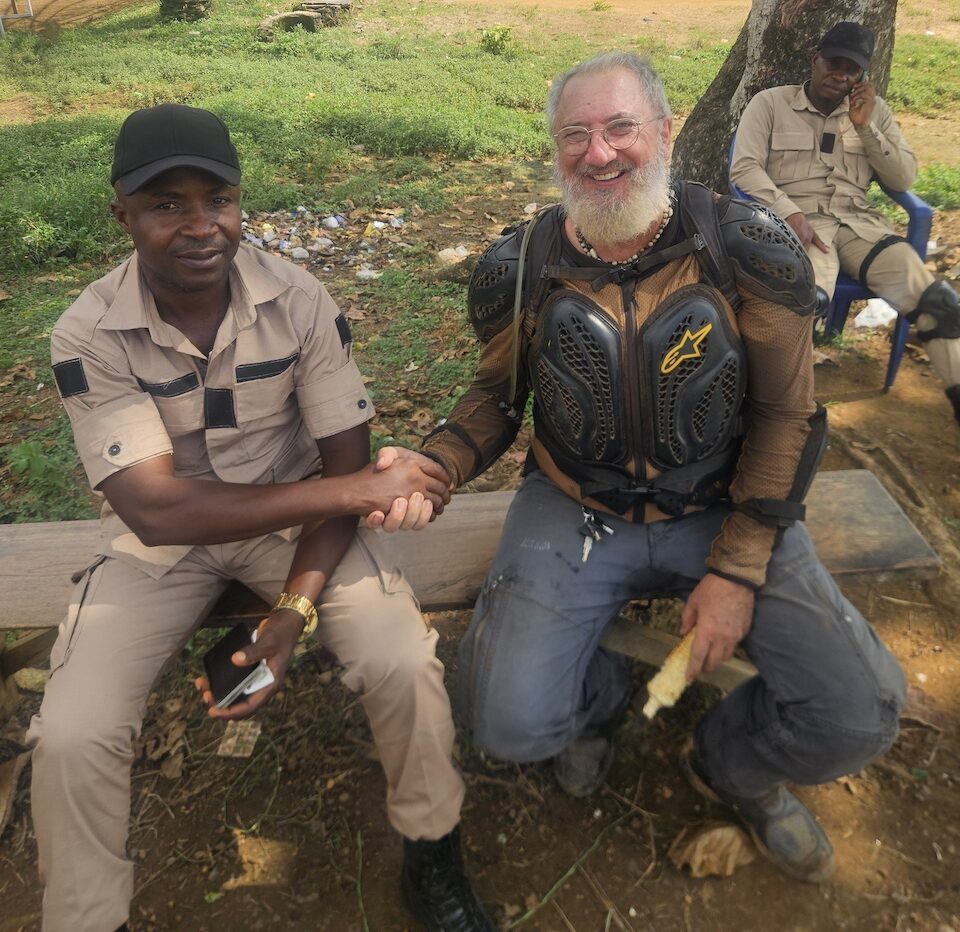
I meet again the customs officer who had turned me back a few days earlier. We laugh about it, exchange a hug like old friends.
That’s Africa. 😉
Then come the actual formalities: the CPD and passport checks.
The immigration officer keeps my passport until the following day in order to limit my movements. In other words, they do not want me leaving without an escort. Lol.
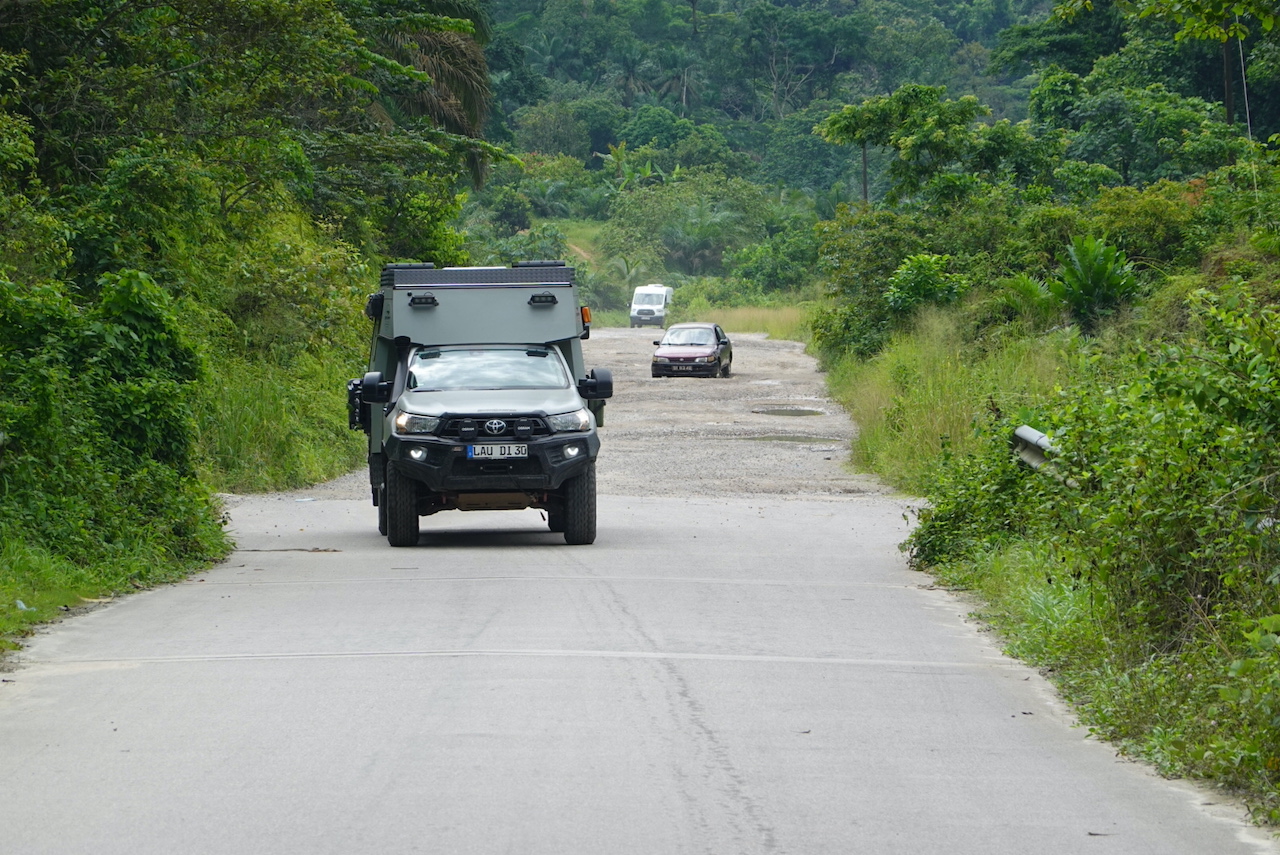
Inside the barracks courtyard, two German vehicles are already parked:
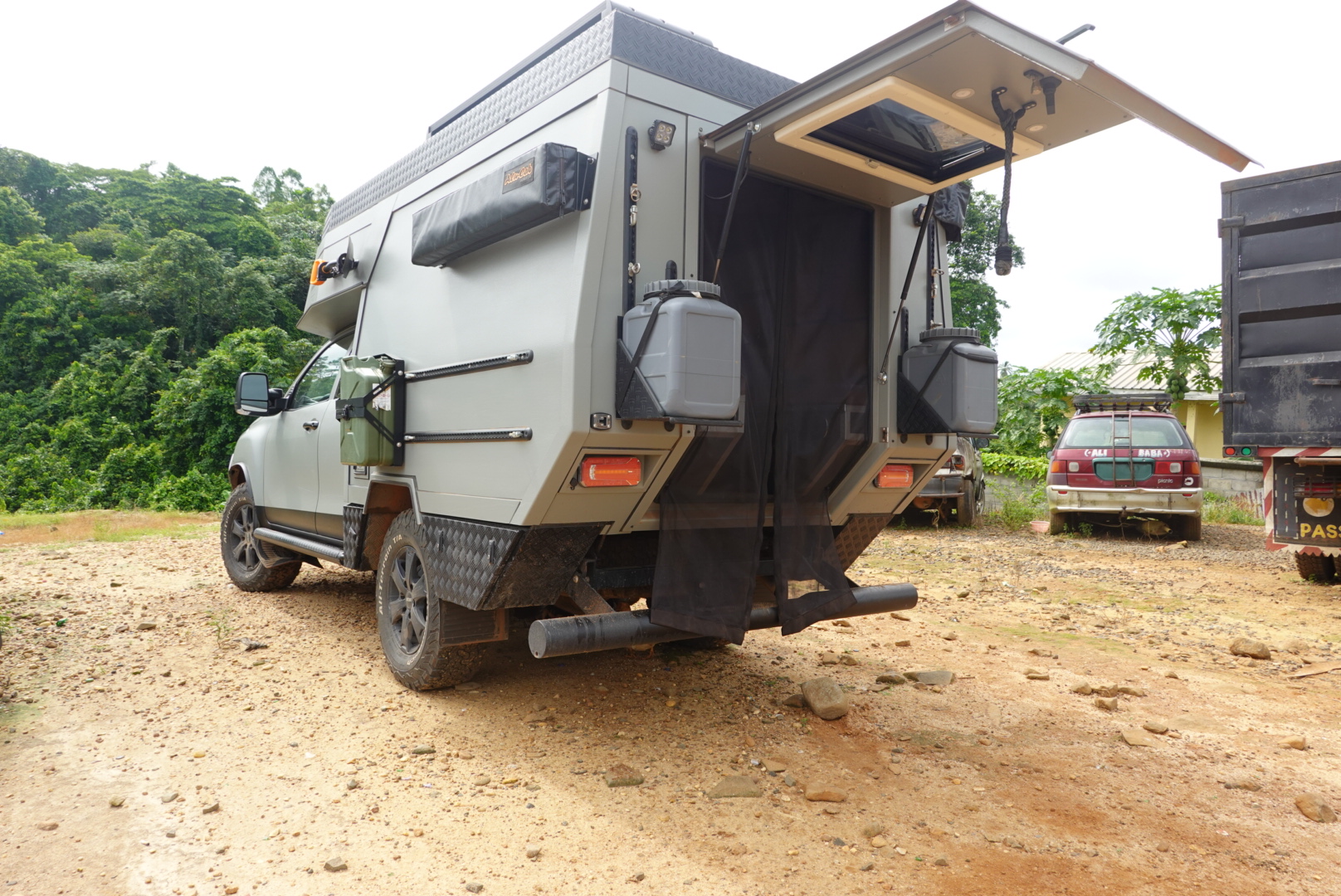
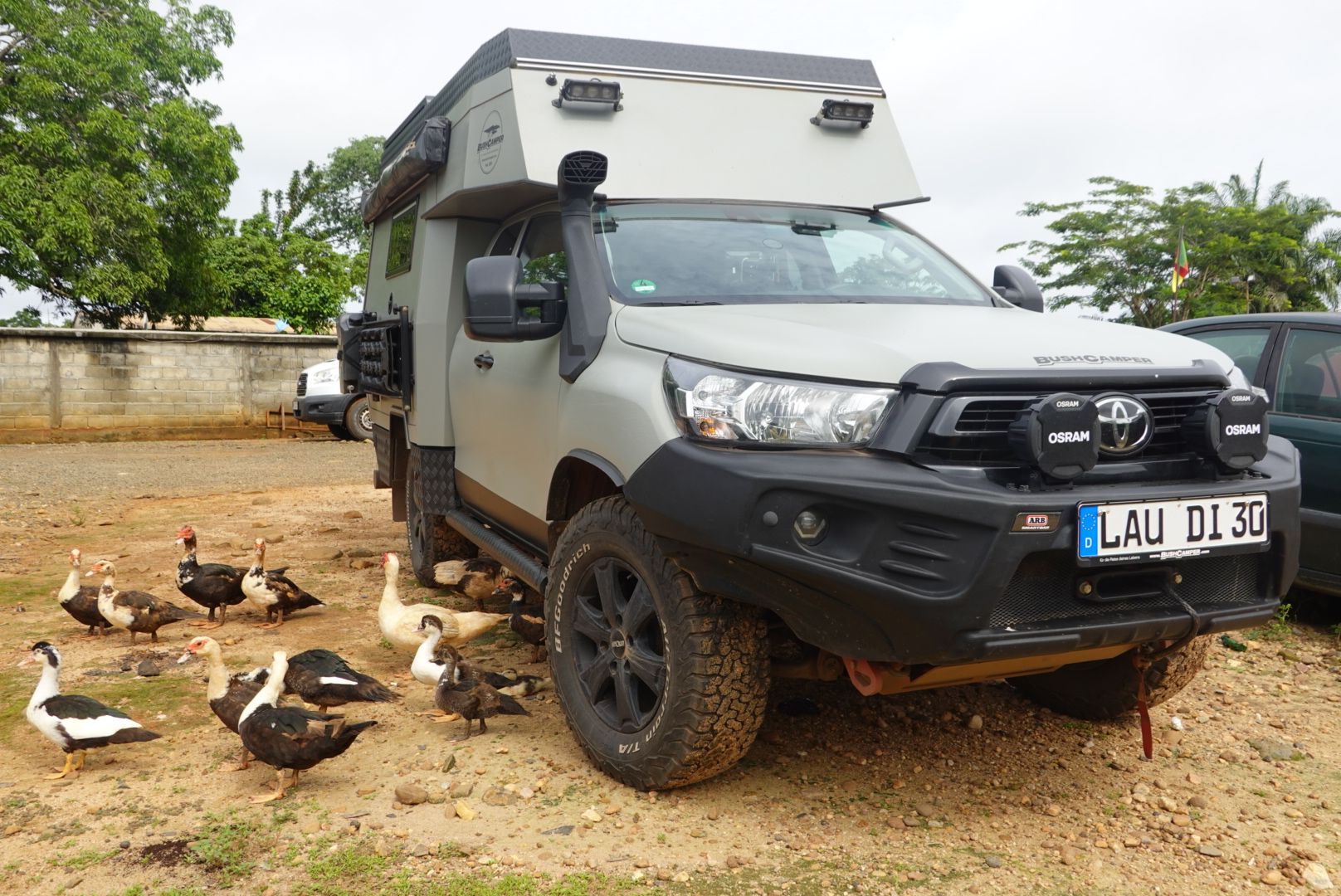
- A magnificent brand-new Hilux fitted with an Alu-Cab camper unit. The whole setup is probably worth around €100,000. I chat briefly with its occupants. They left in January, and this is their first major trip. Having recently retired, I imagine it will not be their last.
- The second vehicle is a minivan.
As for me, I am not allowed to pitch my tent.
I do not insist. First, the place is not particularly inviting, and second, thunderstorms are threatening. We are at the beginning of the rainy season.
The police take me to what is probably the only hotel in town: the Santa Helena.
On the way, I exchange 100 USD on the black market and receive 50,000 CFA francs.
The exchange rate is not great, but I have little choice.
The room costs 8,000 CFA, about €12.
Interestingly, although we are now in Cameroon, English is still the dominant language in the region—which helps explain the separatist tensions and the requirement to travel under escort.
June 13, 2026 – A Day Under Escort
Today, we are supposed to leave Ekok under a gendarmerie escort bound for Douala.
When I say “we,” I mean two German couples: one traveling in a minivan and the other in the Hilux with the Alu-Cab camper.
The first is a mixed couple. The man, Sam, is of Eritrean origin. He and I have a friendly but lively discussion about visas in Africa.
I know the argument well: Europeans impose so many difficulties on Africans seeking Schengen visas that African countries are simply applying reciprocity.
Having been married twice to foreign women, including a Senegalese woman, I am fully aware of the frustrating and sometimes humiliating procedures faced by Africans wishing to enter Europe, especially France.
However, in my view, the situations are not comparable.
On one side, immigration is often economically motivated. On the other, we are talking about tourists.
Furthermore, a Schengen visa grants access to twenty-seven countries.
In Africa, every country has its own visa, often increasingly expensive and accompanied by procedures that can be downright Kafkaesque.
I will probably return to this topic another time.
Anyway, I am up around 7 a.m.
I must report to the checkpoint at 8:30, when the escort is supposed to arrive.
At least in theory.
In practice, I first sit with the Germans. After my short debate with Sam, I leave them and join the immigration officers.
For one thing, they are sitting under a shelter equipped with a fan that provides a welcome breeze.
For another, I can actually talk with them, unlike the Germans who mostly speak… German.
In the end, we do not leave until around noon.
Two escort vehicles accompany the convoy, one at the front and one at the rear.
At the last minute, three buses also join the convoy.
Very quickly, I begin to wonder what the escort is actually for.
The lead vehicle travels fairly fast and I have no trouble keeping up on the motorcycle.
The minivan and especially the buses, however, struggle to maintain the pace because of the badly damaged sections of road.
The convoy stretches out over a huge distance and, in the event of an attack, I seriously doubt our protectors would be of much help.
Around kilometer 90, we reach an especially rough stretch filled with rocks and deep deterioration.
It is not particularly difficult, but it is long and exhausting.
About twenty kilometers later, we finally reach a beautiful asphalt road.
That is precisely when the escort abandons us, despite having supposedly been assigned to accompany us all the way to Buea, roughly 200 kilometers farther south.
No matter.
I resume my usual cruising speed of about 70 km/h.
During a break, I watch the Germans overtake me.
It will be the last time I see them.
I continue peacefully on my own.
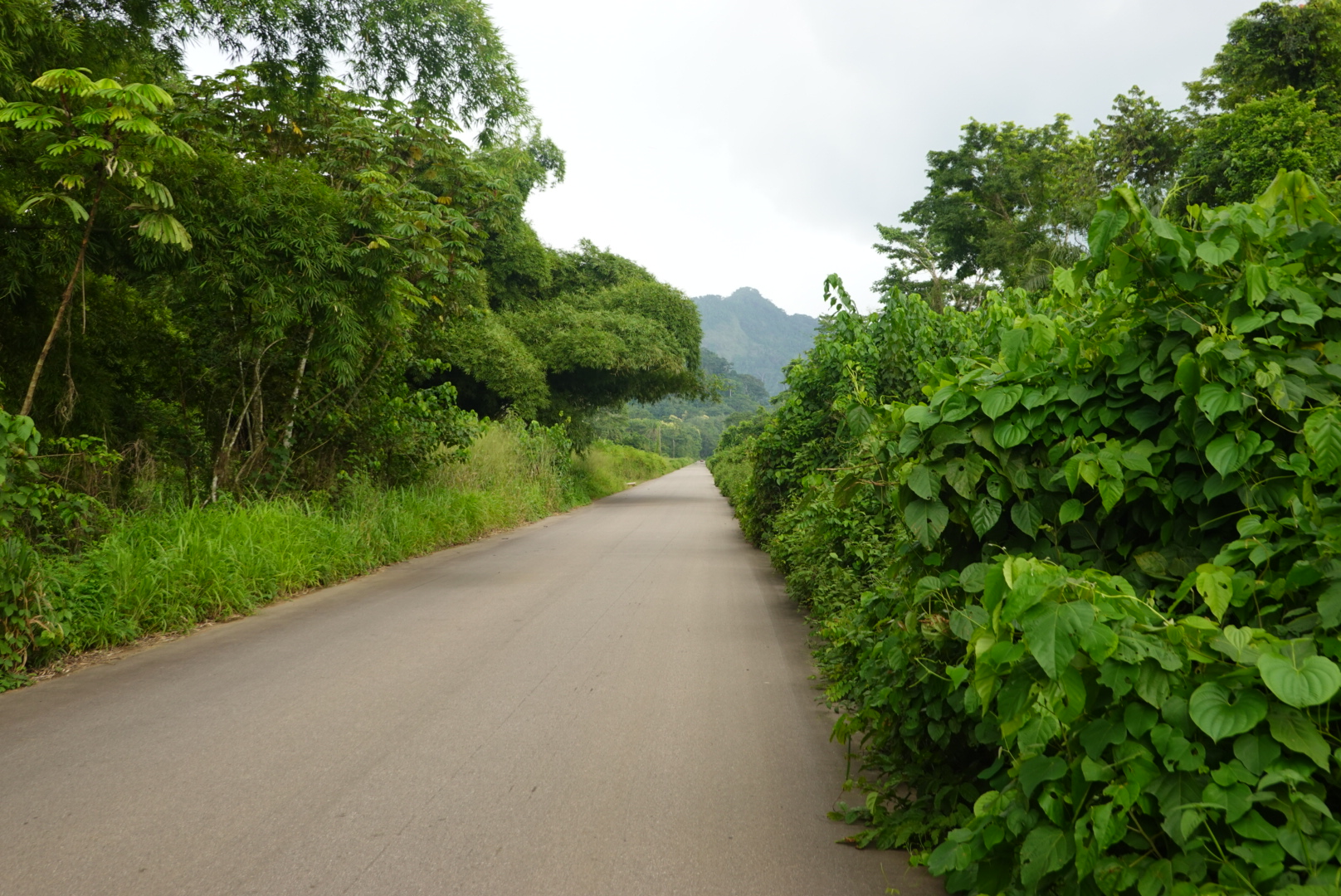
The road is magnificent and relatively quiet.
I cannot help comparing it to my first journey through Cameroon.
Back then, before reaching Douala, there was not a single paved road—only red laterite tracks.
We crossed the country during the rainy season, in July, and it was not without difficulty.
The contrast with today is striking.
For now, I simply enjoy the pleasure of riding peacefully.
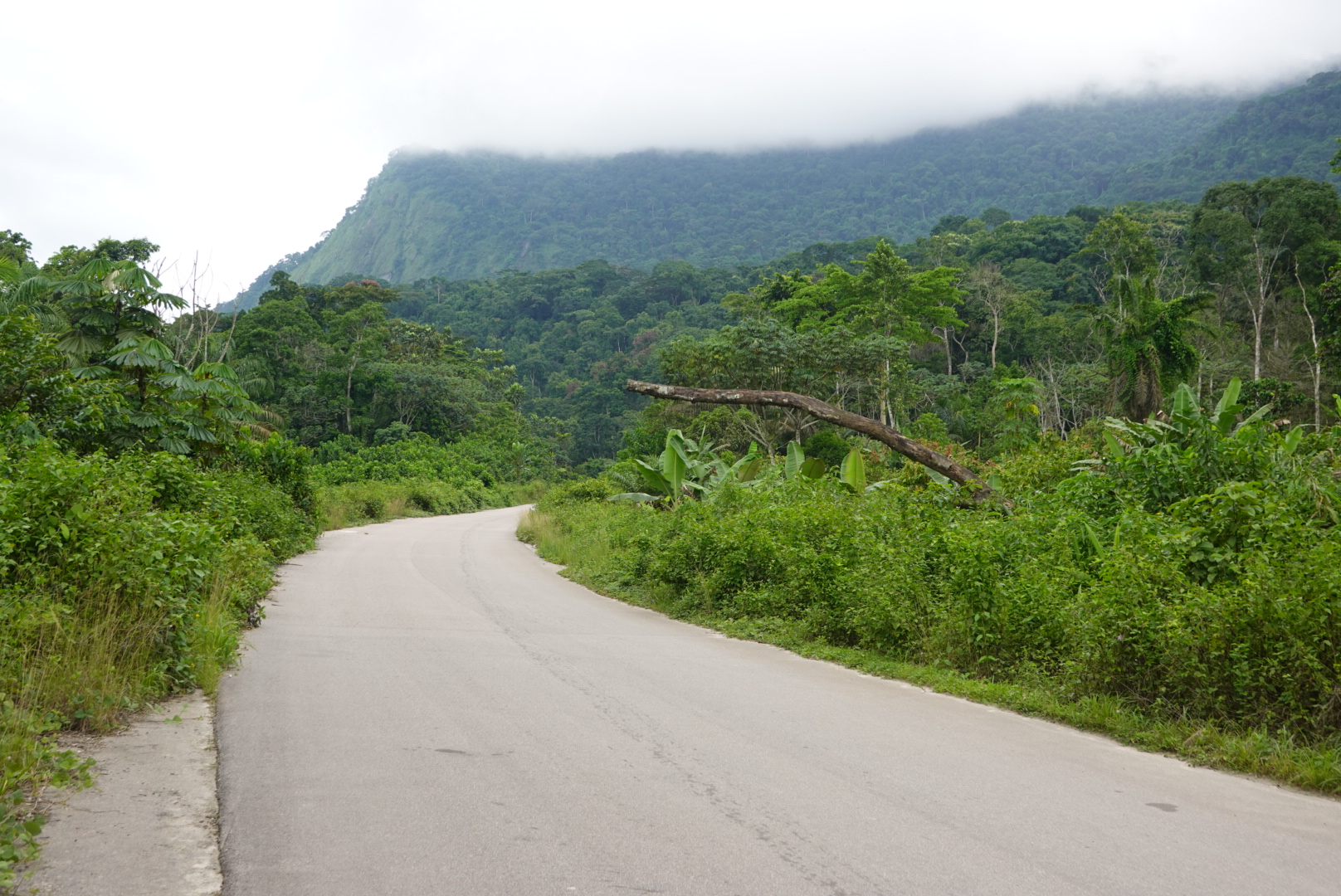
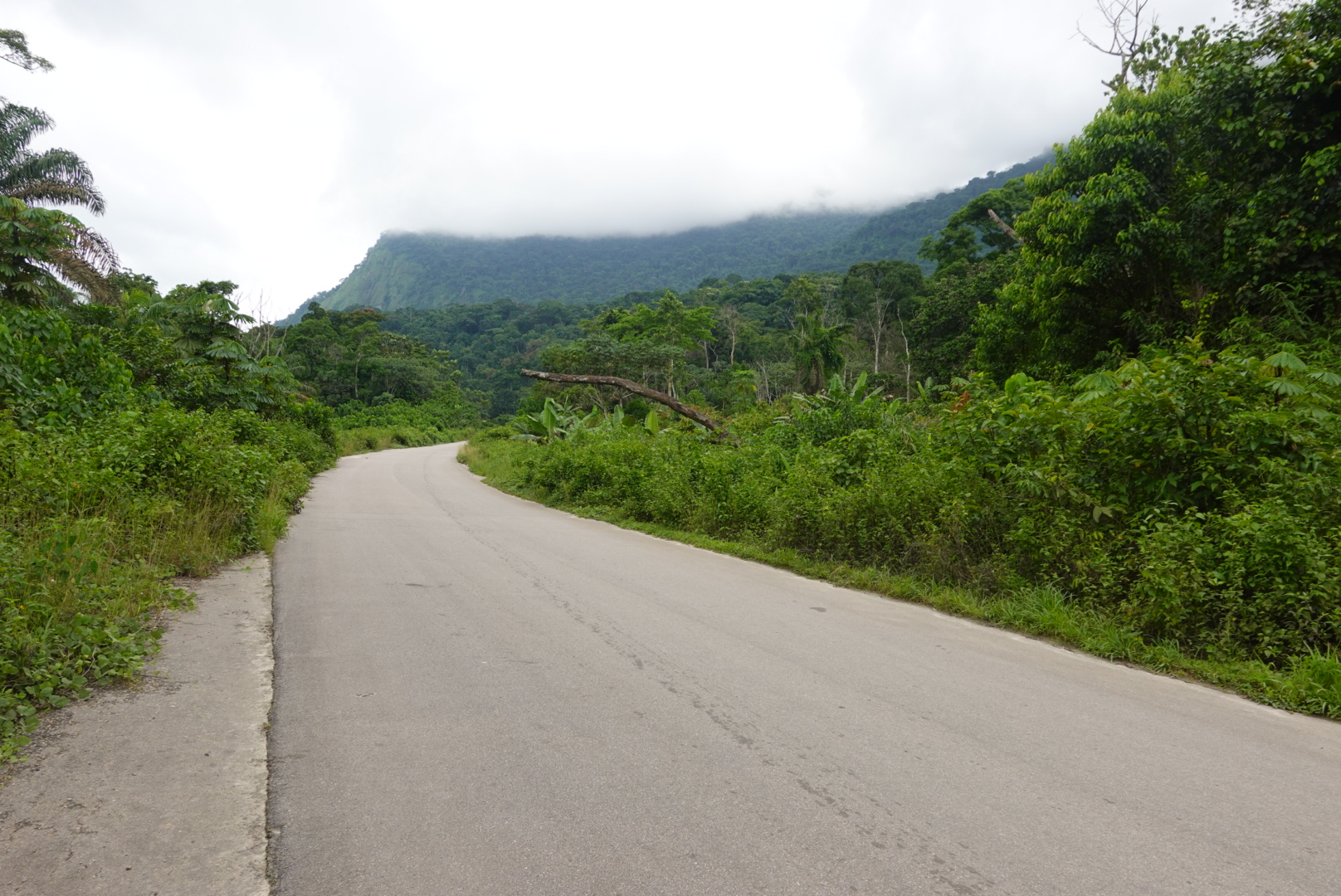
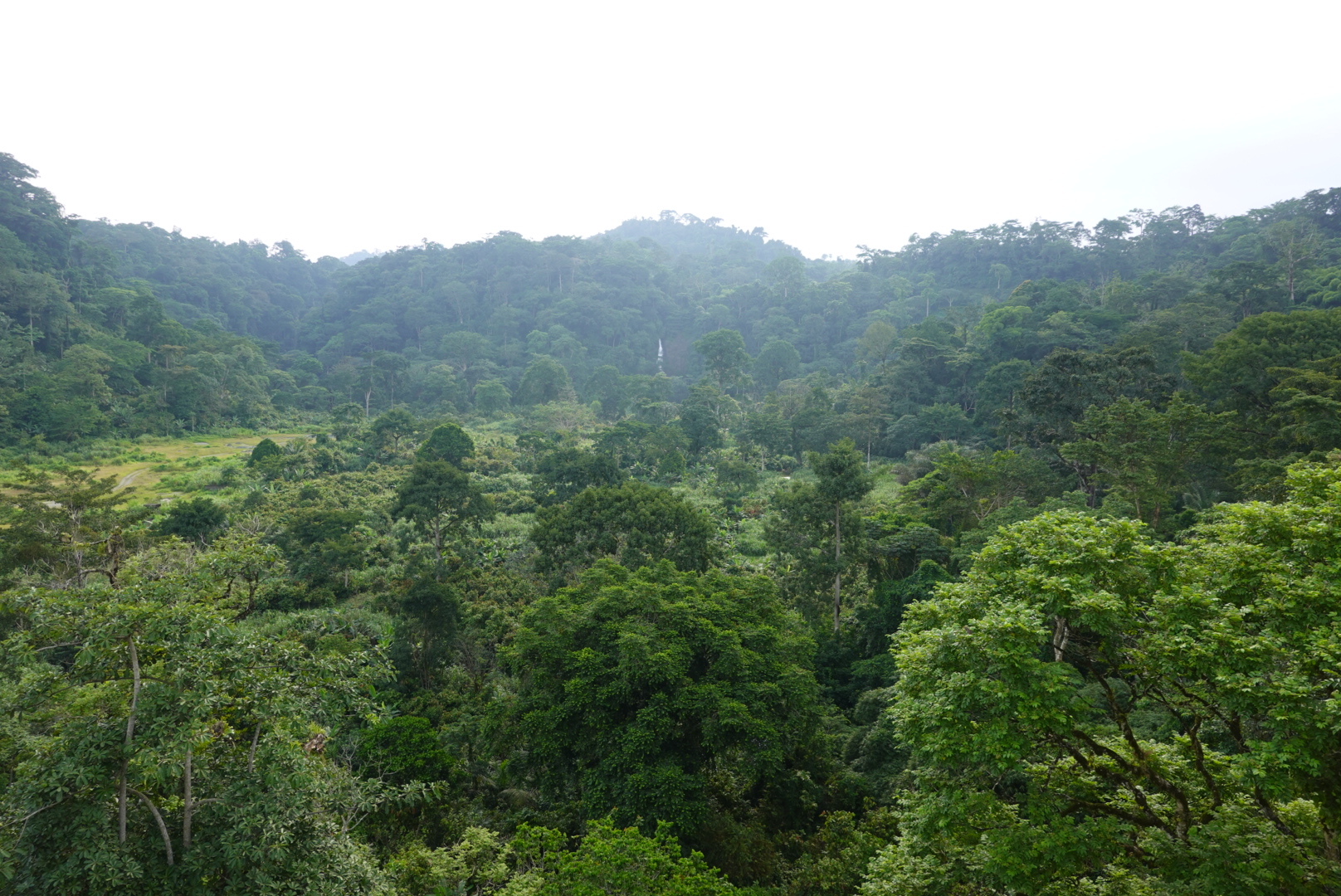
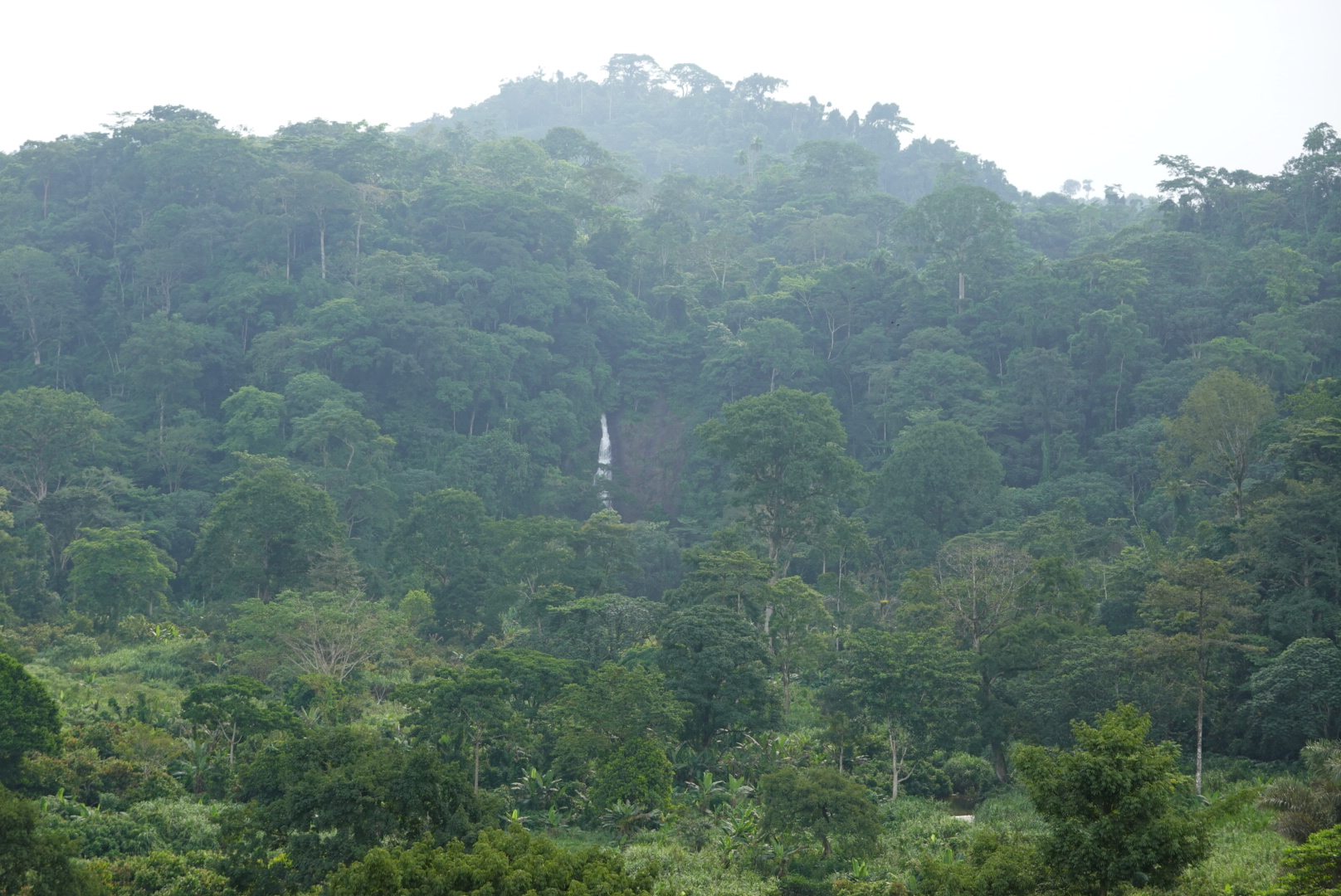
The scenery is sometimes breathtaking, and the vegetation an intense, vibrant green.
It is simply beautiful.
I am not sure how to describe it better; I have never been particularly talented at writing about landscapes.
A small thunderstorm catches me while riding.
I do not even bother putting on my rain gear.
I know it will not last and that I will be dry again within minutes.
I simply slip my phone into the tank bag.
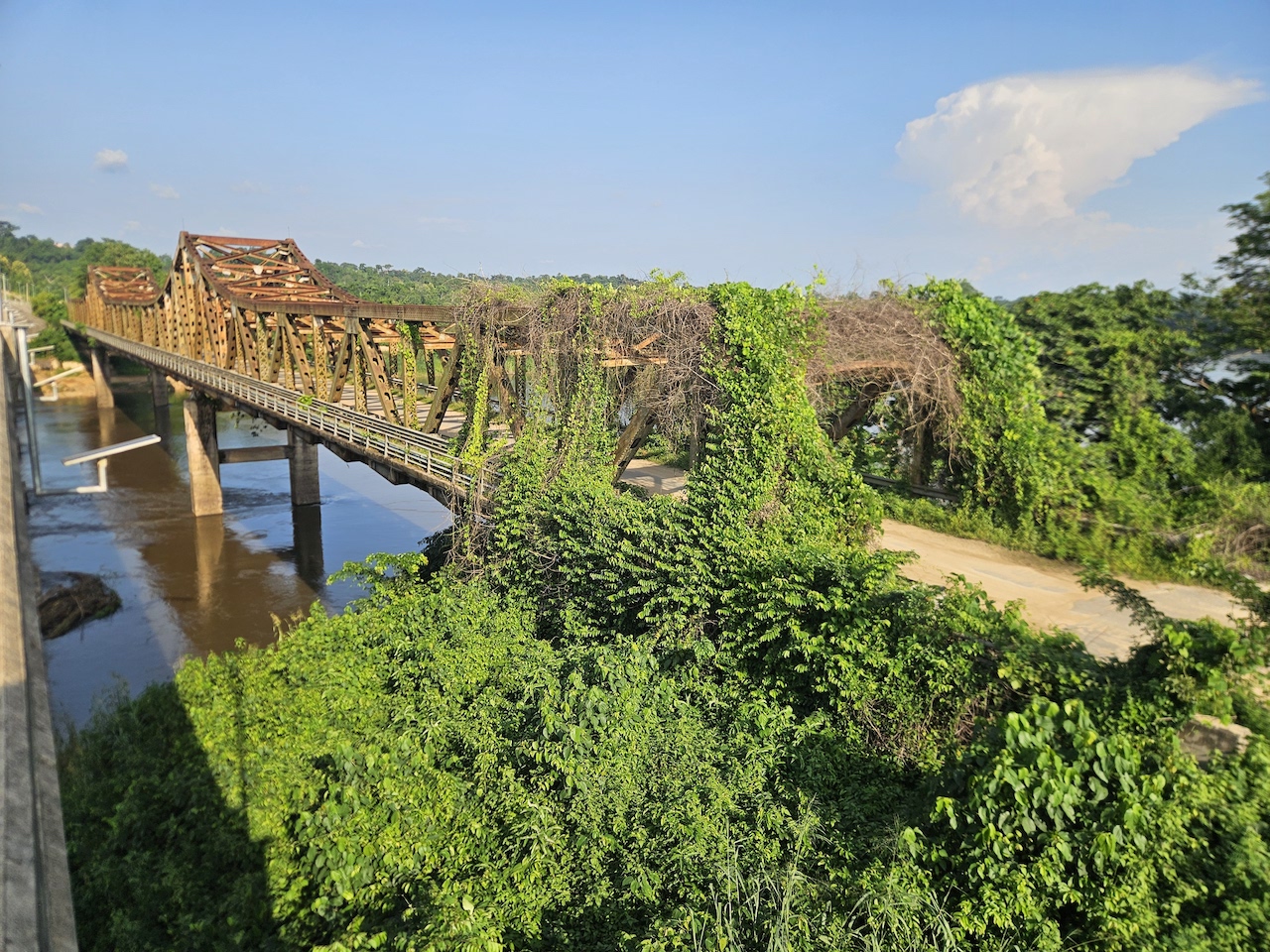
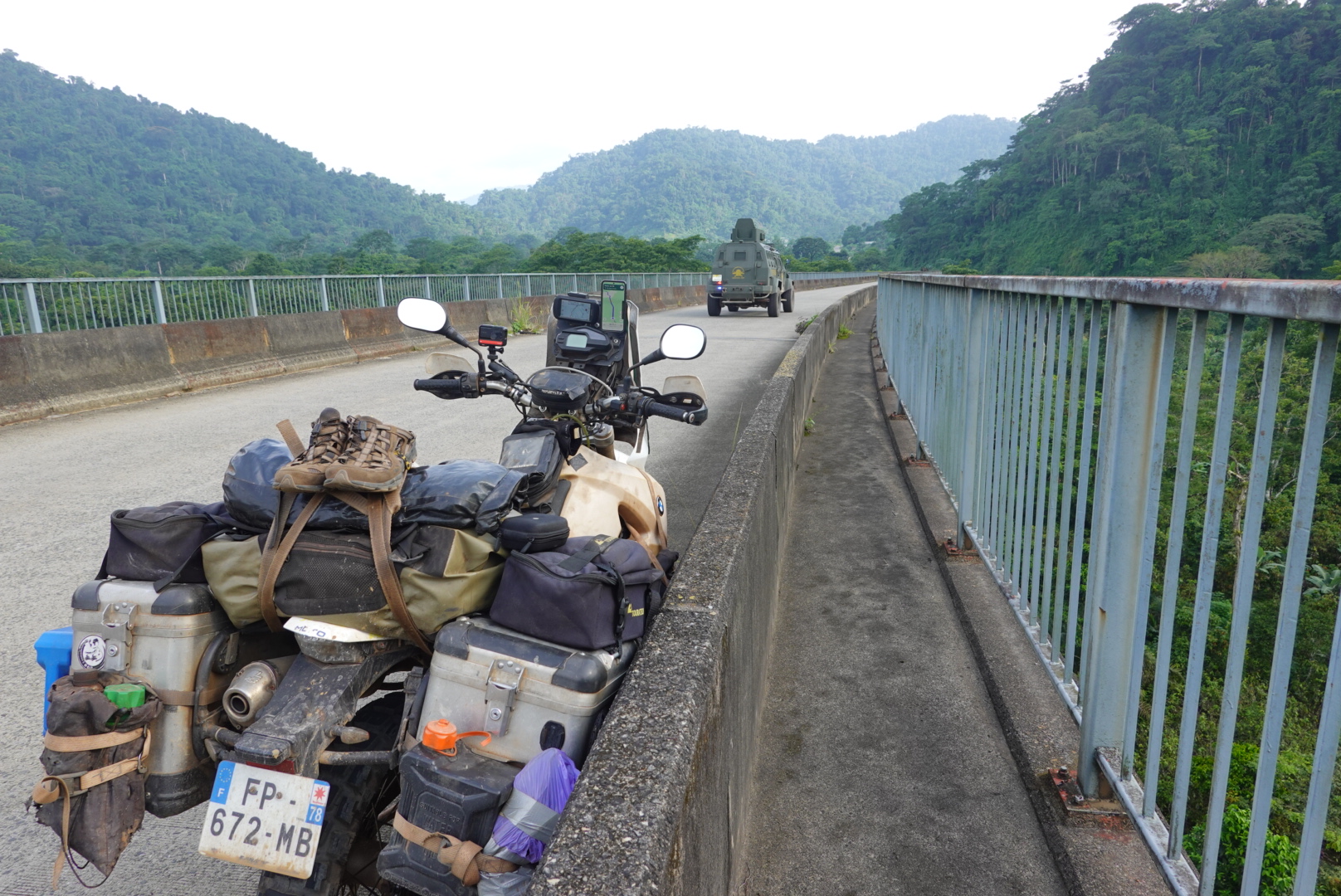
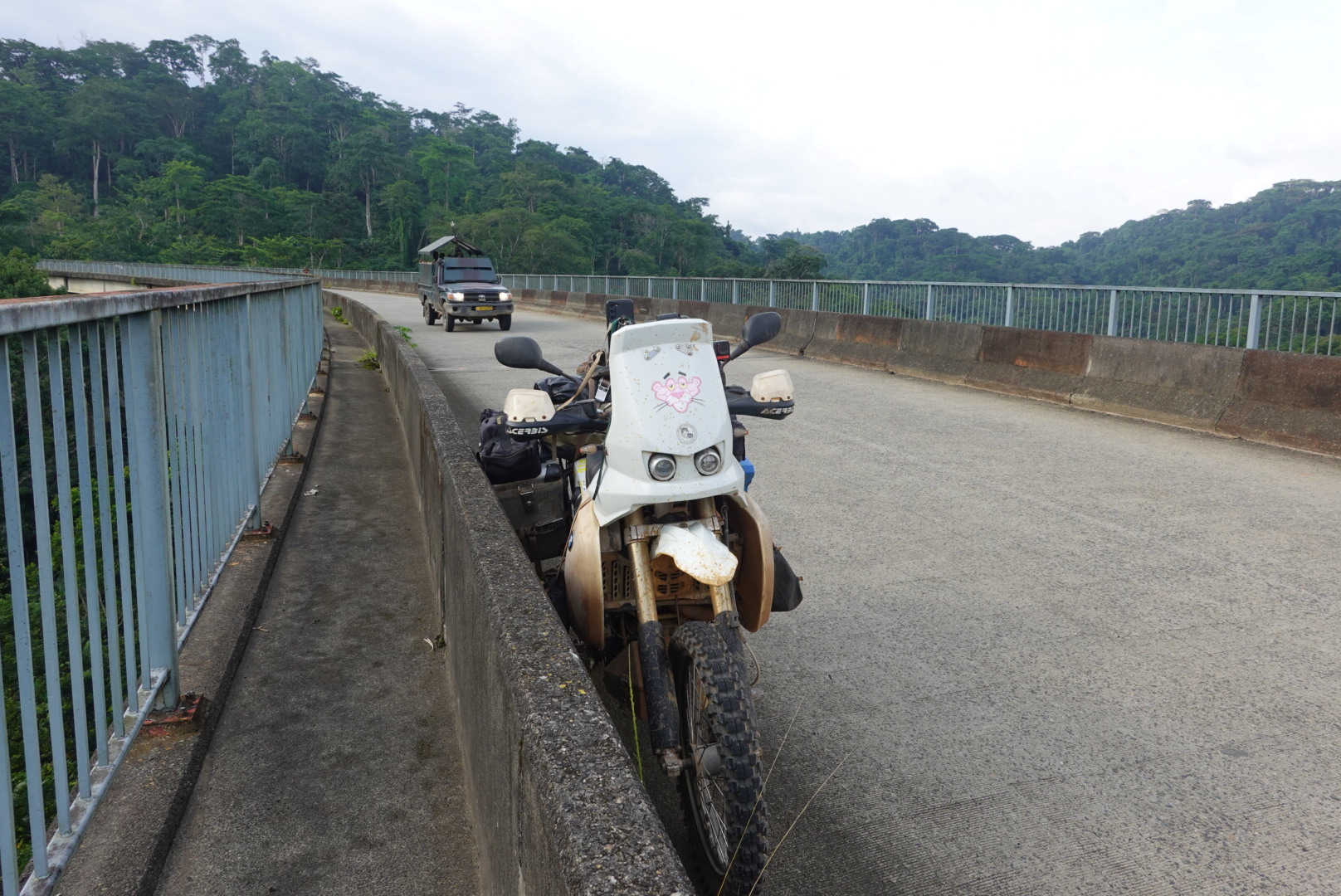
Farther on, I stop to take a few photos from a huge viaduct.
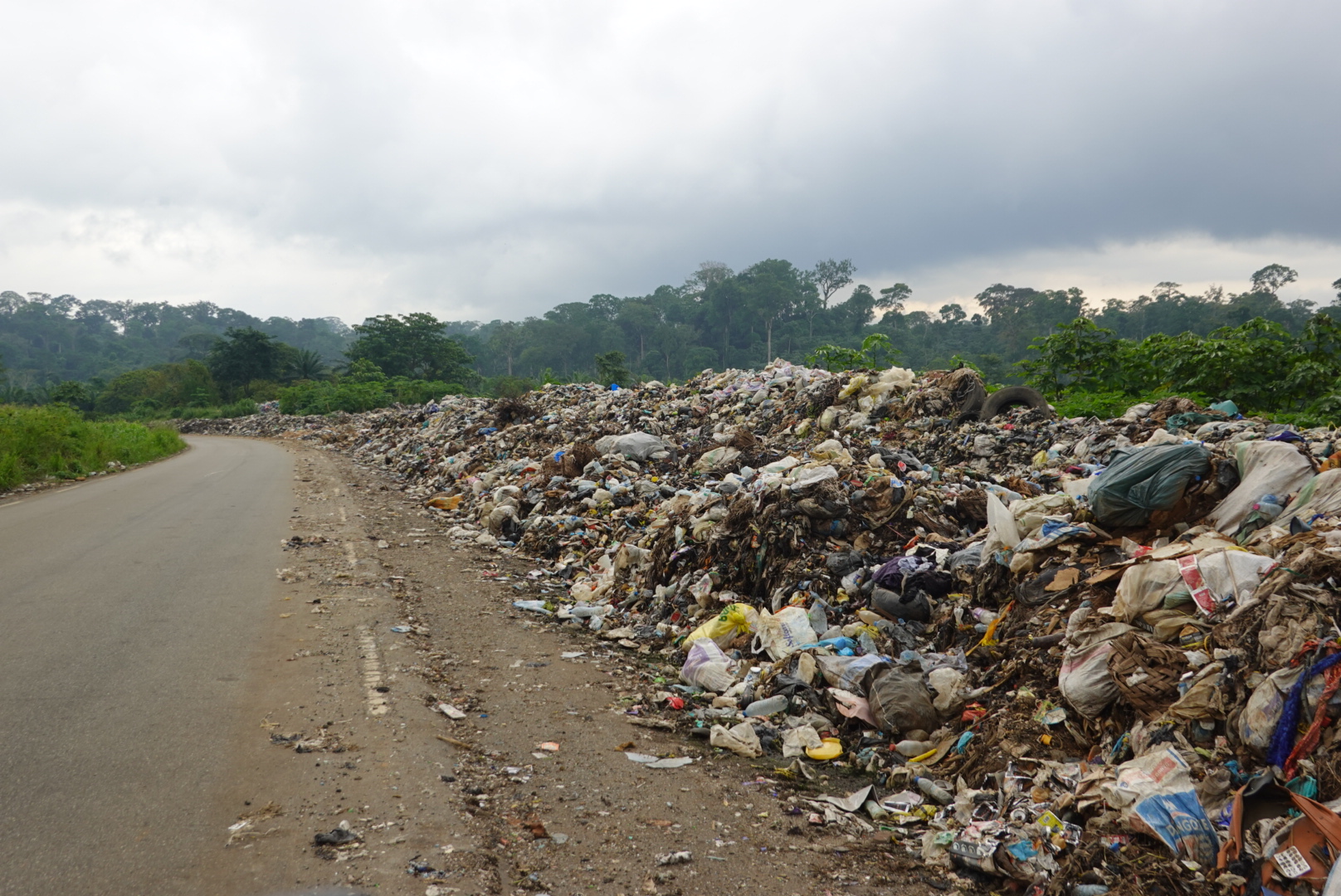
Toward the end of the day, I pass a landfill beside the road.
At first, it shocks me.
Yet, compared with many cities in West Africa, Cameroonian towns actually appear rather clean.
There clearly seems to be some form of waste collection service.
What remains unresolved is the question of waste treatment itself.
Eventually, I stop at a hotel in Kumba just before nightfall.
Good timing.
A few minutes later, an exceptionally violent thunderstorm breaks out.
Hotel: 10,000 CFA (I can’t wait to get back to wild camping!)
Dinner: 3,000 CFA – rice and chicken.
The chicken seems to have been boiled first and then simply fried in a pan.
Particularly bland.
June 14–15, 2026 – Yaoundé
On the morning of the 14th, I head toward Yaoundé.
But first, I have to cross Douala and its sprawling suburbs.
The GPS predicts one hour to cover…
37 kilometers.
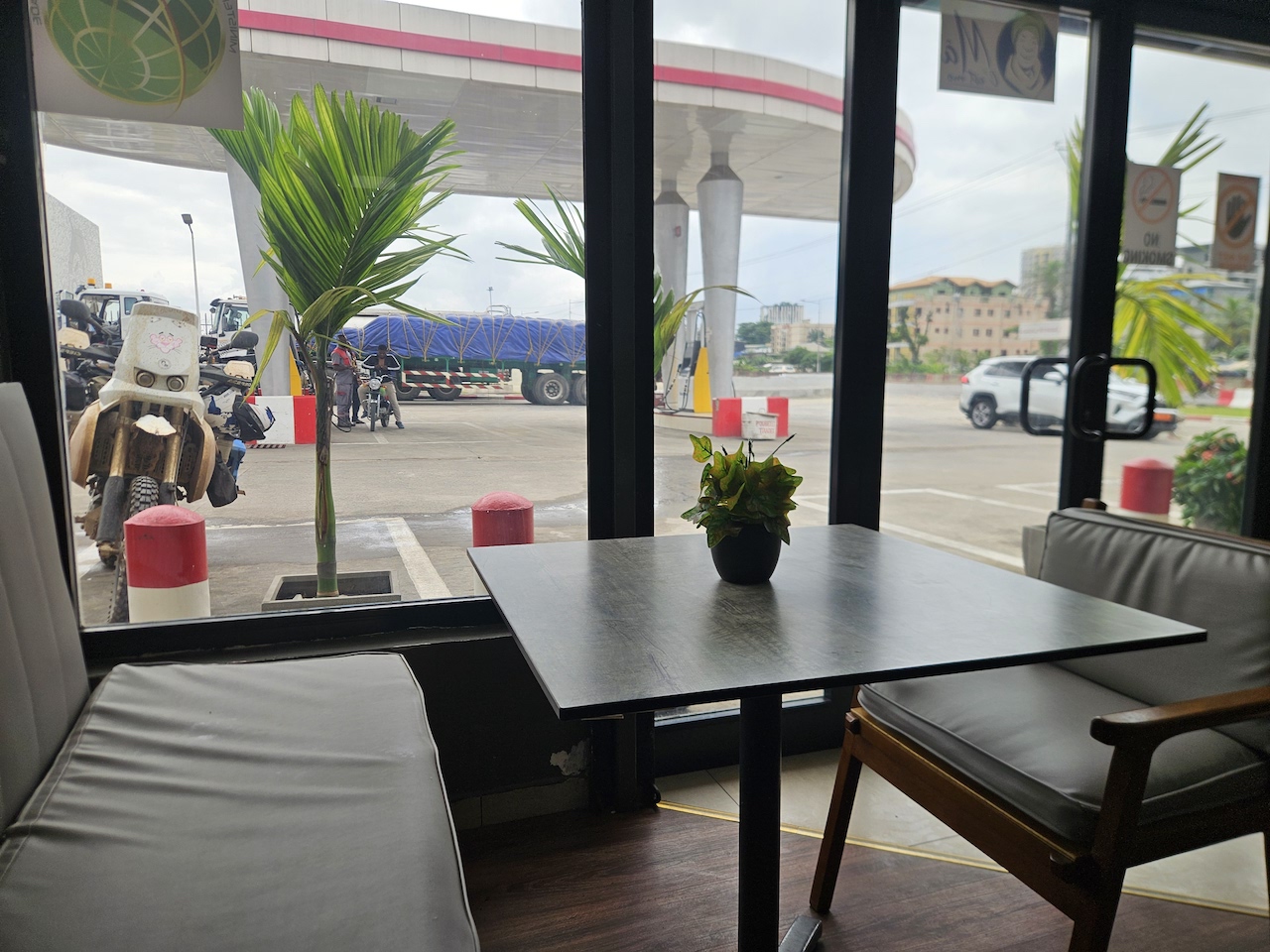
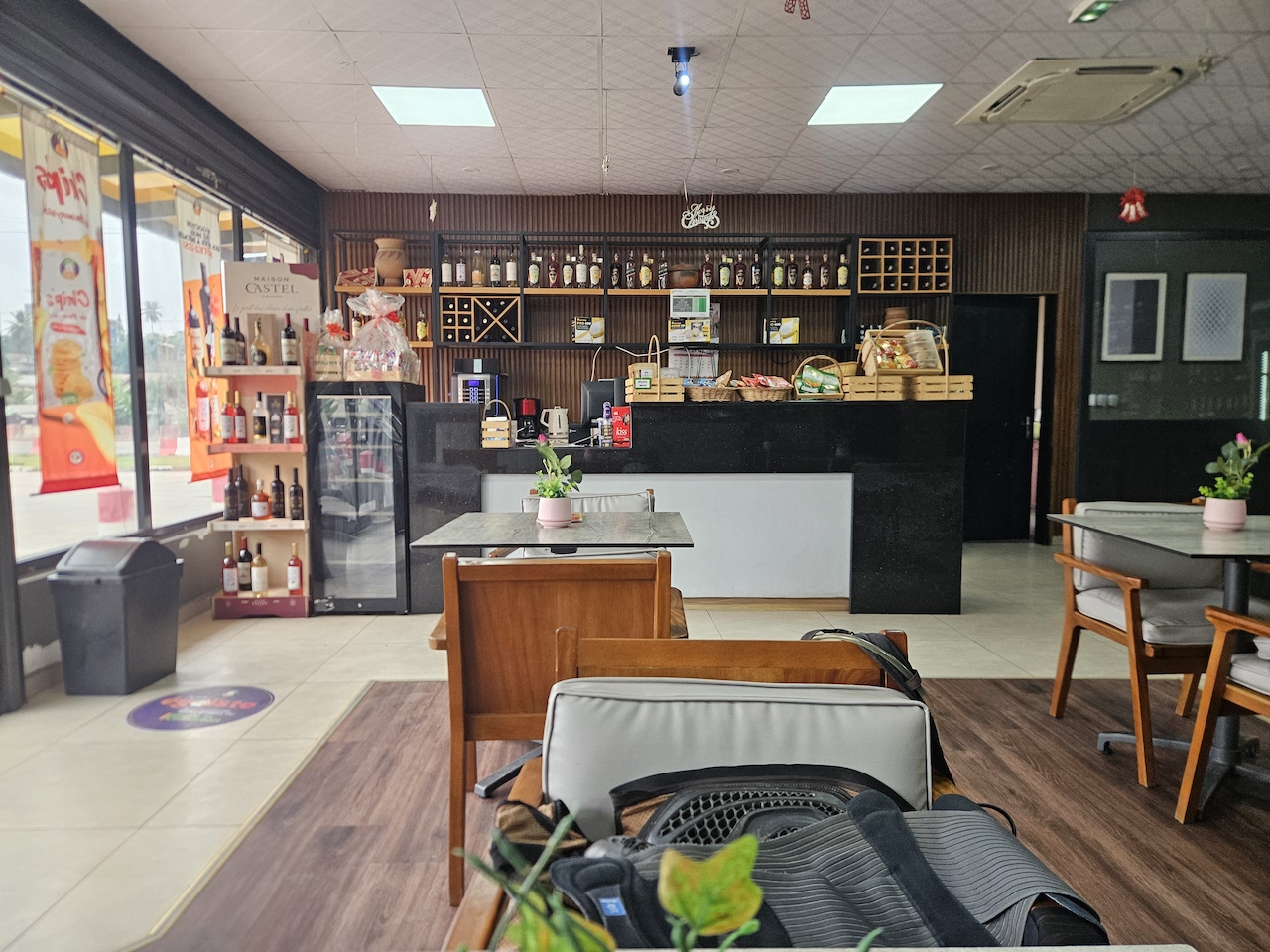
Halfway through, near the port, I stop to eat something and withdraw some money.
I take the opportunity to send a few photos to Alain, my former travel companion.
This gas station, perfectly ordinary by Western standards, would have seemed like pure science fiction in this location twenty-three years ago.
Once again, the contrast is striking.
I soon continue toward Boumnyebel, less than 100 kilometers from Yaoundé, where I spend the night.
The following day, after booking a small apartment on the outskirts of the capital, I set off again.
While looking for accommodation, I discover with amusement that Baptiste stayed in Yaoundé at the very same monastery where we slept twenty-three years earlier.
I ride at a relaxed pace.
I only have 90 kilometers to cover.
Then soldiers stop me at a checkpoint.
Judging by one soldier’s insignia, it appears to be an anti-terrorist patrol.
More importantly, it is the first time on this trip that I encounter such an insistent request for a “gift.”
At first, one of them—a relatively young man—asks for €200.
Then €100.
Then finally €50.
When I explain that I have no money left and need to go to the bank, he exclaims:
“What? A white man without money? That’s impossible!”
I simply laugh.
Same strategy as always: take things lightly, avoid confrontation, and keep everything on a joking tone.
Eventually, somewhat reluctantly, he agrees to shake my hand and let me continue.
A second checkpoint a few kilometers later proves much friendlier.
Those officers are simply curious.
I continue on my way feeling relaxed.
This time, although I no longer have the luxury of wasting time, everything seems to be going perfectly.
I should reach the DRC before my precious visa expires…
Except…
Isn’t it said that the best is the enemy of the good?
Less than ten kilometers from my destination, the motorcycle’s temperature warning light comes on.
A big red light.
A very bad sign.
June 14–15, 2026 – Yaoundé (continued)
Less than ten kilometers from my destination, the motorcycle’s temperature warning light comes on.
A big red light.
A very bad sign.
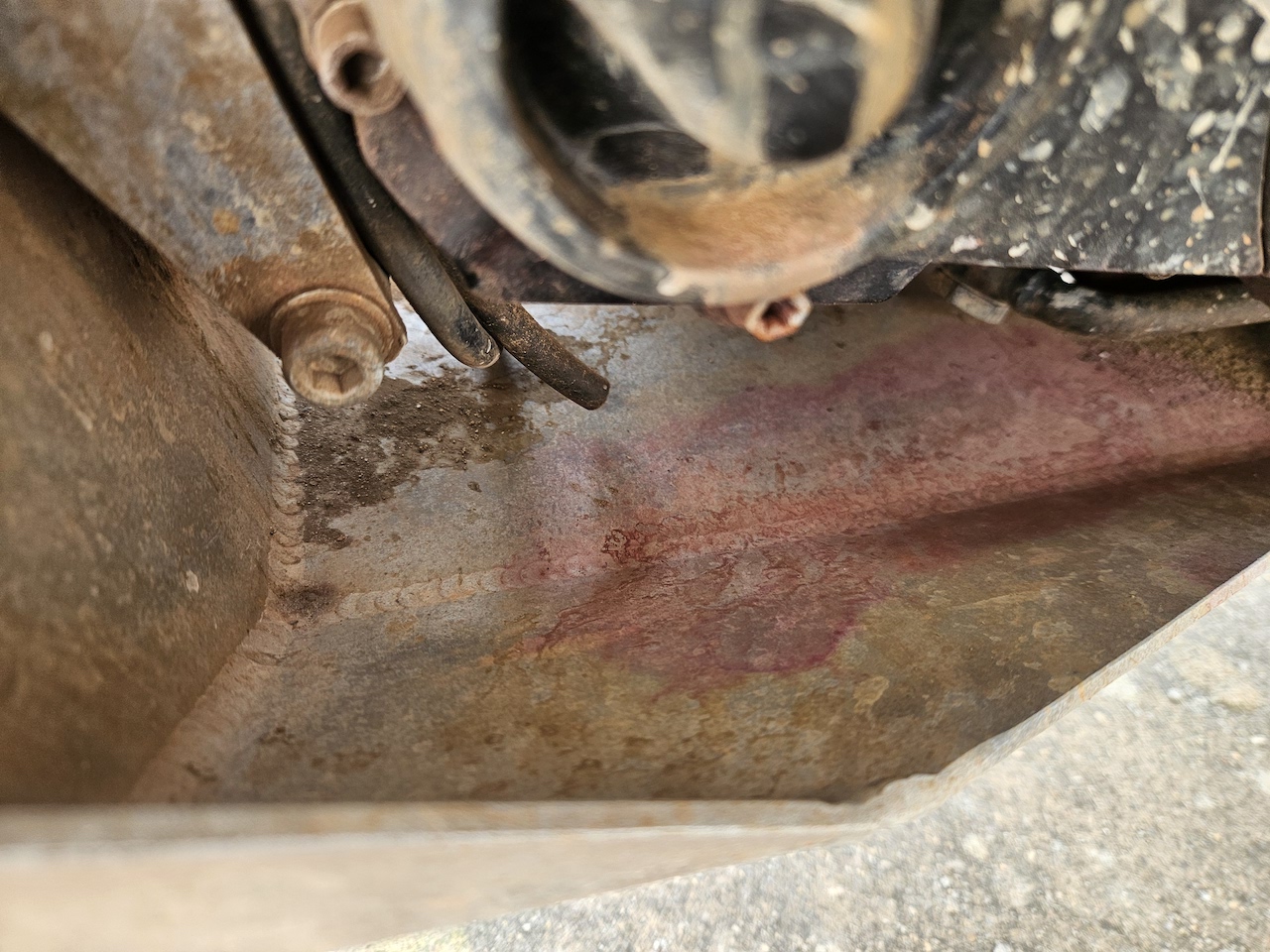
I stop immediately and discover yet another disaster.
And this time, it truly is a disaster.
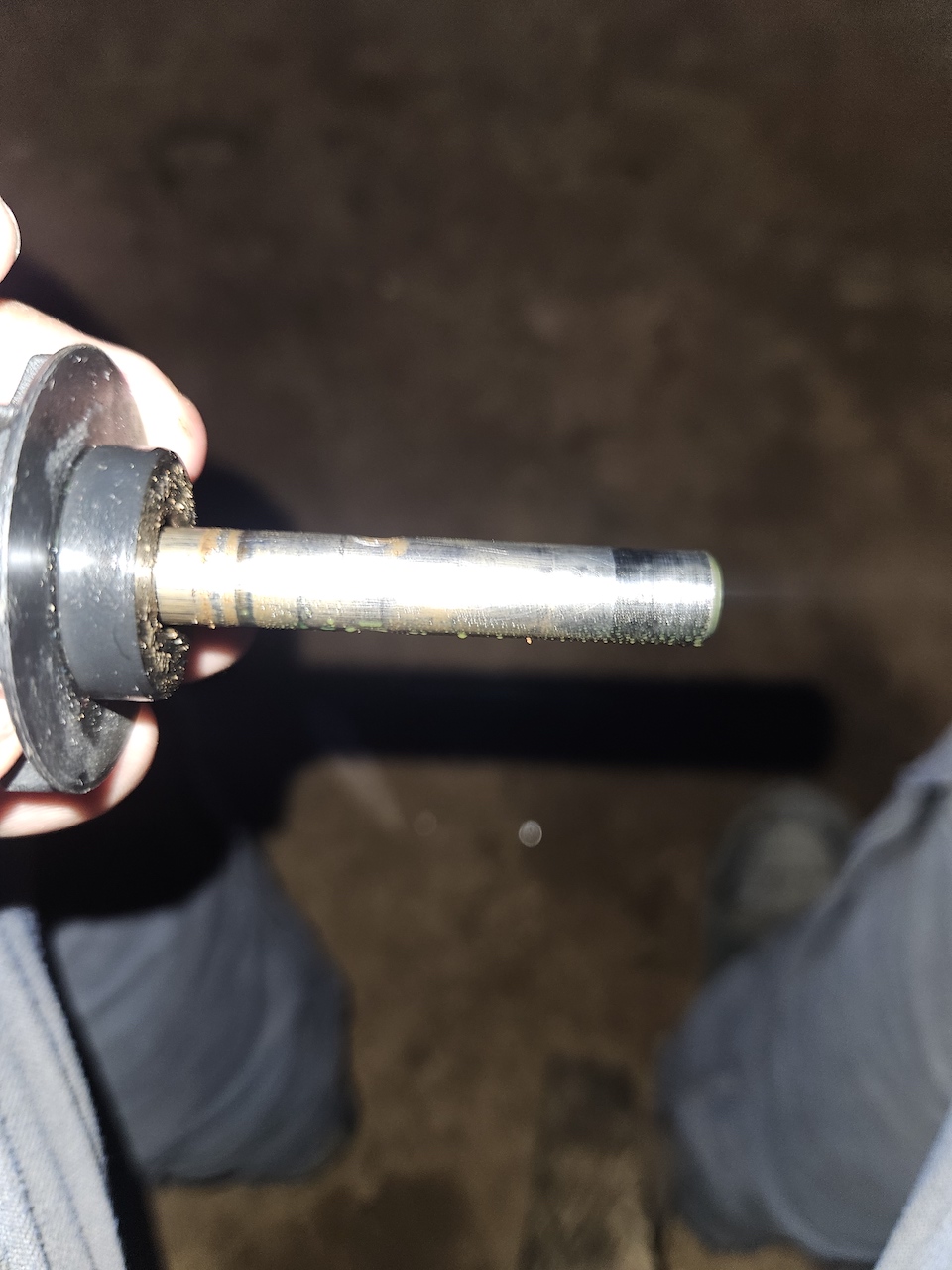
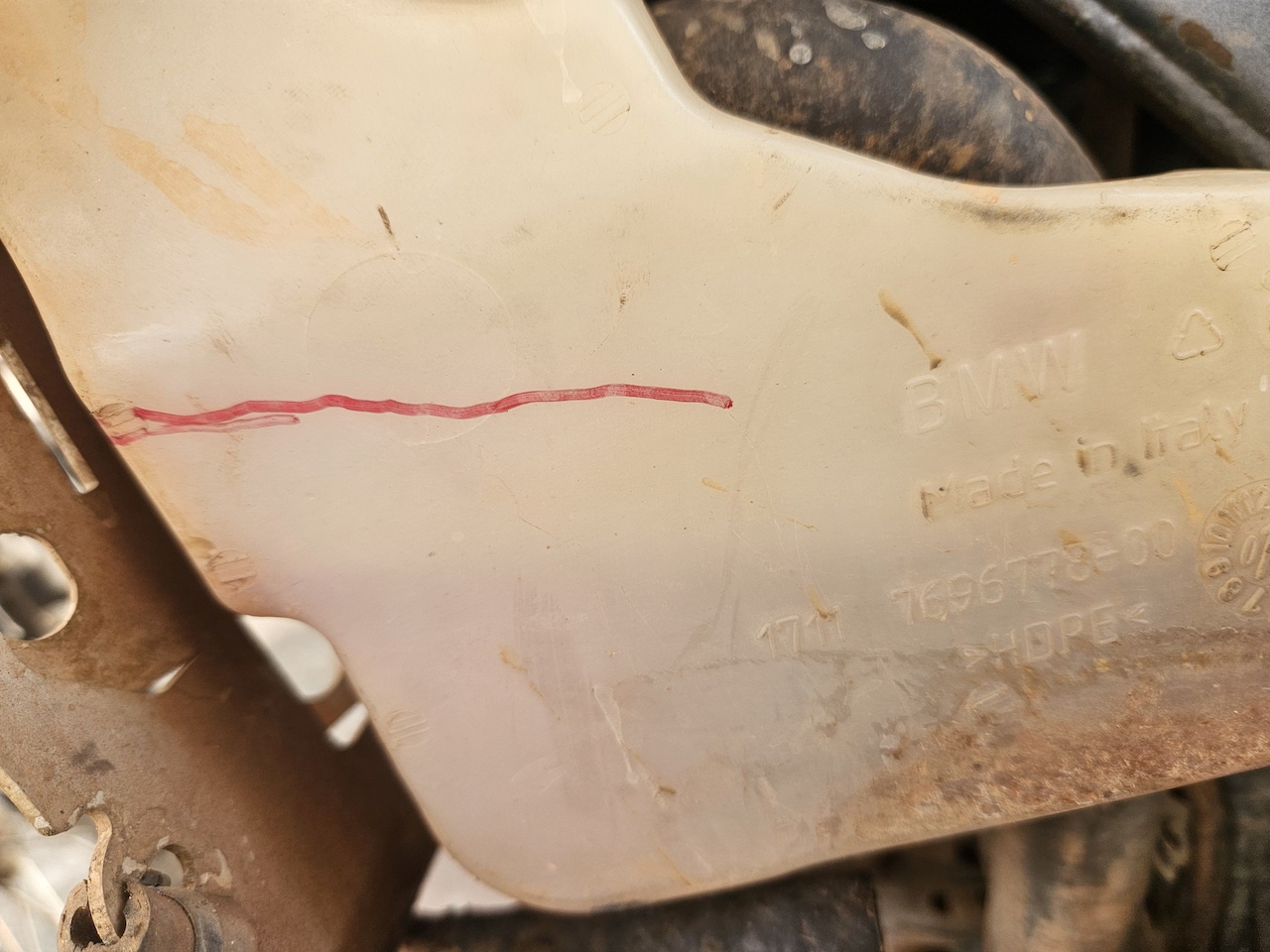
The coolant has leaked out through the weep hole—the drainage hole in the water pump.
One of the seals has failed.
What happened?
Something stupid.
The kind of thing that happens when you try too hard to do things perfectly.
While we were reassembling the motorcycle, two of my friends had drawn my attention to an important detail: that famous drainage hole must remain completely clear and sit between the two seals.
I therefore asked Peter to check this point.
At that stage, the motorcycle was already partially reassembled.
He decided to dismantle it again.
He then concluded that the seal appeared too thick and was at least partially obstructing the hole.
While I was checking the specifications and consulting one of my friends, Peter took it upon himself, without informing me, to visit another craftsman and have the seal’s thickness reduced by two or even three millimeters.
By the time I found out, it was too late.
At first glance, the sealing lip itself did not appear damaged.
However, reducing a seal by that much worried me greatly.
As a precaution, I ordered two new sets of seals. Laurie’s mother—the partner of the couple I met in Benin—was due to bring them to Namibia, assuming the repair held up until then.
That assumption was apparently too optimistic.
For now, the situation is rather catastrophic.
I no longer benefit from the powerful network of Nigerian motorcyclists who helped me so much until now.
On iOverlander, I cannot find any truly reliable mechanic in Yaoundé.
There seem to be a few in Douala, but none here.
Most importantly, I no longer have any spare seals with me.
And I doubt I will find suitable replacements locally.
Even if I did, they would need to be of sufficient quality to withstand both high temperatures, coolant, and engine oil.
None of this is insurmountable in itself.
But it means yet another delay.
And this one seems impossible to avoid.
The DRC visa cannot be obtained in any of the surrounding countries: not in Cameroon, not in Gabon, and not in Congo.
That is precisely why I took the precaution of obtaining it in Abidjan.
As I reflect on the situation tonight, two major options present themselves.
1. Give up, at least for this trip, on crossing the DRC
In that case, I would have to reach Cabinda, the Angolan exclave, and board a boat to Angola.
But this would involve several consequences:
- Losing the DRC visa, which was particularly expensive (the second most expensive visa after Nigeria’s—the latter being the most expensive visa I have ever obtained anywhere in the world).
- Paying additional transportation costs for the boat to Angola.
- Giving up the opportunity to cross the DRC and, above all, to return to Kimpangu, a place that left a deep impression on me twenty-three years ago.
- Complicating any return to Maquela do Zombo and Damba, two locations in Angola that I very much wanted to revisit and which would now require a significant detour.
2. Leave the motorcycle temporarily in Yaoundé and take a bus to Brazzaville, then continue to Kinshasa
This solution would allow me to preserve my DRC visa, which is a multiple-entry visa valid for three months after its first use.
However, it would require obtaining a new Cameroonian visa to return and collect Lady Pink, since my current visa only allows a single entry.
That would also represent a significant additional cost.
At least a Cameroonian visa is much easier to obtain.
In both scenarios, I would also need a Congolese visa.
With the first option, a single-entry visa would suffice.
With the second option, I would need a multiple-entry visa, which obviously comes with a very different price tag.
For the moment, I have already ordered new seals from France.
A friend will arrange to have them sent to me.
After that, I will need to find a mechanic as competent as Peter who, despite his mistake—for which I also feel partly responsible—is genuinely excellent.
And no, I do not feel capable of carrying out this repair myself.
There are simply too many components that need to be dismantled.
So that is the situation tonight.
As I write these lines, a violent thunderstorm has broken out and the power is out.
Of all my travels, this is the first time I have had to deal with such a concentration of problems over such a short period.
But then again…
That is also part of the game.
To be continued…
Situation as of June 17, 2026
- The seals should be delivered today to my friend Jérôme, with whom I shared part of a journey twenty-three years ago. He will then arrange to forward them to me.
- After that, I will need to find a good mechanic. I have a lead and plan to visit him today. He is a Frenchman who has been living here for many years.
- Another option is to perform the repair myself. Now that I have seen how it is done, it seems feasible.
- Tracy, the Canadian motorcyclist who has been traveling with her dog for several years, is currently stuck in Nigeria. Her Cameroonian visa application was rejected. She has to travel to Calabar to try to resolve the issue.
- The German couple should arrive here very soon. They could take me as far as Brazzaville. From there, I could take the ferry to Kinshasa and save my DRC visa. However, I would then have to come back and, above all, obtain a second Cameroonian visa.
Overall, that option would cost roughly twice as much as taking the boat between Cabinda and Soyo, which would allow me to bypass the DRC entirely.
So I have not yet made a final decision, although a plan is beginning to take shape in my mind.
Preferred Option
- Do not go to Kinshasa right now (too expensive, and above all it would involve the risk—however small—of being refused a new visa. Ideally, I would visit immigration in Yaoundé beforehand to negotiate the matter, but that would take time, which is precisely what I am short of).
- Instead, try to have my DRC visa extended at every embassy I encounter along the way: first in Yaoundé, then later in Brazzaville.
- That would give me time to ride some of the tracks in Cameroon, weather permitting. There is one in particular that I would really like to explore.
- I could also visit an African motorcyclist whom I have been following on social media for some time: Jean Milhe. That would potentially allow me to seek a visa extension in Libreville as well—and visit Gabon at the same time.
If Nothing Works Regarding the DRC Visa
I would still have two possibilities:
1. Try to cross through a small rural border post
Perhaps it could be negotiated, either from the Congolese side or from Angola.
2. Postpone the DRC for now and return during the journey home
Because yes, I currently think I will return north via western Africa after spending several months exploring southern and eastern Africa.
My present idea is to travel as far as Uganda before eventually heading back in the opposite direction.
In that case, the DRC would not be abandoned—only postponed.
It would not be the first time I have postponed a plan. Lol.
And it would also give me the opportunity to see how Angola has changed over the last twenty-three years.

No Comments